
Bare PCB Fabrication for Consumer Products
Consumer Electronics PCB Manufacturing
PCBELEC manufactures custom bare PCBs for consumer electronics, from compact connected devices to home entertainment and appliance controls. Match your board construction, materials and acceptance requirements to the intended product and project stage.
Share your board requirements: sales@pcbelec.com
Consumer Products & Board Roles
Start with the Product and Board Function
Consumer electronics PCBs provide the circuit interconnections for functions such as control, processing and device interfaces. Identify the particular board, its available space and its connections before defining the manufacturing requirements.
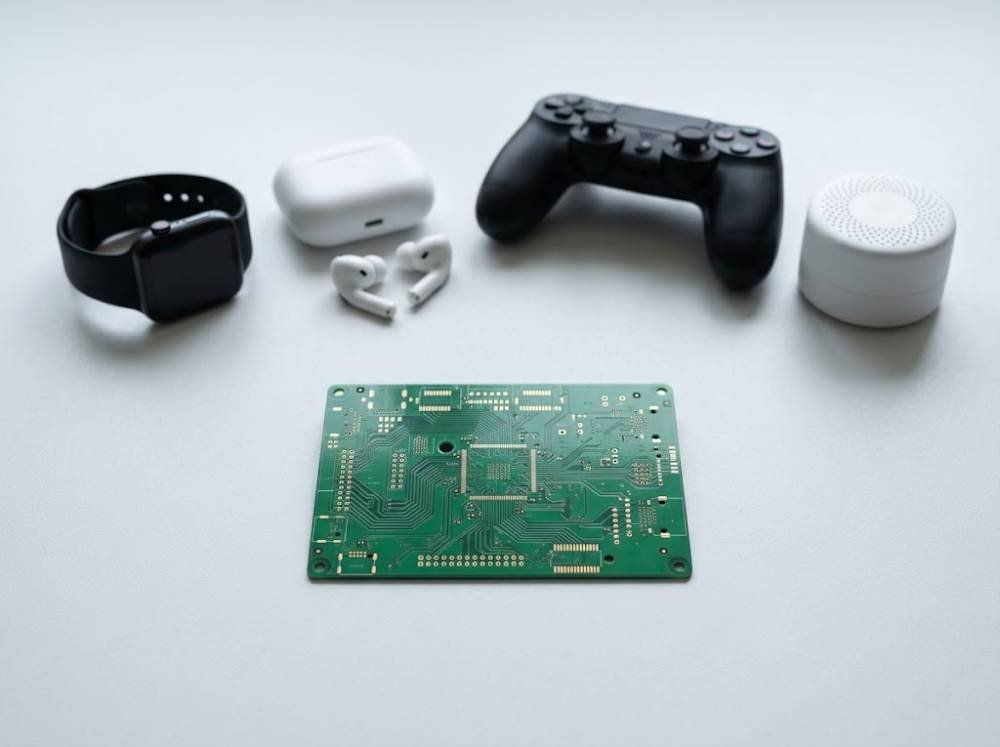
Manufacturing the Specified Bare Board
PCBELEC focuses on bare PCB fabrication. Submit the board design and manufacturing requirements for review. Circuit design, component sourcing, assembly and finished product validation are separate activities.
Review Manufacturing Capabilities →-
01
Wearables & Portable Devices
Board requirements for wearable, handheld and portable products, defined around the intended enclosure and connection arrangement.
Confirm: outline, thickness, mounting, interfaces and any specified flexible regions.
-
02
Audio, Video & Home Entertainment
Bare-board requirements for audio products, media devices, display interfaces and associated controls.
Confirm: board function, stackup, connectors, copper and specified electrical requirements.
-
03
Gaming & Personal Computing Accessories
Board constructions for controllers, input devices and personal computing accessories with defined mechanical and connection requirements.
Confirm: layout density, hole locations, connection features and mechanical tolerances.
-
04
Smart Home & Connected Devices
Board requirements for connected home products, sensors, user interfaces and associated control electronics.
Confirm: control or communication role, material requirements, mounting and installation conditions.
-
05
Home Appliances & Consumer Controls
Bare boards for appliance interfaces and control functions, specified for the actual circuit and product installation.
Confirm: board role, connections, copper, spacing and applicable customer requirements.
PCB Construction & Material Selection
Choose the Construction Your Product Needs
Start with the approved circuit and mechanical requirements. Compact products do not automatically require HDI or rigid-flex, and a more complex construction is not a substitute for a clearly defined board specification.
Swipe horizontally if needed to compare all construction options.
| Construction | When to Evaluate | What to Define | Related Capability |
|---|---|---|---|
| Single- / Double-Sided Rigid | Designs whose routing, connections and mechanical requirements can be met with one or two conductive layers. | Board outline, thickness, copper, holes, surface finish and applicable dimensional tolerances. | Rigid PCB → |
| Multilayer | Designs that specify additional routing, reference or power layers within a defined board format. | Layer arrangement, dielectric thicknesses, material grade, copper, finished thickness and hole structure. | Multilayer PCB → |
| HDI | Dense layouts that specify microvias, build-up interconnects or fine features beyond the selected conventional construction. | Build-up sequence, via spans, pad geometry, dielectric system, filling requirements and acceptance criteria. | HDI PCB → |
| Flexible | Designs requiring a flexible circuit region or connection, with the actual bend and installation conditions specified. | Layer structure, bend location and conditions, coverlay, stiffeners, connection areas and finished thickness. | Flexible PCB → |
| Rigid-Flex | Designs calling for rigid and flexible regions within an integrated board construction. | Region definitions, rigid-to-flex transitions, stackup, thicknesses, bend conditions and mechanical interfaces. | Rigid-Flex PCB → |
Categories can overlap: a multilayer or rigid-flex design may also include HDI features. Review the complete construction rather than treating each label as an independent capability guarantee.
A cost or manufacturability discussion does not authorize changes to approved materials, critical geometry or acceptance requirements. Record proposed alternatives and obtain the required approval before release.
Product Constraints & Manufacturing Review
Balance Product Constraints and Manufacturing Cost
Define what the product requires before comparing manufacturing options. Separate fixed design conditions from items open to review, so quotations refer to a clear construction and acceptance scope.
Swipe horizontally if needed to view all manufacturing considerations.
| Product Requirement | Manufacturing Details to Define | What to Review Before Quotation |
|---|---|---|
| Board Space & Mechanical Fit | Outline, finished thickness, mounting holes, connector positions, datum references and critical dimensional tolerances. | Identify enclosure-critical features and where a general tolerance is acceptable. Confirm board thickness and delivery format against the approved drawing. |
| Routing Density & Interconnects | Layer count, copper, critical line widths and spaces, hole structure and any microvia, filling or capping requirements. | Confirm which features are required by the released design. Review construction changes as proposals, not automatic manufacturing substitutions. |
| Flexible Regions & Installation | Flexible-area boundaries, stackup, bend location and conditions, coverlay, stiffeners and connection details. | Distinguish installation bending from repeated movement. Confirm the specified construction and any customer evaluation requirements. |
| Materials, Copper & Finish | Material grade or approved list, finished copper, surface finish, solder mask, markings and substitution restrictions. | Identify mandatory grades and finishes separately from options that may be quoted as alternatives. Keep each alternative clearly defined and subject to approval. |
| Quantity, Panel Format & Acceptance | Prototype and production quantities, single-board or panel delivery, separation features, packaging, inspection and report requirements. | Compare quotations on the same quantity, construction and delivery scope. State whether panel format is fixed or may be proposed for review. |
Manufacturing review evaluates the submitted board requirements. It does not include circuit redesign, enclosure design or finished-product validation.
Prepare Your Manufacturing Files →Quality, Inspection & Acceptance
Define Acceptance Before the Build
PCBELEC provides microsection reports with every order, offers 100% impedance testing and supports IPC Class 3 requirements. Specify the acceptance criteria and records required for your consumer electronics PCB order.
-
01
Microsection Reports for Every Order
Each order includes a microsection report. Identify any additional requirements for sample locations, measurements, acceptance limits or customer report format.
-
02
100% Impedance Testing
Provide the specified targets, tolerances and structures. Confirm the test approach, coverage definition and required reporting for the accepted design.
-
03
IPC Class 3 Support
State the governing board standard, revision, acceptance class and customer additions. Class 3 is supported where specified, not assumed for every consumer product.
Agree on What the Delivered Board Must Meet
Connect the drawing, manufacturing data and inspection requirements to the same released revision. Resolve conflicting instructions before production rather than leaving acceptance open to interpretation.
-
01
Drawings & Critical Dimensions
Identify the approved outline, thickness, hole and interface requirements. Distinguish critical tolerances from general drawing tolerances and define any required measurement records.
-
02
Construction & Electrical Requirements
Confirm the approved stackup, materials, copper, interconnects and specified electrical verification. Include impedance conditions where they apply.
-
03
Inspection & Delivery Records
State the governing acceptance requirements and any additional reports, identification, packaging or customer documentation needed with the delivered order.
-
04
Changes & Customer Approval
Record accepted engineering answers, substitutions and deviations. Define when a changed material, construction or feature requires customer approval before release.
Identify additional inspection or documentation requirements during inquiry. Confirm their accepted scope before production rather than assuming every evaluation is included.
Explore Testing & Inspection →Prototype-to-Production & Project Inquiry
Move from Evaluation Boards to Production
Keep each build tied to a defined revision. As the product develops, carry approved changes into the fabrication package and confirm what must remain consistent for the next order.
-
01
Submit the Initial Files
Provide the board data, drawing, construction and intended quantity. Mark preliminary information and identify any manufacturing questions that need resolution before quotation.
-
02
Define the Evaluation Build
Confirm the prototype revision, materials, dimensions and acceptance criteria. Identify the records needed for your project evaluation, including any customer-specific requirements.
-
03
Record Approved Changes
Update the released files after evaluation. Keep accepted material, thickness, geometry and interface changes visible, with their effect on quotation and delivery scope confirmed.
-
04
Release the Production Order
Align the approved construction, quantity, panel format, marking, packaging and required records. Prototype acceptance does not automatically approve later substitutions or production changes.
Include These Details with Your Inquiry
Files & Revision
Gerber and drill data, fabrication drawings and the current released or preliminary revision.
Construction & Features
Outline, thickness, stackup, materials, copper, finish and any specified impedance, flex or interconnect details.
Acceptance & Records
Governing requirements, critical tolerances, inspection conditions and requested delivery documentation.
Quantity & Delivery
Evaluation and production quantities, board or panel format, packaging, destination and target delivery date.
Consumer Electronics PCB Manufacturing FAQ
Clarify the Requirements Before You Order
Practical answers about board construction, quotation, acceptance and moving a consumer electronics project from evaluation into production.
Need a project-specific answer?
sales@pcbelec.comWhat types of PCBs are used in consumer electronics?
Consumer electronics can use single- or double-sided rigid boards, multilayer boards, HDI, flexible circuits and rigid-flex constructions. The appropriate structure depends on the actual circuit, packaging, connections and acceptance requirements.
A product category such as “wearable” or “smart home device” does not define a complete manufacturing specification.
Do compact consumer products always require HDI?
No. A compact enclosure alone does not establish the need for HDI. Evaluate the routing, component escape requirements and specified interconnect structure of the actual board.
Where HDI is required, define the build-up sequence, via spans, pad geometry, dielectric system and any filling or capping requirements.
When should flexible or rigid-flex construction be considered?
Consider these constructions when the design specifies flexible connections, flexible regions or integrated rigid and flexible sections. They are not default requirements for every portable product.
Provide the bend location and conditions, region definitions, thicknesses, coverlay, stiffeners and connection requirements. Distinguish installation bending from repeated movement.
How can I prepare a consumer electronics PCB for quotation?
Submit Gerber and drill data, fabrication drawings, the revision, construction, material requirements and quantity. Include critical dimensions, special features, acceptance criteria and requested records.
State the board or panel format, packaging, destination and target delivery date. Clearly mark preliminary information and identify which alternatives may be reviewed.
What affects the manufacturing cost of a consumer PCB?
The quotation reflects the complete manufacturing scope, including dimensions, stackup, materials, copper, interconnects, finish, quantity, delivery format and required inspection or documentation.
Compare quotations using the same specification. A lower quoted price should not be assumed to cover different materials, tolerances or acceptance requirements.
What inspection and quality records are available?
PCBELEC provides microsection reports with every order, offers 100% impedance testing and supports IPC Class 3 requirements. Define the applicable specification, acceptance class and required records.
Where impedance is specified, confirm targets, tolerances, test approach, coverage definition and report format. Additional customer records should be identified during inquiry.
What changes when a prototype moves into production?
Confirm the released revision, approved evaluation changes, materials and construction. Align production quantity, panel format, markings, packaging, delivery conditions and required records.
Prototype acceptance does not automatically approve a different material, changed geometry or revised manufacturing condition. Record changes and obtain the required approval before release.
Does PCBELEC provide PCB design or assembly?
PCBELEC focuses on custom bare PCB manufacturing. The service described here covers the agreed fabrication, inspection and delivery-document scope, not circuit design, component sourcing or PCB assembly.
For assembly inquiries, use the PCBJHY referral in the site footer.