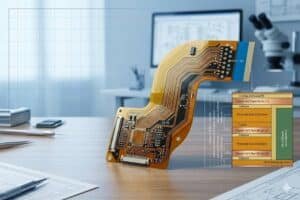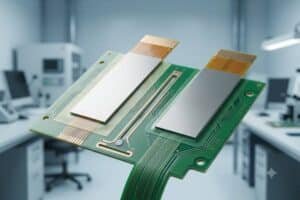
Choosing the wrong PCB surface finish is one of the most expensive mistakes you can make in circuit board manufacturing — it can mean poor solderability after three reflow cycles, wire bonds that fail in the field, or an assembly that oxidizes on the shelf before it ever reaches the production line.
The good news: almost every project ends up choosing between just a few finishes — ENIG, OSP, and HASL. This guide gives you the complete decision matrix for all 10 surface finishes, so you can pick the right one before you request your next quote.
New to surface finishes? A PCB surface finish is the protective metal coating applied to exposed copper pads and vias. It preserves the solderability of the copper, protects it from oxidation, and provides a bondable surface for component assembly. Without it, bare copper oxidizes within hours and becomes nearly impossible to solder reliably.
Quick Answer: Which Surface Finish Should You Choose?
If you’re in a hurry, here are the rules of thumb our engineers use every day:
- Choose ENIG if your board has wire bonding, gold fingers, BGA or fine-pitch components, or needs a long shelf life. It’s the default choice for high-reliability and communication products. → Read the full ENIG guide
- Choose OSP (Organic Solderability Preservative) if you’re building high-volume consumer electronics with simple SMT assembly and need the lowest cost with the flattest pads. → Read the full OSP guide
- Choose HASL (leaded or lead-free) if your board has through-hole and larger SMT components, budget matters, and pad flatness isn’t critical. → Read the full HASL guide
- Choose Immersion Tin or Immersion Silver if you need a flat, ENIG-like surface at a lower price and can control storage conditions.
- Choose ENEPIG or Hard Gold only when you specifically need gold wire bonding or extreme wear resistance (e.g., edge connectors cycled thousands of times).
Still unsure? The comparison matrix and 4-question decision tree below will narrow it down in two minutes.
PCB Surface Finish Comparison Matrix
This is the heart of this guide. All 10 finishes compared side by side on the factors that actually drive the decision:
| Surface Finish | Relative Cost | Solderability | Pad Flatness | Shelf Life | Wire Bonding | Fine-Pitch / BGA | RoHS | Best For |
|---|---|---|---|---|---|---|---|---|
| ENIG | High | ★★★★★ | Excellent | 12+ months | Yes (gold) | Excellent | ✅ | High-reliability, BGA, gold fingers |
| ENEPIG | Very High | ★★★★★ | Excellent | 12+ months | Yes (gold/copper) | Excellent | ✅ | Wire bonding + soldering hybrid, IC substrates |
| Hard Gold (electrolytic) | Very High | ★★★★☆ | Good | 12+ months | Yes | Fair (tab areas only) | ✅ | Edge connectors, keys, high-wear contacts |
| OSP | Very Low | ★★★★☆ (1–2 reflows) | Excellent | 3–6 months | No | Excellent | ✅ | High-volume consumer SMT |
| HASL (leaded) | Low | ★★★★★ | Poor | 12+ months | No | Poor | ❌ | Prototypes, through-hole, legacy repairs |
| Lead-Free HASL | Low | ★★★★☆ | Poor | 12+ months | No | Poor | ✅ | Cost-sensitive general SMT/THT |
| Immersion Tin (IMSN) | Medium | ★★★★☆ | Excellent | 6–12 months* | No | Excellent | ✅ | Fine-pitch on a budget, backplanes |
| Immersion Silver (IMAG) | Medium | ★★★★★ | Excellent | 6–12 months* | Limited | Excellent | ✅ | Mixed SMT, memory modules, high-speed analog |
| Carbon Ink | Low | ★★★☆☆ | Good | 6–12 months | No | Fair | ✅ | Cheap touch pads, jumpers, low-cost keypads |
| Bare Copper + anti-tarnish | Very Low | ★★★☆☆ | Excellent | <3 months | No | Good | ✅ | Short-run boards assembled immediately |
* Shelf life for tin and silver depends heavily on packaging — sulfur-free, nitrogen-sealed bags are essential.
How to Read This Matrix
- Relative cost is benchmarked against lead-free HASL (= lowest practical reference). ENIG typically runs 1.3–2× the cost of lead-free HASL depending on gold thickness and board area.
- Solderability reflects wetting performance after standard storage and one or more reflow cycles.
- Pad flatness matters whenever you place BGA, QFN, or 0.4 mm-pitch parts: coplanarity failures are the #1 cause of head-in-pillow (HiP) defects.
- Shelf life assumes standard moisture-barrier packaging at <30 °C / <60% RH.
Decision Tree: Choose Your Finish in 4 Questions
Answer these four questions in order — you’ll land on one finish 90% of the time:
Q1: Does your board need wire bonding, gold fingers, or gold-edge connectors?
- Yes → ENIG (solder + bondable gold in one process) or ENEPIG (if you also need copper wire bonding or very thin packages). For pure edge connectors with heavy mating cycles → add Hard Gold on the tabs. → Hard gold vs. ENIG for gold fingers
- No → go to Q2.
Q2: Does your board use BGA, QFN, or fine-pitch (≤0.5 mm) components?
- Yes → eliminate HASL (uneven pads cause coplanarity defects). Choose ENIG, OSP, Immersion Tin, or Immersion Silver based on budget and Q3/Q4.
- No → go to Q3.
Q3: How long will boards sit between fabrication and assembly?
- More than 6 months, or uncontrolled storage → ENIG or HASL (both tolerate 12+ months).
- Less than 3 months, tight JIT flow → OSP is perfect and cheapest.
- 3–12 months with good packaging → Immersion Tin or Silver works.
Q4: What’s your volume and budget?
- High volume + consumer product → OSP (lowest cost, flattest pads) or lead-free HASL (if pads are large).
- Low/medium volume, mixed technology → ENIG remains the safest universal choice despite the premium.
- Prototype / one-off boards → lead-free HASL for the best price, or ENIG if fine-pitch parts are involved.
Quick scenario examples
| Your situation | Recommended finish |
|---|---|
| 4-layer IoT sensor board, BGA, 6-month inventory cycle | ENIG |
| 500k-unit TV remote boards, simple SMT, JIT assembly | OSP |
| Power supply board, big through-hole parts, prototype run | Lead-free HASL |
| Memory module with gold-edge contacts, 8-month shelf life | Immersion Silver body + hard gold fingers |
| IC substrate / SiP with gold + copper wire bonding | ENEPIG |
10 PCB Surface Finishes at a Glance
Here’s the detail behind the matrix. Each finish gets a one-paragraph profile — click through for the full deep-dive guides.
1. ENIG (Electroless Nickel Immersion Gold)
A two-layer metallic finish: a 3–6 µm electroless nickel barrier topped with a 0.05–0.1 µm immersion gold layer.
- Pros: Excellent flatness, 12+ month shelf life, works with multiple reflow cycles, bondable for gold wire, protects copper through every fabrication step.
- Cons: Highest common-process cost; the (rare) “black pad” defect requires an experienced fabricator to control.
- Best for: BGA/fine-pitch boards, gold fingers, wire bonding, and anything where reliability outranks cost.
→ Full guide: What Is PCB Immersion Gold (ENIG) Surface Finish?

2. OSP (Organic Solderability Preservative)
A thin organic film (Entek and similar chemistries) chemically bonded to the copper surface — not a metal at all.
- Pros: Lowest cost, perfectly flat pads, simple process, RoHS-compliant, re-workable.
- Cons: Only 3–6 months shelf life, degrades after 1–2 reflow cycles, can’t support wire bonding, and needs nitrogen reflow for best results. Not visible to inspection equipment (no metallic sheen).
- Best for: High-volume consumer SMT boards assembled soon after fabrication.
→ Full guide: What Is PCB OSP Surface Finish?
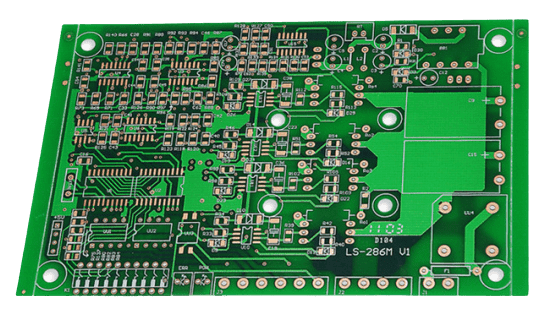
3. HASL (Hot Air Solder Leveling)
The classic: the board is dipped in molten solder, then hot-air knives blow off the excess, leaving a solder-coated pad.
- Pros: Cheapest metallic finish, excellent solderability, very forgiving, longest track record, easy to inspect visually.
- Cons: Uneven, dome-shaped pads — unsuitable for BGA and fine pitch; high processing temperature (~260 °C+) can stress thin boards; poor flatness.
- Best for: Prototypes, through-hole-dominant boards, cost-driven projects with large components.
→ Full guide: Hot Air Solder Leveling (HASL) Explained
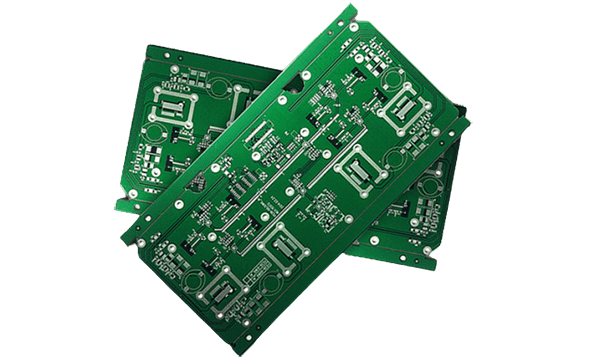
4. Lead-Free HASL
Identical process to leaded HASL but using a SAC (Sn-Ag-Cu) or similar lead-free solder alloy.
- Pros: Same cost and solderability advantages as HASL, RoHS-compliant, widely available.
- Cons: Even higher soldering temperature than leaded HASL; pad unevenness still rules out fine-pitch work.
- Best for: RoHS-compliant general-purpose boards where flatness doesn’t matter.
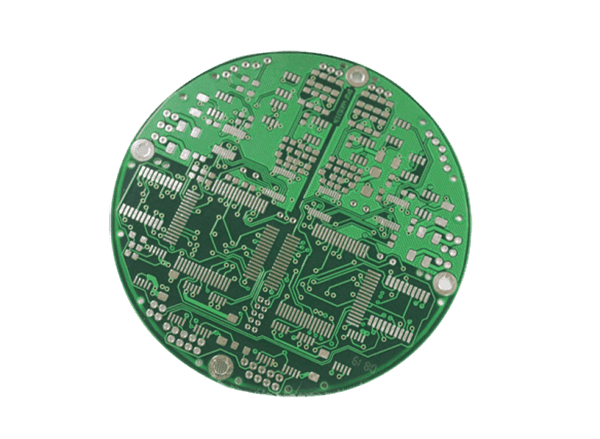
5. Immersion Tin (IMSN)
A flat, pure-tin layer chemically deposited directly onto copper.
- Pros: Flat pads like ENIG at a fraction of the cost, excellent for press-fit pin insertion, copper-tin intermetallic bonds directly with solder.
- Cons: Tin whisker risk (mitigated by modern matte-tin chemistries), copper-tin intermetallic growth limits shelf life to ~6–12 months, can’t withstand many reflow cycles.
- Best for: Fine-pitch boards on a budget, backplanes, press-fit applications.
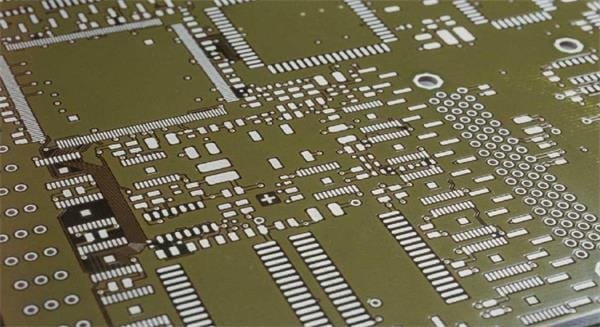
6. Immersion Silver (IMAG)
A thin silver layer (0.1–0.3 µm) deposited over copper, often with an anti-tarnish topcoat.
- Pros: Excellent solderability, flat pads, lower loss at high frequencies than nickel-containing finishes (great for RF), compatible with aluminum wire bonding.
- Cons: Tarnishes on exposure to sulfur (needs sulfur-free packaging), shelf life 6–12 months, can suffer micro-voids (“creeper corrosion”) in harsh environments.
- Best for: High-speed/analog boards, memory modules, mixed-technology assembly.
→ Deep dive: Immersion Silver PCB Finish
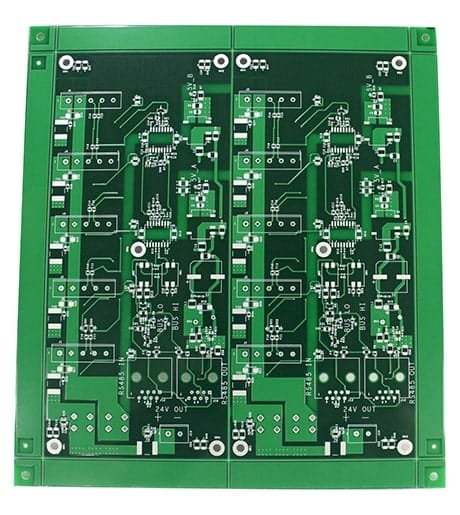
7. ENEPIG (Electroless Nickel / Electroless Palladium / Immersion Gold)
ENIG plus an intermediate palladium layer that sits between nickel and gold.
- Pros: Eliminates black-pad risk, supports gold AND copper wire bonding, excellent for very thin packages and IC substrates, outstanding multiple-reflow performance.
- Cons: Most expensive finish on this list; requires a capable fabricator; palladium cost fluctuates.
- Best for: IC substrates, SiP modules, medical/automotive boards needing both soldering and bonding.
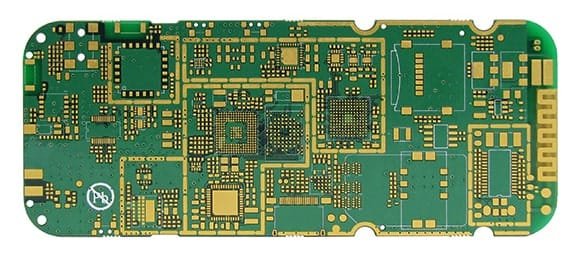
8. Hard Gold (Electrolytic Gold)
Electrolytically plated gold (typically 0.5–1.5 µm over a nickel barrier), applied to specific areas like edge connectors rather than the whole board.
- Pros: Extreme wear resistance (thousands of insertion cycles), excellent contact resistance, gold-wire bondable, durable.
- Cons: Expensive, requires electrical plating buses that must be removed afterward, solderability slightly below immersion finishes due to additives.
- Best for: Gold fingers, edge connectors, keyboard contacts, sliding contacts.
→ Comparison: Hard Gold vs. ENIG for PCB Gold Fingers

9. Carbon Ink
A printable conductive carbon paste applied to selected pads — common on very low-cost consumer products.
- Pros: Extremely cheap, no metal plating needed, works for simple contact points and jumpers.
- Cons: Limited current capacity, mediocre solderability, not for fine pitch or high reliability.
- Best for: Remote controls, low-cost keypads, jumper alternatives on single-sided boards.
10. Bare Copper with Anti-Tarnish Coating
Bare copper pads treated only with an anti-oxidation dip (often confused with OSP).
- Pros: Lowest possible cost, perfectly flat.
- Cons: Shelf life under 3 months, must be assembled almost immediately, limited process window.
- Best for: Quick-turn boards that go straight from fab to assembly.

Cost Comparison: What You'll Actually Pay
Exact pricing varies by fabricator, gold thickness, and board size — but the relative order is stable across the industry:
| Finish | Relative cost (lead-free HASL = 1.0×) | Notes |
|---|---|---|
| Lead-Free HASL / HASL | 1.0× | Cheapest metallic option |
| OSP | 0.9–1.0× | Often the cheapest overall |
| Carbon ink / anti-tarnish | 0.9–1.0× | Area-dependent |
| Immersion Tin | 1.1–1.3× | |
| Immersion Silver | 1.2–1.4× | Silver price fluctuates |
| ENIG | 1.3–2.0× | Driven by gold price + coverage area |
| ENEPIG | 1.8–2.5× | Palladium adds cost |
| Hard Gold (on tabs) | 2.0–3.0× (tab area) | Only plated where needed |
What drives the cost up or down:
- Gold price and thickness — ENIG/ENEPIG quotes track the gold market; specifying thicker gold (e.g., 0.15 µm for bonding) raises cost.
- Coverage area — finishes on the whole board cost more than tab-only hard gold.
- Panel utilization — finishes are priced per panel; tighter panelization amortizes the setup cost.
- Volume — like everything in PCB manufacturing, unit cost drops sharply with volume.
Practical rule: for every project above prototype volume, get quotes for both ENIG and your low-cost candidate (OSP or immersion tin/silver). The premium for ENIG is often smaller than expected — and cheaper than one reliability failure.
Common Mistakes When Choosing a Surface Finish
- Reusing last order’s finish by default. A finish that suited last month’s board may be wrong for this month’s BGA layout. Re-run the decision tree for every new design.
- Ignoring assembly flow. Two reflow cycles (double-sided SMT) already stress OSP and immersion tin. If your board sees multiple reflows plus wave soldering, ENIG or HASL holds up far better.
- Over-specifying gold. Full-body hard gold on a board that only needs gold fingers can double the price for zero reliability benefit.
- Underestimating storage. OSP and immersion silver boards stored in plain poly bags in humid warehouses regularly arrive unsolderable. Moisture-barrier bags + desiccant + sulfur-free paper for silver — always.
- Forgetting the second side. OSP degrades on the second side during double-sided assembly; plan the reflow sequence or choose ENIG.
- Chasing flatness where it doesn’t matter. Paying for ENIG on a through-hole power board is money spent for nothing — HASL does that job perfectly.
- Ignoring RoHS/regulatory requirements. Leaded HASL is still ideal for prototypes and repair work but can’t ship in RoHS markets. Confirm the destination market before quoting.
How PCBELEC Helps You Decide
You don’t have to make this call alone. At PCBELEC, every quotation includes a free DFM review — our engineers check your stack-up, components, assembly process, and delivery schedule, and recommend the surface finish that fits your reliability needs and budget. If your board has gold fingers or BGA pads, we’ll flag the exact areas where a premium finish pays off (and where it doesn’t).
Upload your Gerber files for a quote and get a surface-finish recommendation with your DFM report — usually within 24 hours.
FAQ: PCB Surface Finish Selection
For most applications, ENIG offers the best balance of reliability, shelf life, and process tolerance. ENEPIG goes one step further and is preferred for wire-bonded and IC-substrate applications. "Most reliable" always depends on the assembly process and storage, though — a well-handled OSP board can outperform a mishandled ENIG board.
Usually yes, if your board has BGA/fine-pitch parts, gold fingers, wire bonds, or a long inventory cycle. If it doesn't, ENIG is an unnecessary premium — OSP or HASL will do the job at lower cost.
Technically yes — OSP is perfectly flat and wets well on the first reflow. But it supports fewer reflow cycles and a shorter shelf life. For double-sided BGA assembly or long storage, ENIG is safer; for single-reflow, high-volume consumer BGA boards, OSP is a proven and much cheaper alternative.
Typical shelf life (moisture-barrier packaging, <30 °C / <60% RH): ENIG, ENEPIG, hard gold, and HASL — 12+ months; immersion tin and silver — 6–12 months; OSP — 3–6 months; anti-tarnish copper — under 3 months.
OSP and lead-free HASL are the two cheapest RoHS-compliant options. OSP wins on flatness and cost; lead-free HASL wins on shelf life and rework tolerance.
Dig Deeper: Our Full Surface Finish Guides
- What Is PCB Immersion Gold (ENIG) Surface Finish? — the complete ENIG deep-dive
- What Is PCB OSP Surface Finish? — OSP process, pros/cons, and assembly tips
- Hot Air Solder Leveling (HASL) Explained — the classic finish, leaded and lead-free
- Hard Gold vs. ENIG for PCB Gold Fingers — choosing the right finish for edge connectors
- Immersion Silver PCB Finish — a flat, mid-cost alternative