Table of Contents
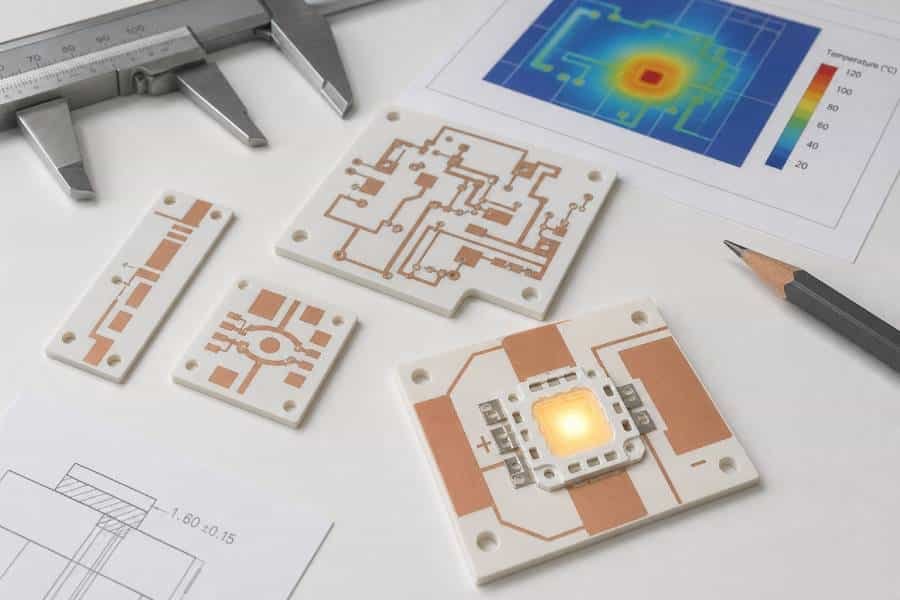
Choosing a ceramic substrate for high-power electronics is not simply a matter of selecting the material with the highest thermal conductivity.
Alumina, aluminum nitride and silicon nitride offer different combinations of heat transfer, mechanical behavior and manufacturing requirements. The right choice depends on the limitation your project needs to address—and on whether the complete circuit structure meets its thermal, electrical and reliability targets.
This guide focuses on application-level tradeoffs. For substrate grades, metallization routes, layer thicknesses and quotation requirements, use our Ceramic PCB Materials guide.
When Should You Evaluate a Ceramic Substrate?
A ceramic substrate becomes a candidate when the existing circuit construction cannot meet a defined requirement.
That requirement might involve heat transfer through an electrically insulating substrate, a demanding operating environment, or the reliability of a metallized power-substrate structure under repeated temperature changes.
Start by identifying the actual limitation:
- Is the substrate a significant part of the thermal resistance?
- Does the project require electrical isolation through the substrate?
- Are temperature cycling and mechanical loading central qualification concerns?
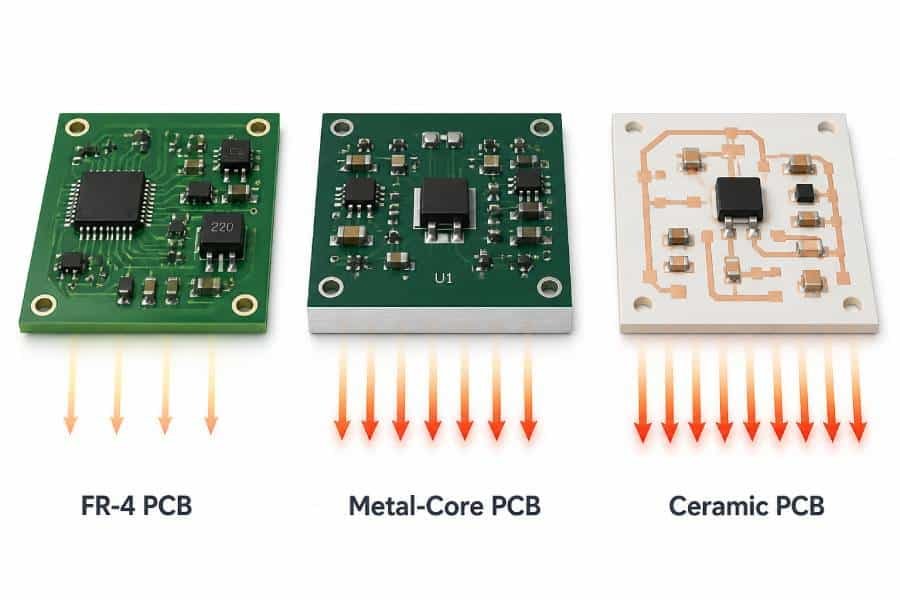
- Can the existing FR-4 or insulated metal substrate construction meet the requirements?
- Would a material change solve the problem, or is another interface the dominant limitation?
Do not assume that a ceramic material will automatically lower device temperature or extend product life. The result depends on the complete heat path, conductor structure, interfaces and operating conditions.
Start With the Application Requirements
Heat Transfer Through the Complete Structure
Thermal conductivity describes how readily heat travels through a material. It does not, by itself, describe the thermal performance of a finished circuit.
The relevant heat path may include the device interface, conductor layers, ceramic thickness and contact with the cooling structure. If another interface dominates the thermal resistance, a higher-conductivity ceramic may provide less benefit than expected.
Compare candidate materials using the actual construction and cooling conditions—not only their data sheet headline values.
Reliability Under Temperature Changes
Thermal expansion differences can generate stress within a metallized structure and its connections.
However, comparing the ceramic’s coefficient of thermal expansion with silicon is not enough to establish product reliability. Copper thickness, joining method, geometry, mounting and the operating temperature cycle also matter.
Use qualification evidence relevant to the proposed structure rather than treating a material name as a lifetime guarantee.
Electrical Isolation and Operating Conditions
Ceramics can provide electrical insulation through the substrate, but insulation through the material is different from creepage along a surface and clearance through air.
The customer design team must define the applicable electrical and safety requirements. A ceramic data sheet does not automatically establish compliant conductor spacing or an approved operating voltage.
Total Project Cost
Compare more than the raw substrate price.
The relevant cost can include material availability, metallization, dimensional requirements, inspection, qualification and the consequences of changing an already approved construction.
A more expensive ceramic is justified when it addresses a demonstrated requirement. It is not automatically the better choice.
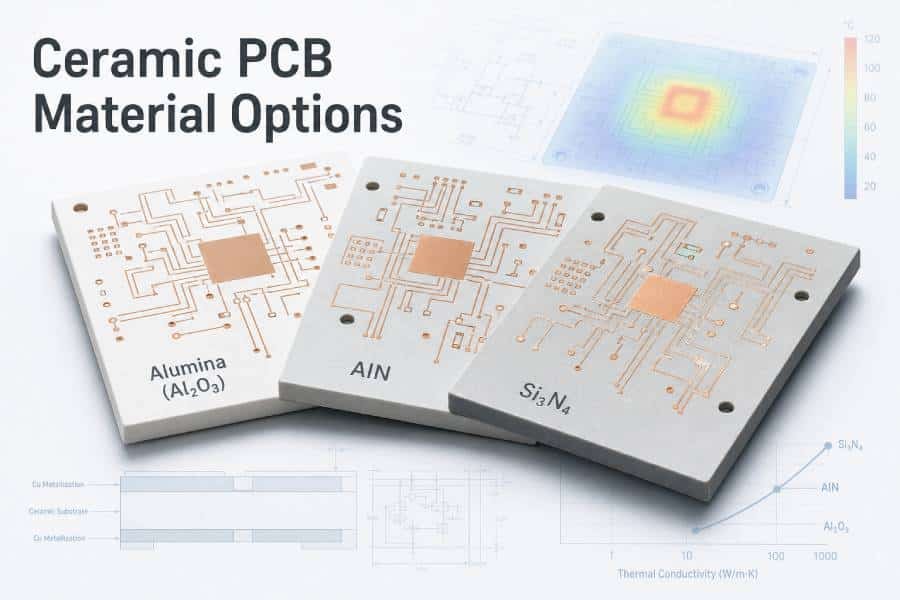
Alumina: Evaluate an Established Ceramic Route
Alumina, or aluminum oxide, is an established electrically insulating ceramic used in electronic substrates and metallized circuit structures.
It is a practical candidate when the customer needs a ceramic construction but does not require the thermal performance of a selected AlN grade or the mechanical characteristics associated with a selected Si₃N₄ structure.
The selection still needs grade-specific review. Alumina content, ceramic thickness, metallization and finished geometry influence whether the proposed part meets the application requirements.
Consider alumina when:
- The complete construction can meet the thermal target.
- An established ceramic material route is appropriate.
- The project benefits from avoiding unnecessary material complexity.
- The required reliability can be demonstrated for the proposed structure.
Do not reject alumina solely because another ceramic has a higher published thermal conductivity. First determine whether additional conductivity would materially improve the application.
Aluminum Nitride: Evaluate the Benefit of Higher Thermal Conductivity
Aluminum nitride, or AlN, combines electrical insulation with high thermal conductivity.
It is worth evaluating when heat transfer through the ceramic is a significant limitation in a compact power circuit or package.
The key question is not simply whether AlN conducts heat better than alumina. It is whether the selected AlN grade and complete structure provide enough improvement to justify their sourcing, processing and qualification requirements.
Consider AlN when:
- Analysis identifies the ceramic layer as an important thermal bottleneck.
- The available area or cooling arrangement limits other options.
- A grade-specific thermal improvement supports the required temperature margin.
- The proposed metallized structure can meet the reliability requirements.
AlN should not be presented as automatically more reliable than alumina. Reliability depends on the material and construction together.
Silicon Nitride: Evaluate Mechanical Robustness and Cycling Requirements
Silicon nitride, or Si₃N₄, is considered in metallized power-substrate constructions where mechanical robustness and thermal-cycling reliability are important.
For these projects, the decision may prioritize the durability of the complete structure rather than the highest ceramic thermal conductivity.
Consider Si₃N₄ when:
- Repeated thermal cycling is a central qualification concern.
- Ceramic cracking or interface durability is a relevant failure mode.
- Mechanical loading and mounting conditions require careful evaluation.
- Relevant reliability evidence is available for the proposed construction.
Si₃N₄ is not a universal solution for every harsh environment. Grade, joining route, conductor geometry and application conditions still require review.
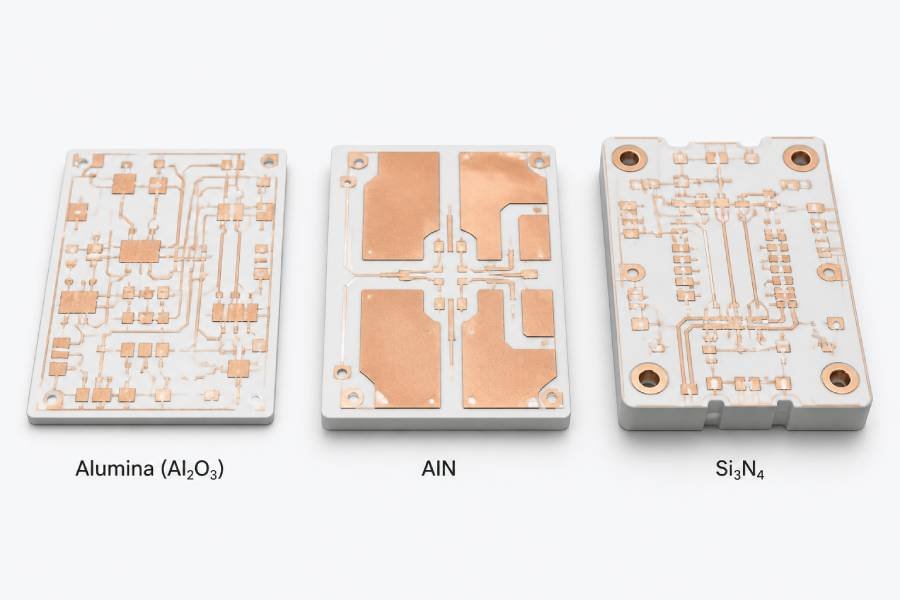
Alumina vs AlN vs Silicon Nitride: Application Tradeoffs
| Material | Main Reason to Evaluate It | Important Selection Question | What Must Not Be Assumed |
|---|---|---|---|
| Alumina — Al₂O₃ | An established electrically insulating ceramic route | Can the proposed grade and structure meet the thermal and reliability targets? | That lower thermal conductivity automatically makes it unsuitable |
| Aluminum nitride — AlN | Higher heat conduction through the ceramic | Is the ceramic layer a meaningful thermal bottleneck, and does the improvement justify the complete project cost? | That higher conductivity guarantees lower device temperature or longer life |
| Silicon nitride — Si₃N₄ | Mechanical robustness and cycling performance in a qualified power-substrate structure | Is there relevant qualification evidence for the selected grade, joining route and geometry? | That the material name alone guarantees resistance to cracking or fatigue |
This comparison is a starting point for evaluation, not a fixed material ranking. Use the selected supplier grade and proposed construction when reviewing data.
How Application Conditions Change the Choice
High-Power LED and Laser Electronics
For LED and laser applications, first establish the allowable device temperature and the complete path to the cooling structure.
Alumina may remain a candidate if the construction meets the temperature target. AlN deserves evaluation when the ceramic layer makes a significant contribution to the thermal limitation.
Do not choose solely from electrical input power or a broad “high-power” label. Dissipated heat, footprint and interface conditions determine the relevant comparison.
Automotive and Industrial Power Modules
For power modules, temperature cycling and mechanical durability can be as important as steady-state heat transfer.
Evaluate the metallized structure as a whole. Ceramic grade, copper geometry, joining method and mounting conditions need to match the qualification requirements.
Si₃N₄-based structures may be candidates where robustness and cycling performance are central. AlN or alumina may also be appropriate where the complete construction meets the required thermal and reliability targets.
RF and Microwave Power Circuits
RF applications require dielectric performance as well as thermal review.
Compare grade-specific dielectric constant and loss data at the relevant frequency and temperature. Then assess conductor characteristics and the intended circuit construction.
A ceramic substrate is not mandatory for every high-frequency circuit. A qualified RF laminate may meet the requirements without changing to a solid ceramic construction.
High-Temperature or Mechanically Demanding Applications
Evaluate all affected materials and interfaces—not only the ceramic substrate.
A ceramic base does not establish the temperature capability or durability of the complete product. Conductor interfaces, connections, mounting and environmental exposure can remain limiting factors.
Use an application-specific qualification plan rather than relying on broad “harsh-environment” descriptions.
A Practical Material Evaluation Workflow
1. Define the Limiting Requirement
Document the thermal, electrical or reliability requirement that the current construction cannot meet.
If the limitation is not yet clear, selecting a different ceramic material is premature.
2. Compare Realistic Constructions
Compare candidate grades using relevant ceramic thicknesses, conductor structures and cooling interfaces.
Avoid comparing bare-material data for one option with finished-product performance for another.
3. Review Relevant Material and Reliability Evidence
Use supplier data with identified test conditions. For reliability, look for evidence relevant to the proposed construction and operating cycle.
A typical material property and a finished-part acceptance requirement serve different purposes.
4. Validate Through the Customer’s Engineering Process
The customer design team should assess thermal behavior, electrical performance and reliability using appropriate analysis and prototype qualification.
Manufacturing feasibility feedback supports this process, but does not replace system validation.
5. Confirm Fabrication Compatibility
Once the material direction is defined, confirm whether the proposed grade, metallization, geometry and acceptance requirements can be supported.
Any proposed change should return to the customer for approval before fabrication.
Material and Metallization Must Be Evaluated Together
Alumina, AlN and Si₃N₄ identify ceramic materials. DBC, AMB, DPC and thick-film construction describe different ways of creating a conductive structure.
They are not interchangeable labels.
A material choice must therefore be reviewed together with the proposed metallization route, conductor thickness and geometry. Do not assume that every ceramic grade supports every process, or that a manufacturer offers all construction routes.
For the detailed distinction between substrate materials, conductor structures and fabrication requirements, continue to the Ceramic PCB Materials guide.
Frequently Asked Questions
No. AlN’s higher thermal conductivity is useful when heat transfer through the ceramic is a meaningful limitation.
If alumina already meets the complete application requirements, changing to AlN may add cost or qualification work without a necessary benefit.
Evaluate Si₃N₄ when mechanical robustness and cycling reliability are central requirements.
Compare qualified metallized structures, not only the thermal conductivity of the ceramic materials.
There is no universal answer.
The choice depends on dissipated heat, temperature limits, substrate thickness, footprint and cooling interfaces. Evaluate whether alumina meets the target and whether AlN provides a meaningful improvement in the actual structure.
Not automatically.
Compare the insulating layer, heat path, circuit requirements and qualification needs of the complete alternatives. A change to ceramic should address a specific requirement rather than follow a general material ranking.
No. Insulation through the ceramic, creepage along surfaces and clearance through air are separate considerations.
The design must still meet the applicable safety and electrical requirements.
No. Product life depends on operating conditions and multiple failure mechanisms.
Lower thermal resistance may support a thermal objective, but reliability still needs validation for the complete product.
Once the customer design team has selected and validated a material direction, the next step is to document the required construction.
Define the ceramic grade, metallization route, layer thicknesses, geometry and acceptance criteria before requesting a quotation.
Use the Ceramic PCB Materials guide to organize these requirements for manufacturing review.
PCBELEC focuses on bare PCB fabrication, not circuit design or PCB assembly. Ceramic material availability, process support and requested verification must be confirmed for the specific project.