Table of Contents
Why We Built This Low‑Cost PCB Assembly Content Hub
For most hardware teams, the challenge is not simply “finding cheap PCB assembly” but making smart cost trade‑offs while still hitting quality, lead time, and reliability targets. Comparison tools and global access have made it easier than ever to collect quotes—yet understanding what sits behind those numbers still requires experience, context, and structured questions.
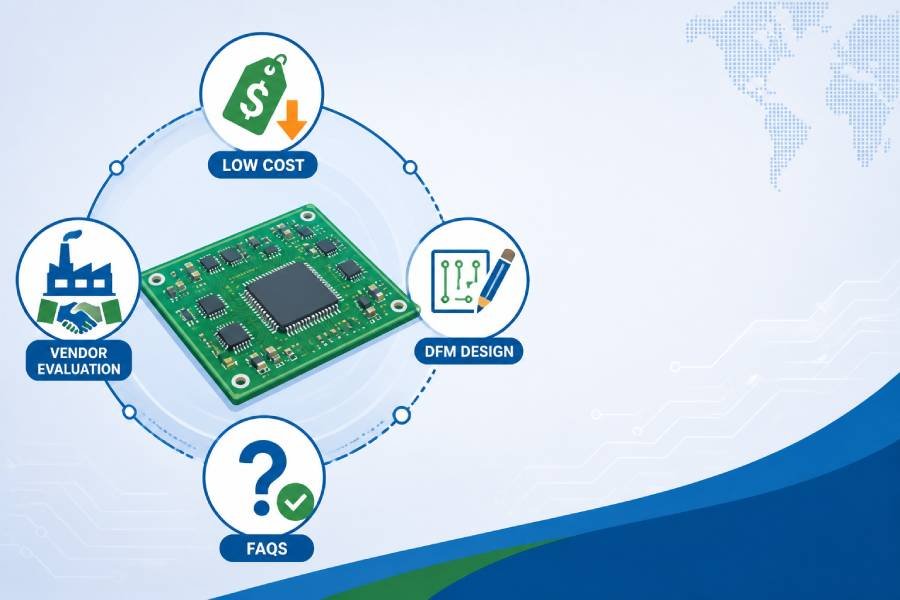
This content hub is designed as a single entry point for everything we’ve published around low‑cost PCB assembly. It connects four core pieces:
- What “low‑cost PCB assembly” really means and which factors drive cost.
- How to design your boards for low‑cost assembly using proven DFM techniques.
- How to evaluate low‑cost assembly providers if your products ship into Europe or North America.
- A practical FAQ with straight answers to the questions teams ask most often.
You can read the series end‑to‑end or jump directly to the article that matches your current challenge.

Understanding Low‑Cost PCB Assembly and Cost Drivers
The first article in the series explains what we mean by low‑cost PCB assembly and how cost is actually structured. Industry guides and cost breakdowns show that price per board depends on more than just labour rates—it reflects board complexity, BOM choices, test coverage, lead time requirements, and volume.
In that article, you’ll find:
- A clear definition of low‑cost assembly that distinguishes between “cheap” and “cost‑effective”.
- An overview of major cost drivers: layer count, board size, component density, special processes, and testing.
- Practical notes on how volume and lead time tiers change pricing, with examples drawn from typical commercial ranges.
This foundation helps you read any quote more critically and see which levers you can realistically adjust without undermining the product.
Recommended reading: What Is Low Cost PCB Assembly and Key Factors That Drive PCB Assembly Cost
Designing for Low‑Cost PCB Assembly: DFM Tips from Manufacturing Practice
The second article looks at the problem from the design side—what layout, stack‑up, and BOM decisions make your boards easier and cheaper to assemble. Manufacturing and DFM checklists consistently highlight that thoughtful design can reduce rework, improve yields, and avoid costly special cases.
Key topics covered include:
- DFM rules for layout and footprints: spacing, pad design, via usage, and panelization strategies that stay within standard capability windows.
- BOM decisions that keep costs down: standard packages, widely available components, and avoiding unnecessary “exotics” unless they genuinely add value.
- Designing for test and assembly: adding test points, considering single‑ vs double‑sided assembly, and minimizing overlapping fine‑pitch parts that demand more inspection.
If your main lever is “we can adjust the design”, this article gives you practical, production‑oriented guidance rather than abstract DFM theory.
Recommended reading: Designing for Low Cost PCB Assembly: DFM Tips from Manufacturing Practice
Evaluating Low‑Cost PCB Assembly Services: A Buyer’s Guide for Western Markets
The third article moves from design to supplier selection. Guides on cost‑effective PCB assembly and cheap‑manufacturing pitfalls all stress that partner choice is as important as design optimization when you sell into Western markets.
That buyer’s guide focuses on three big themes:
- Lead Time, Logistics, and Service Level:how to interpret lead‑time promises, understand end‑to‑end timelines from DFM to shipping, and judge whether a supplier’s communication style will actually support your project.
- Red Flags in “Too Cheap” Offers:what to watch for in extremely low quotes—thin testing, weak quality signals, vague responses—and why these often translate into rework and hidden costs down the line.
- Practical Vendor Evaluation Checklist:a structured set of questions you can ask around capabilities, quality systems, DFM support, sourcing options, testing, lead times, and after‑sales policies.
If you are about to shortlist or onboard a new provider for low‑cost assembly, this guide is designed to be used directly in RFQs, vendor calls, and factory audits.
Recommended reading: How to Evaluate Low Cost PCB Assembly Services: A Buyer’s Guide

Low‑Cost PCB Assembly FAQs: Straight Answers for Real Projects
The FAQ article sits on top of these deeper pieces as a quick‑answer layer. It collects questions that recur in RFQs, internal reviews, and early supplier conversations, and answers them in 3–5 sentences each so you can move fast.
Among the topics it covers:
- What “low‑cost PCB assembly” means in practice and how much it typically costs in different scenarios.
- What is usually included in a quote, how lead times and MOQs work for prototypes vs production, and how turnkey vs consigned sourcing affects total cost.
- Design and quality questions: which DFM habits matter most for low‑cost, what risks come with the absolute cheapest offers, and which certifications and controls you should expect even at lower price points.
This FAQ is ideal when colleagues or stakeholders ask targeted questions and you want concise, non‑marketing answers you can share or adapt.
Recommended reading: Low‑Cost PCB Assembly FAQs: Straight Answers for Real Projects
How to Use This Content Hub in Your Day‑to‑Day Work
For busy engineering, sourcing, and product teams, the simplest way to use this hub is to treat it as a reference library for every stage of the PCB assembly journey.
A practical workflow might look like this:
- When starting a new project and budgeting assembly, read the cost and definition article to calibrate expectations and identify main levers.
- While finalizing schematics and layout, use the DFM tips article to check your design against cost‑effective manufacturing practice.
- Before sending RFQs or choosing a new supplier, use the buyer’s guide and its checklist in vendor conversations and plant audits.
- When questions pop up from management or colleagues, share relevant sections of the FAQ for concise explanations.
By connecting all four pieces through this overview page and consistent internal links, you build not just marketing content but a living knowledge base your team can rely on whenever “low‑cost PCB assembly” is on the agenda.