
Table of Contents
Introduction
For most electronics teams in Europe and North America, “low‑cost PCB assembly” is no longer about chasing the absolute cheapest quote on the market. It is about finding partners who can deliver predictable quality, realistic lead times, and transparent logistics at a total cost that makes sense over the full lifecycle of a product.
Online price comparison tools and global manufacturing access mean that buyers can get dozens of quotes in a matter of hours—but the spread between the lowest and the most workable options is usually explained by subtle differences in process, testing, communication, and risk, not just labour rates. Cheap unit pricing can quickly turn into hidden costs in rework, field failures, schedule slips, and lost engineering time if the assembly service behind it is not robust enough for your market, your volumes, or your reliability targets.
This guide is written from a buyer’s point of view, with a focus on how to evaluate “low‑cost” PCB assembly offers from suppliers who serve Western markets. It walks through the practical checks you can apply across key dimensions—lead time, logistics and service level, typical red flags in “too cheap” offers, and a vendor evaluation checklist you can use in every sourcing round—to help you separate genuinely cost‑effective partners from risky bargains.
Low Cost vs “Too Cheap”: What This Guide Covers
Low cost PCB assembly and “cheap PCB assembly” are often used interchangeably, but they describe very different realities in practice.
A genuinely low cost service aims to reduce total project cost through efficient processes, smart sourcing, and solid engineering support, while a “too cheap” offer typically trades away quality, reliability, or transparency in ways that can be far more expensive later.
From a buyer’s perspective—whether in the US, Europe, or other mature electronics markets—the headline price on a quote is only the starting point.
Hidden costs can show up as poor yield, repeated rework, missed schedules, inconsistent component sourcing, weak testing, or field failures that damage your brand.
That’s why this guide focuses on how to evaluate low cost PCB assembly services beyond unit price, using criteria you can discuss with any potential partner: capabilities, quality systems, DFM and engineering support, sourcing models, testing, lead times, communication, and overall service culture.
In the following sections, the guide will help you frame the right questions and expectations before you start comparing quotes.
The idea is not to push you toward the most expensive vendor, but to help you spot which “low cost” partners are reducing cost in sustainable ways—and which “too cheap” offers are simply pushing risk and hidden expenses into the future.
Clarify Your Project and Budget First
Before you start comparing low cost PCB assembly services, it helps to get very clear on what you’re building, how mature it is, and what level of risk you can tolerate.
Suppliers in the US, Europe, and Asia will all ask similar questions—volume, complexity, application, timelines—because these factors drive not just pricing, but which processes, test strategy, and service level make sense for your project.
Define Volume, Complexity, and Risk Level
A prototype run of ten boards with a few BGAs is a very different buying problem from a 5,000‑piece low‑volume production with mostly standard SMT parts.
Low‑volume PCB assembly is often the better choice when designs are still evolving, demand is uncertain, or you need fast iterations and learning more than the absolute lowest unit cost.
Complexity also matters. High layer counts, HDI structures, dense BGAs, mixed‑technology boards, or safety‑critical applications will naturally push you toward vendors with deeper engineering and quality infrastructure, even if their headline prices are not the lowest.
In practical terms, it’s useful to write down a short profile before you ask for quotes: target quantity and phase (prototype, low volume, or scale‑up), approximate complexity (layers, fine‑pitch parts, special materials), and application risk (internal tool vs medical or industrial control).
Align Cost Expectations with Requirements
Once you have that profile, you can start to align your budget expectations with your requirements, instead of treating “low cost” as a universal target.
Guides on PCB assembly pricing consistently note that quotes are not arbitrary—they reflect real drivers like labour, materials, setup effort, complexity, testing depth, and schedule pressure.
If you need aggressive lead times, extensive testing, tight compliance requirements, or support for ongoing design changes, it’s reasonable to expect that the lowest headline quote may not be realistic or sustainable for your project.
Equally, if you’re building internal prototypes with standard components and modest complexity, it’s fair to look for cost‑conscious partners and ask explicitly how they keep total cost down without cutting corners on basic quality.
Having this internal picture first—volume, complexity, risk, and what “success” looks like for you—makes later vendor conversations more productive and lets you judge whether a low cost PCB assembly offer is genuinely aligned with your needs or simply “too cheap” for the level of reliability you expect.
Evaluating Technical Capabilities and Process Fit
Once you know what you need to build, the next step is to check whether a low cost PCB assembly service can actually handle that type of work and whether their processes fit your project, not just your budget.
In Europe, North America, and Asia alike, serious providers publish capability tables—layer counts, minimum trace/space, SMT/THT options, BGA support, inspection methods—because matching those capabilities to your design is the foundation of a realistic low cost partnership.
Check Process and Technology Capabilities
Start by confirming the basics: SMT, THT, and mixed‑technology support; whether they comfortably handle single‑ and double‑sided placement; and what their limits are on package types such as fine‑pitch QFPs and BGAs.
Capability pages and buyer guides typically list minimum component sizes, maximum board dimensions, supported surface finishes, and whether HDI features like microvias or complex stack‑ups are part of their standard offering or treated as special‑case work.
For cost‑sensitive projects, you want a good match between your design and their “standard” process window.
If your design requires processes that sit at the edge of their capability—extreme fine‑pitch, unusual board shapes, or very heavy copper—it may demand extra engineering, special fixtures, and additional inspection, which quickly erodes the advantage of a low headline price.
A practical way to approach this is to share a short technical summary with potential vendors before asking for detailed quotes: number of layers, smallest trace/space, smallest component size, presence of BGAs or HDI, and any special materials or finishes.
Their reaction to that summary—how clearly they respond, what questions they ask, and whether they flag anything as non‑standard—is often a good early indicator of whether their technical capabilities truly fit your project.
Confirm Volume and Scalability
Technical fit is only half of the picture; you also need to make sure the volume and production model you have in mind matches their strengths.
Many low cost PCB assembly services focus on prototype and low‑volume builds, where flexibility, fast response, and engineering access matter more than marginal differences in unit cost.
Others are set up for higher volumes, where line efficiency and automation dominate decisions, and where small engineering changes can create large savings over thousands of boards.
Buyer guides often recommend asking a few simple questions up front: what typical order sizes they handle, whether they can support both prototypes and follow‑on low‑volume production, and how they approach scaling a design from tens to hundreds or thousands of units.
If you expect a design to evolve—from first prototypes through pilot builds to regular low‑volume shipments—it’s worth checking whether a potential “low cost” partner has the processes, capacity, and planning discipline to grow with you rather than treating each order as an isolated job.
When technical capabilities and process fit line up with your complexity and volume profile, low cost PCB assembly stops being a gamble and becomes a realistic way to control total project cost without fighting the factory’s natural strengths.
Assessing Quality Systems and Certifications
For buyers in the US and Europe, one of the fastest ways to separate solid low cost PCB assembly services from risky “too cheap” offers is to look at their quality systems and certifications.
Well‑run assembly houses invest in formal quality management systems, workmanship standards, and compliance frameworks because these are what keep yield stable and failures under control when they’re working at aggressive price points.
Look for Relevant Standards and Certifications
At a minimum, most buyer guides recommend looking for ISO 9001 as a baseline quality management system certification.
ISO 9001 is not PCB‑specific, but it signals that the company has documented processes, internal audits, and continuous‑improvement mechanisms around how it handles materials, production steps, inspections, and customer feedback.
Beyond that, electronics‑specific standards matter. IPC‑A‑610 is widely recognised as the global standard for electronic assembly workmanship and acceptability; companies that train staff to this standard and maintain IPC‑A‑610 certified inspectors are usually more consistent in how they judge solder quality, component placement, and overall build condition.
Depending on your sector, you may also want to see industry‑specific certifications: ISO 13485 for medical devices, AS9100 for aerospace, IATF 16949 for automotive, and UL listings or RoHS compliance for material and safety requirements.
These credentials do not guarantee perfection, but they are concrete evidence that a “low cost” provider is at least operating within recognised quality frameworks rather than treating every job as a one‑off experiment.
Ask About Yield, Rework, and Traceability
Certifications are only part of the story; it is also useful to ask about how the company measures and manages quality day to day.
Many mature PCB assembly providers track first‑pass yield, rework rates, and defect categories, and can share typical ranges or case examples when you ask.
If a vendor cannot give you any sense of their yield or rework profile—or dismisses the questions as irrelevant—that is often a sign that their “low cost” claims may be built on uncontrolled quality variation.
Traceability is another useful dimension, especially for higher‑risk applications. Asking whether they apply serial numbers, record test results per unit, and keep batch‑level material records helps you gauge how easily issues can be traced and resolved if something goes wrong.
For prototypes and low‑volume runs, you might not need full aerospace‑style traceability, but basic tracking and documented test coverage are still valuable; they show that cost savings are being pursued within a disciplined quality environment, not by ignoring problems.
When you combine a check on certifications with simple questions about yield, rework, and traceability, you get a much clearer picture of how a low cost PCB assembly service actually manages quality—and whether their practices fit the level of risk your project can accept.
Understanding DFM and Engineering Support
For buyers, one of the most underrated aspects of choosing a low cost PCB assembly service is the level of DFM and engineering support that comes with the quote.
Strong providers don’t just build whatever files you send; they review your design for manufacturability, flag risks, and suggest practical changes that reduce defects, avoid rework, and keep total cost under control.
Does the Vendor Provide DFM Review?
Design for Manufacturability (DFM) checks go beyond simple design‑rule checks. They look at layout choices, clearances, via structures, stencil and paste considerations, panelization, and test access to predict where boards might be hard or expensive to build.
Guides on PCB DFM emphasise that reviewing these aspects before fabrication and assembly helps prevent scrap, avoid last‑minute redesigns, and ensure that boards can be produced to spec with standard processes.
When evaluating low cost assembly services, it’s reasonable to ask directly:
- Do you run a formal DFM review on new designs?
- What kind of issues do you typically look for and report back?
- Will you suggest cost‑saving layout or BOM changes when you see them?
Vendors that can show examples of DFM reports, or talk concretely about typical issues they catch—such as insufficient clearances, problematic panel outlines, or overly fine design rules—are usually better positioned to help you achieve sustainable low cost rather than just a one‑time cheap build.
How Responsive Is Their Engineering Team?
Engineering support is also about how easy it is to have a real conversation about your design.
Buyers in North America and Europe often value suppliers who provide named engineering contacts, reasonable response times, and willingness to jump on a call or share annotated feedback when something in the design looks risky or ambiguous.
When you engage with a potential partner, pay attention to how they handle technical questions:
- Do they answer with specific, practical guidance or only generic marketing language?
- Are they open to reviewing early revisions, not just “final” files?
- Do they help you understand trade‑offs between cost, yield, and schedule?
In practice, the engineering culture behind a low cost PCB assembly service often determines whether cost reductions come from smarter designs and smoother builds—or from cutting back on support, inspection, and communication.
Choosing a partner that takes DFM seriously and offers accessible engineering support makes it much easier to keep both unit price and long‑term project risk under control.
Comparing Component Sourcing and Pricing Models
Even with the right technical and quality fit, the way components are sourced and priced can make a big difference to whether a low cost PCB assembly service is truly cost‑effective for you.
Most providers in the US, Europe, and Asia will offer some mix of turnkey, consigned (kitted), and partial‑turnkey models, each with its own trade‑offs in cost, risk, and workload.
Turnkey, Consigned, or Hybrid?
In a full turnkey model, the assembly house purchases all components, manufactures the bare boards, and delivers finished assemblies; component sourcing, logistics, and inventory are handled by the factory, and you receive a single consolidated quote.
Turnkey typically carries a BOM markup—often cited in the 8–15% or 10–25% range depending on provider and region—but it can still be more cost‑effective in total because you avoid internal procurement labour, separate shipping, and the overhead of managing multiple distributors.
In a consigned model, you buy all parts yourself, manage the stock, and send complete kits to the assembly house.
This gives you full visibility and control over material cost and sourcing decisions, but it also means you carry all the supply‑chain risk: missing or incorrect parts, allocation issues, and kit completeness all become your responsibility, and any problems can delay production.
A partial turnkey or hybrid model splits the difference—for example, you supply high‑value or proprietary ICs and the factory sources standard passives and common connectors.
This can be a good fit when you have established pricing on certain components but still want the convenience and scale advantages of factory sourcing on the rest of the BOM.
For buyers, the key is to match the model to project realities: turnkey often suits small and medium runs or teams without dedicated purchasing staff; consignment can be economical at higher volumes if you already have a strong supply chain; hybrid works well when you want to keep specific parts under your direct control while simplifying the rest.
Transparency on Markups and Fees
Whichever sourcing model you choose, you’ll want clarity on how pricing is structured.
Buyer guides on PCB assembly quotes recommend asking for component pricing to be broken out from assembly labour, NRE (non‑recurring engineering) charges, stencil and fixture costs, and any logistics or handling fees.
For turnkey quotes, it’s reasonable to ask what typical markup range they apply to BOM line items and whether that markup covers all sourcing and warehousing overhead or if additional management fees apply.
For consigned and partial‑turnkey models, clarifying expectations around overage (extra components to cover attrition), handling charges, and what happens if a kit arrives incomplete helps you avoid surprises later.
A low cost PCB assembly service that is open about its sourcing model, BOM markup, and line‑item fees makes it much easier for you to compare quotes on a total cost of ownership basis rather than purely on unit price—especially when you factor in your own labour, risk, and time spent managing components.
Testing, Inspection, and Quality Assurance
A low cost PCB assembly service is only truly low cost if boards work reliably once they leave the factory.
Testing and inspection are the mechanisms that keep defects from escaping into the field, and a good buyer’s guide always encourages you to look carefully at what methods a vendor offers and how those match your project’s risk level.
What Inspection and Test Options Are Available?
Common inspection and testing methods include visual inspection, solder paste inspection (SPI), automated optical inspection (AOI), X‑ray inspection (AXI), in‑circuit testing (ICT), flying‑probe testing, functional testing (FCT), and in some cases burn‑in.
Each method covers different layers of quality: AOI and X‑ray check solder joints and component placement; ICT and flying probe validate electrical connectivity and component values; functional testing confirms that the powered board behaves as intended.
When you evaluate a low cost PCB assembly provider, it’s useful to ask which of these options they support as standard, which are available as add‑ons, and how they typically configure inspection and test for prototypes versus low‑volume and higher‑volume production.
Providers that can clearly explain their default inspection flow—for example, AOI on all boards, X‑ray on BGA regions, first‑article inspection before volume, and functional testing where fixtures exist—are usually more deliberate about preventing defects than those who only mention generic “testing” without detail.
Matching Test Coverage to Your Project
Not every board needs the same depth of testing, and part of evaluating a low cost service is checking whether they can tailor coverage to your application.
Guides on PCB test and inspection note that coverage should be higher for safety‑critical, high‑reliability, or high‑volume products, and can be lighter—but still structured—for early prototypes or internal tools.
For a low‑risk prototype, you might only need AOI, basic visual checks, and a simple functional smoke test, while for an industrial control or medical board, you may want X‑ray on hidden joints, ICT or flying probe for electrical coverage, and full functional testing under realistic conditions.
Good vendors can discuss these trade‑offs openly, helping you choose a test strategy that keeps failure risk within acceptable bounds without overspending on unnecessary inspection for low‑risk builds.
As a buyer, asking how a provider will test your specific design—not just how they test in general—is a practical way to see whether their approach to “low cost” includes thoughtful quality assurance or simply relies on minimal checks to keep headline prices down.
Lead Time, Logistics, and Service Level
For many buyers, especially in Europe and North America, a PCB assembly service feels “low cost” only if it delivers on time and with predictable logistics and support.
Lead time, shipment handling, and how the vendor communicates when things change will strongly influence whether an attractive quote actually works in real project schedules.
Understand Lead Time Tiers and Realistic Schedules
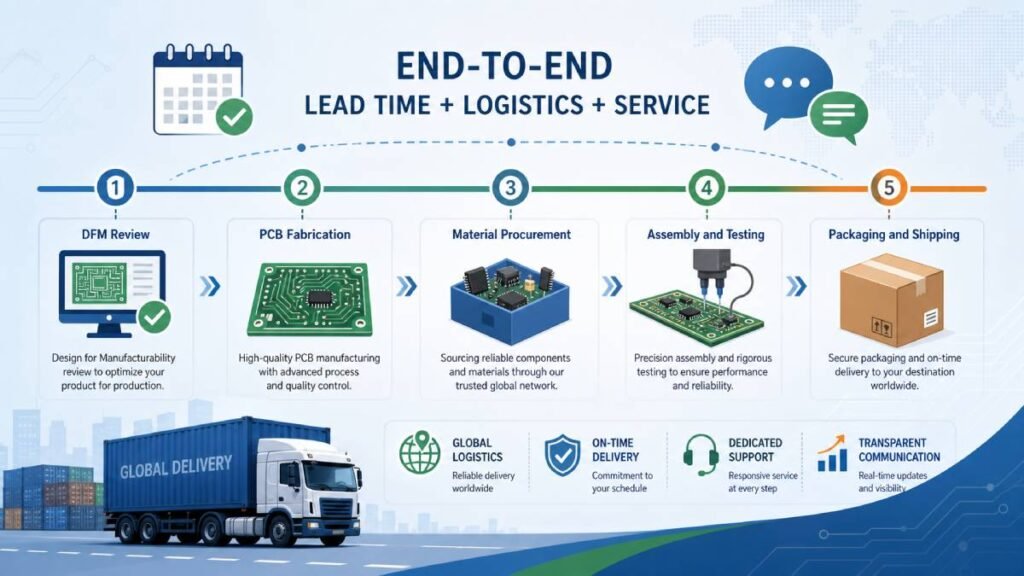
PCB assembly lead time is not a single fixed number; it’s the sum of file review and DFM, bare‑board fabrication, component sourcing, assembly, testing, and packaging, plus separate transit time from the factory to your site.
Guides on manufacturing and assembly lead times note that prototypes can sometimes be completed in a few working days under quick‑turn conditions, while low‑ to medium‑volume production more commonly runs in the 10–20 working‑day range depending on complexity and material availability.
When you evaluate a low cost service, it’s useful to ask explicitly about different lead time tiers—standard, quick‑turn, and any rush options—and what assumptions each tier makes about data readiness, stack‑up complexity, and sourcing.
Reliable providers tend to give clear, realistic lead time windows rather than one optimistic headline number, and they explain what could stretch schedules, such as component shortages, special materials, or incomplete documentation.
Planning ahead also matters: industry guides consistently advise avoiding unnecessary expedite fees by aligning your own design release dates and internal milestones with realistic manufacturing windows, rather than treating every order as urgent.
In practice, a “low cost” partner who delivers predictably at standard lead times is often more valuable than a cheaper vendor whose timelines frequently slip.
Communication, Support, and After-Sales Policies
Lead time and logistics are tied closely to service level and communication.
Buyer guides recommend checking whether a provider offers clear points of contact for project updates, proactive notifications when issues arise, and documented after‑sales policies for handling defects, rework, or replacement.
When comparing low cost PCB assembly options, pay attention to how they respond during the quoting and early discussion phase:
- Do they answer emails and calls promptly and with concrete information?
- Can they explain shipping options, customs handling, and typical transit times to your region?
- Do they outline how they handle complaints, non‑conformances, or returns?
A vendor that provides one‑stop fabrication and assembly, globally reliable shipping, and responsive technical support will often save you significant internal coordination time and reduce the risk of schedule surprises, even if their unit pricing is not the absolute lowest available.
From a buyer’s perspective, that combination of reasonable lead times, solid logistics, and professional service level is a key part of what makes a low cost PCB assembly solution truly workable in real projects.
Red Flags When Evaluating “Low Cost” PCB Assembly
By this point in the guide, “low cost” should mean cost‑effective and well‑controlled, not simply the lowest number on a spreadsheet.
Across industry articles and buyer discussions, several recurring red flags show up when people talk about cheap PCB assembly offers that turned out to be expensive in the long run.
Extreme Pricing with No Supporting Detail
One of the most common warning signs is a quote that comes in far below comparable offers but includes very little information about what is—and isn’t—included.
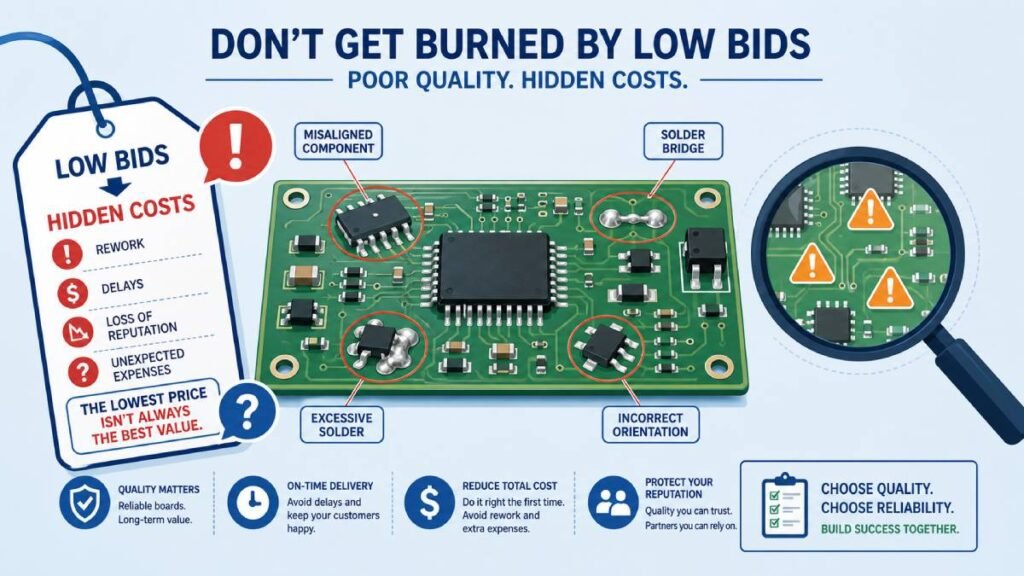
Guides on hidden PCB costs note that unusually low headline prices often come with missing test coverage, minimal inspection, extra fees for changes or rework, and higher shipping or tariff costs that only become visible later.
If a vendor cannot explain how they achieve their low pricing—through automation, scale purchasing, or process efficiency—and instead offers vague answers or refuses to break down BOM markups, NRE, testing, and logistics, that is a clear signal to proceed carefully.
In practice, sustainable low cost usually comes from well‑understood levers, not unexplained discounts.
Weak Quality and Process Control Signals
Another red flag is a lack of visible quality frameworks: no mention of IPC‑A‑610 workmanship, no ISO‑level quality management, and no clear description of inspection or test processes.
Industry discussions on cheap PCB assembly repeatedly link low prices and poor process control to higher rates of defects such as solder bridges, tombstoning, misaligned components, via reliability issues, and delamination in multilayer boards.
If a provider dismisses questions about yield, rework, or traceability, or if they have no structured way to handle non‑conforming boards, it’s likely that any initial savings will be eroded by rework, field failures, or even product recalls.
For buyers targeting Western markets, where warranty obligations and brand reputation carry significant weight, treating these signals as minor details can be costly.
Poor Communication and Lack of Transparency
A third pattern is weak communication and opaque service culture.
Reports of problematic low cost PCB suppliers often mention long periods of silence, vague responses to specific technical questions, and unexpected changes to schedules or pricing without clear explanation.
If you experience “radio silence,” inconsistent answers, or reluctance to share basic information about capacity, lead times, or problem‑resolution processes during your evaluation phase, that behaviour is unlikely to improve once you are committed to a build.
For global buyers, including those sourcing from China or other offshore locations, combining attractive pricing with solid, transparent communication is usually a better long‑term strategy than chasing the lowest offer from a vendor who treats support as an afterthought.
Recognising these red flags early—unrealistic pricing with no detail, weak quality signals, and poor communication—helps you filter out “too cheap” PCB assembly options and focus your time on partners who can deliver genuinely low cost, reliable builds.
Practical Vendor Evaluation Checklist
To close this buyer’s guide, it helps to turn the previous sections into a simple checklist you can use when you talk with potential low cost PCB assembly partners.
Industry checklists and supplier‑audit guides often recommend structuring your questions around capabilities, quality, engineering support, sourcing, testing, lead time, and communication, rather than treating price as the only axis.
Below is a practical set of questions and checks you can adapt to your own projects:
Project Fit and Technical Capabilities
- Can you handle my board’s complexity (layers, smallest trace/space, fine‑pitch ICs, BGAs, mixed SMT/THT)?
- Have you built similar assemblies before, and what challenges did you encounter?
- Are my design rules within your standard capability window, or will they require special handling?
Quality Systems and Certifications
- Which quality and industry certifications do you hold (ISO 9001, IPC‑A‑610, ISO 13485, AS9100, IATF 16949, UL, RoHS)?
- How do you track first‑pass yield, rework, and defect categories, and can you share typical ranges?
What level of traceability do you provide (serial numbers, test records, batch‑level material tracking)?
DFM and Engineering Support
- Do you offer a formal DFM review before fabrication and assembly, and can you share a sample report?
- How quickly can your engineering team respond to questions or proposed design changes during a project?
- Will you suggest layout or BOM changes when you see opportunities to improve manufacturability or reduce cost?
Component Sourcing and Pricing Model
- Which sourcing models do you support—turnkey, consigned, hybrid—and what are the pros and cons for my project?
- How do you structure BOM markups, NRE charges, stencil and fixture costs, and any kitting or handling fees?
- How do you manage component shortages, alternates, and lifecycle issues discovered before or during a build?
Testing, Inspection, and Quality Assurance
- What inspection and test methods do you apply by default (visual, SPI, AOI, X‑ray, ICT, flying probe, functional test)?
- How will you tailor test coverage to the risk profile of my product (prototype vs production, internal vs field use)?
- How are inspection data and test results used—do you feed defect patterns back into the process or treat checks as pass/fail only?
Lead Time, Logistics, and Service Level
- What are your realistic standard and quick‑turn lead times for my type of assembly, and what assumptions do they make?
- How do you handle schedule changes, rush orders, and unexpected issues—who will be my point of contact during production?
- What shipping options, customs handling, and after‑sales support do you provide for my region?
Using this checklist during early conversations makes it much easier to distinguish well‑run low cost PCB assembly services from offers that are simply “cheap.”
It gives you a structured way to compare vendors beyond price, and helps ensure that the partner you choose can support your design, your schedule, and your quality expectations over the full lifecycle of your product.