Table of Contents
Introduction
When you search for “low‑cost PCB assembly”, you quickly learn that the lowest headline price is rarely the best choice for a real product. What matters is the total cost of getting reliable boards to your door—design effort, rework, field returns, and schedule risk included.
This FAQ is written from a buyer’s point of view, for teams in Europe and North America comparing low‑cost PCB assembly services. It focuses on practical questions about pricing, lead times, MOQs, sourcing models, design, and quality, and points you to deeper resources when you need more than a quick answer.
1. What does “low‑cost PCB assembly” actually mean?
In industry practice, “low‑cost PCB assembly” usually means cost‑effective assembly from reputable providers, not simply the cheapest number you can find online. Low‑cost services aim to keep unit prices competitive by optimizing design rules, materials, automation, and sourcing—while still meeting basic quality and certification expectations.
For many buyers, “low‑cost” is contextual: a two‑layer prototype assembled at a few tens of dollars per board can be low‑cost if it avoids weeks of in‑house soldering, while a complex, multilayer, fine‑pitch design may be considered low‑cost at a much higher absolute price if the alternative is even more expensive. The key is comparing total cost and risk, not just unit price.
2. How much does low‑cost PCB assembly usually cost per board?
There is no single fixed price, but industry guides and manufacturer FAQs give reasonable ranges for common scenarios. For mid‑volume, relatively simple SMT assemblies, typical commercial sources show per‑board assembly costs on the order of tens of dollars, with more complex boards or expedited builds costing more.
Important drivers of price include:
- Board complexity: layer count, size, component density, and fine‑pitch or BGA devices.
- Volume: setup and NRE fees are spread over more units at higher volumes, lowering per‑board cost.
- Testing and special processes: X‑ray, ICT, conformal coating, programming, or special handling add to cost.
- Lead time: very fast turnaround often carries premium pricing compared to standard schedules.
When you compare “low‑cost” quotes, always confirm what is included—setup fees, stencil cost, assembly labour, test, and packaging—rather than comparing headline unit prices in isolation.
3. What is typically included in a low‑cost PCB assembly quote?
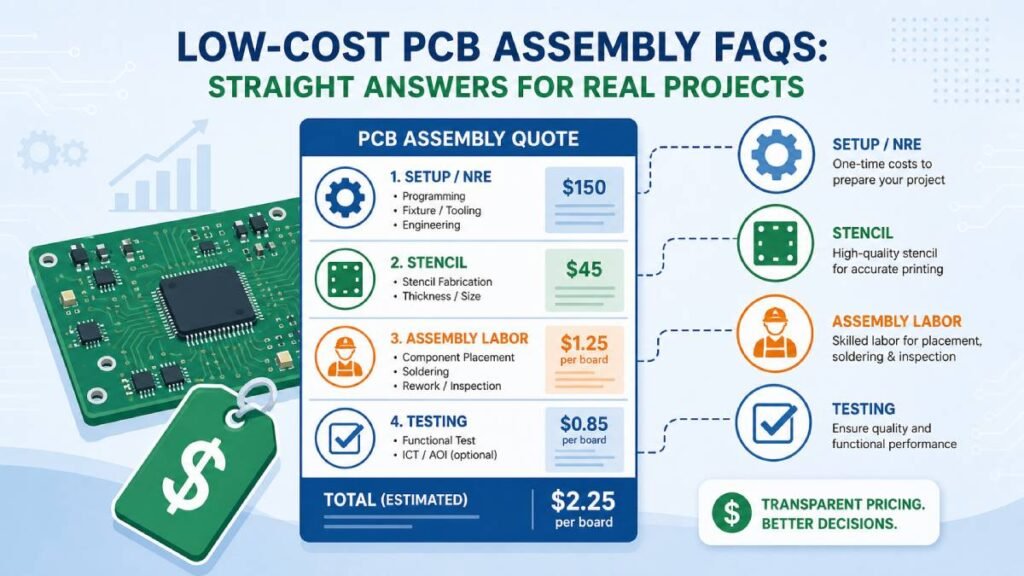
Most PCB assembly FAQ pages and cost guides indicate that a standard quote usually bundles several elements: setup or NRE, stencil, assembly labour per joint, and sometimes basic inspection or test. Some providers itemize these line by line; others bundle them into a single per‑board figure.
At minimum, expect:
- Setup/NRE for programming lines and preparing documentation and tooling.
- Stencil cost for solder paste application.
- Placement and soldering charges based on the number and type of joints.
Beyond that, you should ask explicitly whether AOI, X‑ray for BGAs, basic functional tests, packaging, and freight are included or separate. For low‑cost services, hidden exclusions in the quote are a common source of surprise later.
4. How do lead times work for low‑cost assembly services?
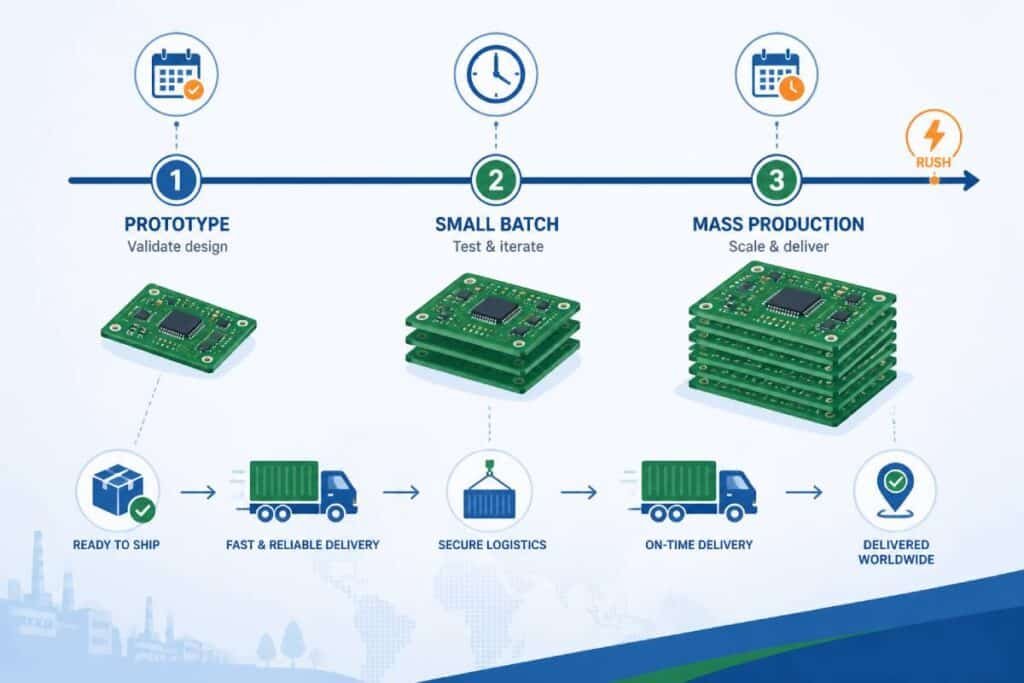
Lead times depend heavily on design complexity, data readiness, component availability, and the provider’s capacity. Quick‑turn services for simple boards can sometimes offer turnaround in a few working days once all data and materials are ready, while more complex or higher‑volume jobs typically run to weeks.
Low‑cost providers often differentiate between:
- Prototype / small batch lead times, which may be shorter but carry higher per‑unit cost due to setup.
- Standard production lead times, which are longer but more cost‑efficient per board.
To avoid misunderstandings, always ask for a committed lead time for your specific design and BOM, not just a generic tier label, and clarify how component shortages, data issues, or test changes can move the date.
5. What MOQs are typical for low‑cost PCB assembly?
Many low‑cost and prototype‑focused assemblers support relatively low MOQs—sometimes in the range of a handful to a few dozen boards for pilot or NPI builds. However, per‑unit costs are usually higher at very low volumes because fixed setup fees are spread across fewer pieces.
For cost‑sensitive projects, it is common to:
- Use a small initial run for design validation and test, accepting higher per‑unit cost.
- Move to larger batches once the design is stable, taking advantage of lower per‑board pricing at higher volumes.
When evaluating low‑cost services, ask how pricing scales with quantity so you can plan prototypes and production with realistic cost curves.
6. Is turnkey or consigned sourcing cheaper for low‑cost PCB assembly?
Whether turnkey or consigned sourcing is cheaper depends on your BOM, supply relationships, and internal logistics costs. Many manufacturers point out that assemblers can often source components at better bulk pricing from their established distributors, which can make turnkey sourcing surprisingly cost‑effective.
Consigned sourcing (you supply the parts) can be appropriate when:
- You already own inventory or have special pricing with certain vendors.
- The BOM includes hard‑to‑source or custom parts that the assembler cannot easily buy.
However, consignment also adds complexity in kitting, shipping, and responsibility for shortages or wrong parts, which can erode apparent savings. For low‑cost strategies, many guides recommend at least hybrid models—critical or custom parts consigned, bulk passives and standard ICs sourced turnkey—rather than full consignment.
7. How should I design my PCB to keep assembly costs low?
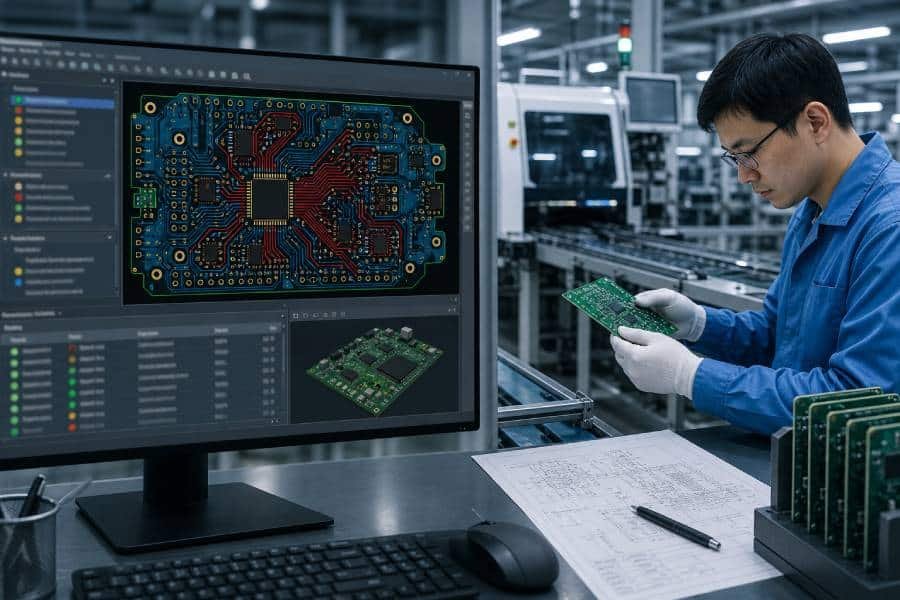
Design‑for‑manufacturing (DFM) plays a major role in keeping assembly costs down without sacrificing function. Industry advice emphasizes that optimizing layout, footprints, and panelization can reduce rework, improve yields, and make it easier for assemblers to run your boards on standard processes.
Common DFM guidelines for low‑cost assembly include:
- Avoiding unnecessarily exotic board shapes or non‑standard thicknesses when not required.
- Keeping component spacing and pad sizes within the assembler’s standard capability window, especially for fine‑pitch ICs and BGAs.
- Using consistent footprints and minimizing unique or non‑standard packages when possible.
- Designing with test access in mind (probe points, headers, or built‑in self‑test), which reduces test time and debugging effort.
Most serious assemblers offer DFM/DFT feedback; asking for such reviews before fabrication and assembly is one of the most effective ways to keep total cost under control.
8. What are the biggest risks of choosing the absolute cheapest PCB assembly offer?
Guides on low‑cost PCB assembly consistently warn that extremely low pricing can come with hidden trade‑offs. Common risks include weaker process control, limited or no testing, lower‑quality or substituted components, and poor communication when things go wrong.
Specific pitfalls frequently mentioned are:
- Hidden charges for test, rework, or shipping that were not clear in the initial quote.
- Lower workmanship standards leading to higher defect rates and more field failures.
- Minimal documentation and traceability, making root‑cause analysis and corrections harder.
A low headline price can be attractive, but once you factor in engineering time spent chasing issues, extended debugging, and potential returns or warranty claims, the cheapest initial quote is often not the lowest total cost.
9. Which certifications and quality controls should a low‑cost assembly provider have?
Even at low‑cost price points, reputable PCB assembly providers usually highlight core certifications and quality frameworks such as ISO 9001 for quality management and IPC‑A‑610 for workmanship standards. For certain regulated or high‑reliability markets, additional standards like ISO 13485, AS9100, or automotive‑focused certifications may be relevant.
Beyond certificates, look for:
- Clear descriptions of inspection and test processes (AOI, X‑ray, ICT, functional test).
- Documented procedures for handling non‑conformances and corrective actions.
- Transparent data on yields and on‑time delivery performance.
Low‑cost should not mean “no structure”: the combination of reasonable pricing and visible quality systems is what distinguishes sustainable low‑cost assembly from risky bargain services.
10. How do I prepare my files and documentation to avoid extra cost and delays?
Almost all PCB assembly FAQs stress that complete, consistent documentation is essential to smooth, cost‑effective builds. Missing or inconsistent data can cause delays, extra engineering time, and even mis‑assembled boards.
At minimum, be ready to provide:
- Fabrication data (Gerbers or ODB++), including all required layers and drill files.
- A clean BOM with manufacturer part numbers, quantities, descriptions, and any approved alternates.
- Pick‑and‑place files with coordinates, rotations, and side information for each component.
- Assembly drawings and test notes where needed, especially for complex or high‑reliability products.
Investing time up front to clean up documentation pays off through fewer questions, faster quotes, smoother production, and avoidance of “rush‑engineering” charges.
11. Can low‑cost PCB assembly still support high‑reliability or regulated products?
Low‑cost assembly does not automatically exclude high‑reliability or regulated applications, but it raises the bar on how carefully you select and qualify suppliers. Some cost‑effective assemblers explicitly target medical, aerospace, automotive, or industrial markets and build their pricing around standardized, efficient processes that still meet these sectors’ requirements.
If you work in such environments, focus less on headline “low‑cost” claims and more on:
- Proven experience with similar products and compliance regimes.
- Certifications, traceability, and documented quality metrics.
- DFM/DFT support to ensure your design can be built consistently at scale.
The real question is not “Can low‑cost support regulated products?” but “Which cost‑effective providers have systems strong enough to support my regulatory and reliability needs?”.
12. How should I use this FAQ with more in‑depth resources?
This FAQ is designed as a quick‑answer layer above more detailed content. For deeper exploration of specific topics, you can connect each question to long‑form articles on cost drivers, DFM for low‑cost assembly, and vendor evaluation guides.
A practical way to use it is:
- Start here when you or your colleagues raise short, tactical questions.
- Follow links to detailed design or buyer guides when a topic becomes central to a project decision.
- Use recurring questions and answers as prompts for refining your internal checklists and RFQ templates.