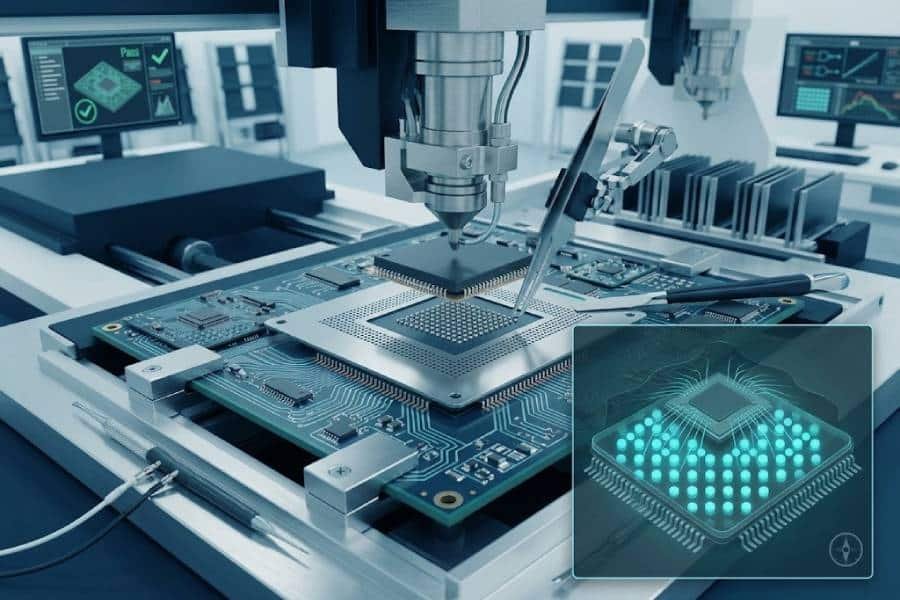
Low-Volume PCB Assembly
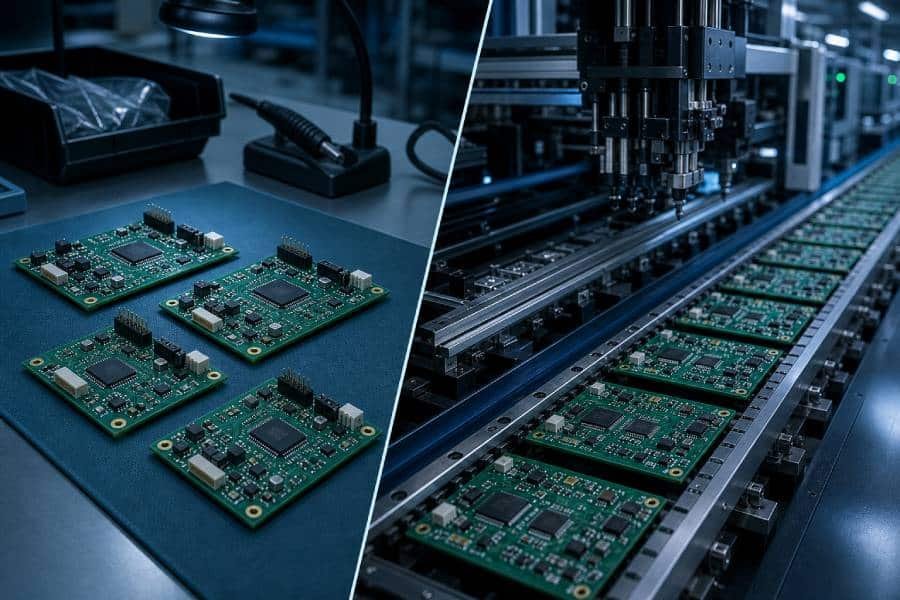
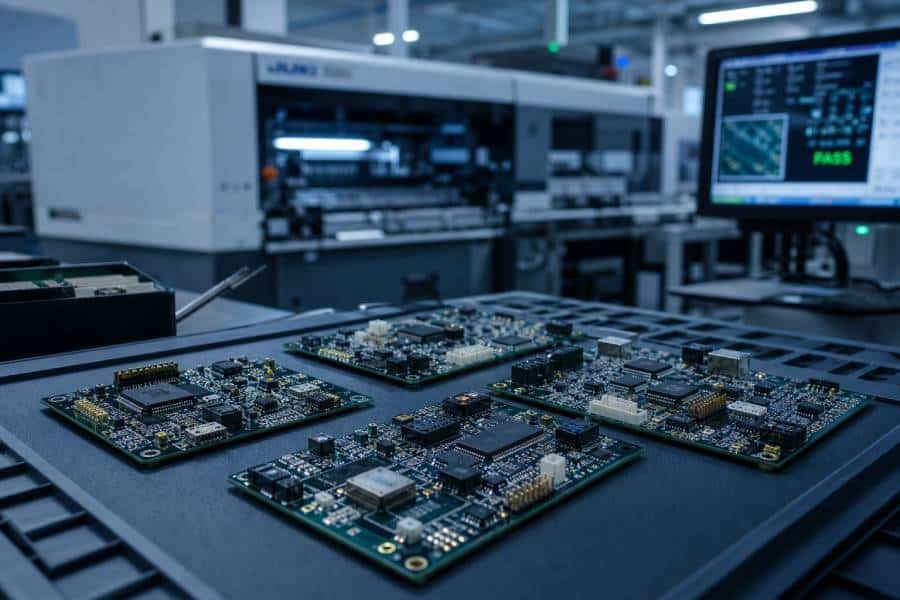
Small-batch PCB assembly is the smart choice for prototyping, NPI, and market testing — but only if you understand when it applies, how it differs from mass production, and what to prepare before ordering.
When to Choose Low-Volume PCB Assembly
Low-volume PCB assembly is not just “a small order” — it is a strategic production decision. Understanding the scenarios where small-batch assembly makes technical and commercial sense helps you avoid over-committing to mass production before your design is proven.
Decision rule: If your annual volume is under 1,000 units OR your design is still changing, low-volume assembly is almost always the right choice. The cost per unit is higher than mass production, but the total project cost is lower — no tooling investment, no minimum order commitments, no excess inventory risk.
Low-Volume vs Mass Production: Strategic Comparison
The choice between low-volume and mass production is not just about quantity — it is about risk, flexibility, and cash flow. The comparison below highlights where each approach wins and where it does not.
| Factor | Low-Volume Assembly | Mass Production | Who Wins |
|---|---|---|---|
| Typical Quantity | 10 – 1,000 units | 5,000+ units | Depends on annual demand |
| Cost Per Unit | Higher (no volume discount amortization) | Significantly lower | Mass production (at scale) |
| Total Upfront Cost | Low — no tooling, no MOQ commitment | High — tooling, stencils, NRE charges | Low-volume (at early stage) |
| Design Flexibility | High — change design between batches freely | Low — design freeze required before tooling | Low-volume |
| Lead Time to First Board | 48 hours – 2 weeks | 4 – 8 weeks (tooling + setup) | Low-volume |
| Excess Inventory Risk | Minimal — produce what you need | High — MOQ may exceed demand | Low-volume |
| Cash Flow Impact | Pay per batch, scale as revenue grows | Large upfront capital outlay | Low-volume (for startups) |
| Component Sourcing | Broader options — can use non-reel components, consigned parts | Must use reel/tape packaging for automated lines | Low-volume (flexibility) |
Strategic recommendation: For startups, NPI projects, and any product with uncertain market demand, start with low-volume assembly. Transition to mass production only when your design is frozen, demand is proven, and annual volume exceeds 3,000–5,000 units — the point where mass production cost savings overcome the setup investment.
How to Prepare Your Low-Volume Assembly Order
A well-prepared order package reduces turnaround time, prevents errors, and minimizes back-and-forth communication with your assembly partner. Use this checklist before requesting a quote to ensure a smooth production process.
-
Gerber Files (RS-274X):
All copper layers, solder mask, silkscreen, and drill files in extended Gerber format. Include layer stackup information for multilayer boards. -
BOM (Bill of Materials):
Complete BOM with manufacturer part numbers (MPN), quantities, reference designators, and package types. Mark substitute parts and do-not-substitute components clearly. -
Pick-and-Place File:
Centroid file with X/Y coordinates, rotation, and layer (top/bottom) for each component. This drives the automated placement machine. -
Assembly Drawing:
Mechanical drawing showing component placement, orientation, critical dimensions, and any special assembly instructions (e.g., hand-insertion order for THT). -
Test Specification:
If functional testing is required, provide test procedures, test fixture design, or ICT test points. Without this, only visual and AOI inspection can be guaranteed.
-
Panelize for Efficiency:
If your board is small (< 100mm), panelize multiple boards per panel (e.g., 2×2 or 3×3) to reduce per-board handling cost. Most assembly partners offer panelization service if you provide single-board files. -
Use Standard Component Packages:
Prefer 0603/0402 resistors and standard IC packages (SOIC, QFP, QFN) over exotic packages. Non-standard or sole-source components increase lead time and cost in low-volume runs. -
Avoid Hard-to-Source Components:
Check component availability on distributors (DigiKey, Mouser, LCSC) before finalizing BOM. Components with 50+ week lead times can delay your entire assembly. -
Add Fiducial Marks:
Place 2–3 fiducial marks on each board edge for accurate SMT alignment. Missing fiducials force manual alignment, increasing placement time and error risk. -
Include Spare Components:
Add 5–10% extra for small passive components (resistors, capacitors) in your BOM or consigned kit. Setup waste during SMT is normal, and running out of a 2-cent resistor can stall production.
⚠️ Common pitfall: The #1 cause of delayed low-volume assembly orders is an incomplete BOM — missing manufacturer part numbers or vague descriptions like “10uF capacitor” without specifying voltage, tolerance, package, and dielectric type. Always provide complete MPN-level BOMs to avoid sourcing delays.
FAQs About Low Volume PCB Assembly
Low-volume PCB assembly typically refers to production runs of 10 to 1,000 units. Some providers define it as 1–500 pieces. The key characteristic is not the exact number, but the production approach — low-volume uses flexible, quick-changeover processes without dedicated tooling, while mass production uses fixed, high-speed lines optimized for a single product.
Low-volume assembly costs more per unit than mass production because setup costs are amortized over fewer boards. A typical 4-layer board with 50–100 components might cost
8
–
25
p
e
r
u
n
i
t
a
t
100
p
i
e
c
e
s
v
e
r
s
u
s
8–25perunitat100piecesversus3–8 at 10,000 pieces. However, total project cost is lower because there are no tooling or NRE charges.
Yes — this is one of the biggest advantages of low-volume assembly. Each batch is a separate production run, so you can modify your Gerber files, BOM, or layout between batches without any tooling change cost. This makes low-volume ideal for design iteration and NPI (new product introduction).
Turnaround time ranges from 48 hours for simple boards with all components in stock to 10–15 days for complex multilayer boards with consigned or long-lead components. Most low-volume orders ship within 5–7 days after all files are confirmed and components are ready.
Both options are available. In "turnkey" assembly, your partner sources all components and provides full BOM procurement. In "consignment" (kitted) assembly, you supply the components and the partner provides only labor and solder materials. Turnkey is more convenient; consignment gives you control over component authenticity and cost.
You need: (1) Gerber files (RS-274X format), (2) BOM with manufacturer part numbers, (3) pick-and-place/centroid file, and (4) assembly drawing if your board has special requirements. Some providers also accept ODB++ or IPC-2581 formats. Providing complete, accurate files is the single biggest factor in fast turnaround.