Table of Contents
Overview: Two Different Ways to Build PCBs
When planning how to manufacture a new electronic product, one of the first strategic decisions is whether to start with low volume PCB assembly or move directly into mass production. At first glance, the choice may look like a simple question of quantity—build a few boards or build many—but in practice it is more about timing, flexibility, cost structure, and risk.
Low volume PCB assembly refers to small-batch production of populated circuit boards, typically in the range of a handful up to a few hundred or a few thousand units, depending on the assembler and the project. These builds are used for prototypes, engineering validation, pilot runs, early product launches, and ongoing low-demand or specialized applications.
Mass production PCB assembly, by contrast, focuses on high-volume output—often thousands to hundreds of thousands of boards—using heavily optimized processes and mature supply chains. It is the mode companies rely on once designs are stable, demand is proven, and cost targets require the efficiencies that only scale can provide.
What We Mean by Low Volume PCB Assembly
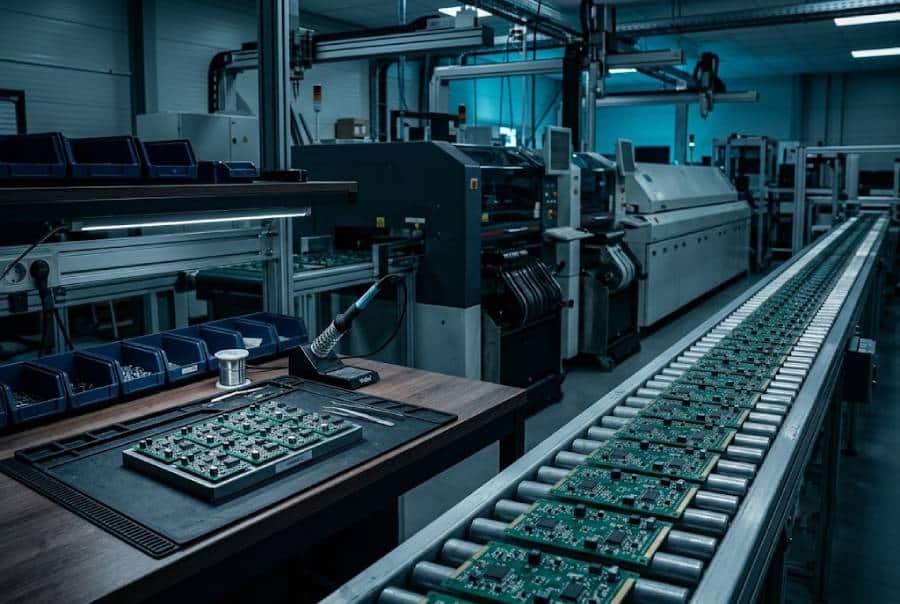
In practical terms, low volume PCB assembly is small-batch PCBA that still uses professional manufacturing equipment, inspection, and testing, but applies those tools to limited quantities where learning and flexibility are more important than unit price. Many service providers describe low volume as production runs from roughly 5 to 2,000 assembled boards, though exact ranges vary.
Low volume PCBA is often the validation stage between one-off prototypes and full-scale mass production. It is used when teams need to confirm that the design, BOM, supply chain, and test strategy can support reliable manufacturing, but they are not yet ready to commit to large orders or inventory. Because these builds use the same kinds of SMT lines, AOI, X-ray, and functional tests as larger runs, they provide realistic data about how the design behaves under factory conditions.
What We Mean by Mass Production PCB Assembly
Mass production PCB assembly is high-volume manufacturing of populated circuit boards for products that are already mature and in steady demand. In this mode, builds are sized to take advantage of economies of scale—typically from thousands to hundreds of thousands of units or more, depending on the market.
Mass production relies on highly optimized processes, including dedicated fixtures, refined stencil designs, standardized work instructions, and detailed statistical process control. Materials are sourced in bulk, contract terms are structured around ongoing demand, and assemblers tune their lines to maximize throughput and minimize per-unit cost.
Because volumes are large, design mistakes or process problems can have significant consequences: a single layout error or BOM issue may affect thousands of boards, and engineering changes must be managed carefully to avoid disrupting inventory and existing field units. For that reason, mass production is best suited to designs that have already been de-risked through earlier stages, often including low volume builds.
Why the Choice Is About Timing, Risk and Cost—Not Just Quantity
The decision between low volume and mass production PCB assembly is less about picking a number and more about matching the manufacturing approach to the product’s lifecycle. Early in development, when designs, requirements, and demand are still evolving, low volume PCBA offers flexibility and risk control; later, when the product is stable and demand is clear, mass production offers the cost efficiency needed to compete at scale.
Each approach has its own cost structure. Low volume runs typically involve higher per-unit pricing because setup costs, engineering time, and tooling are amortized over fewer boards, and material orders may not reach quantity discounts. However, they limit exposure to design and market risk, which can reduce overall project cost by preventing large-scale scrap, rework, or obsolete inventory.
Mass production, on the other hand, reduces unit cost by spreading fixed costs across large quantities and leveraging bulk component pricing. But it increases exposure to risk: if problems emerge after a large lot has been built, they can affect many units and become expensive to correct. The optimal strategy is usually to start with low volume PCB assembly during the learning and validation phases, and then transition to mass production once the design and demand justify it.
Low Volume PCB Assembly: Characteristics and Strengths
Low volume PCB assembly is designed for scenarios where change, uncertainty, and specialization are expected. Rather than focusing purely on maximum throughput, it balances professional manufacturing discipline with the ability to adapt quickly.
Typical Quantities and Stages for Low Volume PCBA
As noted earlier, low volume PCB assembly typically covers production runs from a few units up to a few hundred or a few thousand boards, depending on the assembler and the type of product. These batches are often associated with specific stages:
- Engineering validation builds, used to refine design and test strategies after initial prototypes.
- Pilot runs and pre-production orders, used to verify process stability and operational readiness before mass production.
- Early market launches, beta programs, and regional releases, where limited quantities are deployed to gather real-world feedback.
- Ongoing low-demand or specialized products, which may never reach high-volume status but still require reliable manufacturing support.
In all of these cases, low volume PCBA serves as a practical way to build and learn without overcommitting to large lot sizes.
Flexibility for Design Changes, Variants, and Custom Builds
Flexibility is one of the defining strengths of low volume PCB assembly. Because batches are smaller and production cycles shorter, teams can introduce design revisions, BOM changes, firmware updates, and product variants more frequently without incurring the same disruption or cost seen in mass production.
This makes low volume PCBA particularly well-suited to new product introduction (NPI), where requirements may still be evolving and early customers often request modifications. It also supports products that inherently require customization—such as industrial control boards with site-specific configurations, medical devices tailored to particular applications, or IoT hardware produced in multiple feature sets.
Small-batch assembly makes it easier to run A/B experiments across different variants and observe how each performs in the field. If one configuration proves superior, subsequent builds can converge toward that design without the inertia associated with large-volume inventories.
Risk Reduction for Design, Supply Chain, and Inventory
Low volume PCB assembly reduces risk across three main dimensions: design, supply chain, and inventory.
From a design perspective, small batches limit the impact of layout mistakes, component mis-selections, or test coverage gaps. Problems discovered in a low volume run affect tens or hundreds of boards instead of thousands, making corrective action more manageable. This is especially important when working with complex designs or advanced packages, where unforeseen issues are more likely to appear under real manufacturing conditions.
Supply chain risk is also reduced. Low volume builds provide a way to test whether critical components can be sourced consistently, whether lead times align with project schedules, and whether alternative parts or vendors are needed. If shortages or quality problems arise, they can be addressed before larger orders are placed.
Inventory risk is perhaps the most visible area where low volume PCBA adds value. When demand forecasts are uncertain, building large lots of product can result in overstock, tying up capital and increasing the chance of obsolescence. Small-batch builds allow companies to respond to real orders and early demand signals, scaling output gradually as the market proves itself.
Cost Profile: Higher Unit Price, but Lower Strategic Risk
The main trade-off in low volume PCB assembly is cost. Because setup, engineering review, tooling, and NPI effort must be covered by fewer units, per-board pricing is typically higher than in mass production. Component pricing may also be less favorable if orders do not reach bulk discount thresholds.
However, when viewed at the project level, these higher unit prices often buy meaningful reductions in strategic risk. By discovering design and process issues early, teams avoid the much larger costs associated with scrapping or reworking high-volume builds. They also avoid the financial strain of carrying large inventories before demand is confirmed.
For hardware startups and new product lines, low volume assembly can help manage cash flow and preserve optionality. Investing in small batches to test the market and refine the design is frequently more sustainable than committing to a large run that may or may not match actual customer needs. In this sense, low volume PCB assembly trades higher unit prices for lower overall risk and greater learning value.
Mass Production PCB Assembly: Characteristics and Strengths
Mass production PCB assembly takes over once designs are stable, markets are proven, and cost optimization becomes the primary concern. At this stage, the focus shifts from flexibility and exploration to efficiency, consistency, and scale.
Typical Quantities and Product Types
High-volume PCB assembly typically refers to production runs in the thousands or tens of thousands of units, and in some markets far beyond that. It is common in consumer electronics, high-demand industrial products, telecommunications infrastructure, and other sectors where the same design is produced repeatedly for a large customer base.
Products entering mass production usually have already passed through earlier stages that include prototyping, low volume validation builds, and pilot runs. By the time they reach high-volume lines, designs are expected to be well-understood, with documented performance and established field data to support ongoing manufacturing.
Cost Efficiency Through Scale and Tooling Amortization
The primary strength of mass production PCB assembly is cost efficiency. Fixed costs—such as line setup, stencil fabrication, fixture design, and NPI engineering—are amortized across large numbers of boards, greatly reducing per-unit cost compared to small-batch builds.
Material pricing also improves with scale. Purchasing components in bulk quantities enables access to better discounts, stabilizes supply relationships, and often simplifies logistics. Over time, optimized high-volume processes and carefully tuned tooling further reduce scrap, rework, and labor cost per board.
These economies of scale are essential in competitive markets where unit price is a major factor. For many commodity or high-volume products, mass production is the only viable way to meet both demand and cost targets.
Process Stability, Repeatability, and Statistical Quality Control
Mass production PCB assembly also benefits from process stability and repeatability. With large numbers of boards running through the same lines, assemblers can apply statistical process control, monitor trends, and refine parameters to maintain consistent yields.
Work instructions, inspection plans, and test procedures are standardized so that each unit sees the same sequence of operations. Sampling strategies and automated test coverage help ensure that quality issues are identified and addressed without requiring exhaustive per-unit manual inspection.
This environment is ideal for mature designs where variation needs to be minimized and long-term reliability is critical. Over multiple production lots, high-volume processes can generate robust data about performance, enabling further optimization and continuous improvement.
Limitations: Inflexible to Change and Sensitive to Design Mistakes
The same characteristics that make mass production efficient also make it less tolerant of change and more sensitive to mistakes. Engineering modifications—such as layout changes, BOM updates, or new variants—must be carefully planned and introduced to avoid disrupting the production schedule and inventory.
If a design flaw or documentation error slips into a high-volume build, the impact can be widespread. Thousands of boards may need rework or may become unusable, and field failures can be expensive both financially and reputationally. Correcting such issues often requires formal change control processes, updated work instructions, and coordinated communication with customers.
For products still undergoing rapid evolution or facing uncertain demand, mass production may be premature. In those cases, staying in low volume PCB assembly until the design and market are more settled can prevent problems that are hard to resolve once high-volume lines are engaged.
Side-by-Side Comparison: Low Volume vs Mass Production
After understanding low volume and mass production PCB assembly separately, it helps to compare them directly across the dimensions that most affect project decisions: quantity, lead time, cost, flexibility, and quality control.
Quantity, Lead Time, and Typical Use Cases
Low volume PCB assembly focuses on small-batch runs—often from 5 to a few hundred or a few thousand boards—used for prototypes, engineering validation, pilot builds, early launches, and low-demand products. Lead times can be comparatively short, especially for urgent prototypes or small engineering builds, because batches are limited and assemblers can offer quick-turn services when designs and files are ready.
Mass production PCB assembly, by contrast, deals with much larger quantities, typically ranging from thousands to tens or hundreds of thousands of units. Lead times are influenced not only by assembly time but also by material procurement, capacity planning, and schedule coordination for high-volume lines. This mode is usually reserved for mature products with proven demand, where the cost benefits of scale outweigh the logistical complexity.
A simplified comparison looks like this:
- Low volume PCB assembly
- Quantity: 5–2,000 boards (typical range, varies by provider)
- Lead time: quick-turn possible for prototypes and small batches, standard schedules for more complex builds
- Use cases: prototyping, engineering validation, pilot runs, early launches, specialized low-demand products
- Mass production PCB assembly
- Quantity: thousands to hundreds of thousands of boards
- Lead time: driven by bulk material procurement, capacity, and scheduling on high-volume lines
- Use cases: mature products with stable designs and strong, predictable demand
Cost Structure: Setup, Material Pricing, and Unit Cost
Low volume and mass production PCB assembly differ significantly in cost structure. In low volume PCBA, fixed costs such as line setup, stencil fabrication, fixture development, and engineering review are spread across relatively few units. As a result, per-unit prices are higher than in mass production, and material pricing may be less favorable because component orders do not reach large quantity breakpoints.
In mass production, the same fixed costs are amortized over much larger quantities, reducing the cost per board. Bulk material purchases benefit from volume discounts, and efficient, highly tuned processes help minimize labor, scrap, and rework per unit. For products with sustained demand and tight price targets, these economies of scale are essential.
From a decision-making standpoint, this means:
- Low volume PCBA → higher unit price, but lower overall risk and investment while design and demand are still uncertain.
- Mass production PCBA → lower unit price, but higher exposure if design or market assumptions prove incorrect after large lots have been built.
Flexibility vs Efficiency: Changeover, Variants, and Customization
Flexibility and efficiency are often in tension between low volume and mass production PCB assembly. Low volume PCBA is optimized for changeover and variation: assemblers expect to handle diverse designs, frequent revisions, and smaller orders, making their workflows more adaptable. This supports multiple BOM variants, custom configurations, and iterative design changes without excessive disruption.
Mass production, in contrast, is optimized for efficiency. Lines are configured to run large numbers of identical boards, and changeovers—such as switching designs, stencils, or fixtures—are costly in both time and effort. While some variation can be supported, such as different build codes or minor BOM changes, the system works best when designs are stable and variants are limited.
Therefore:
- Low volume PCB assembly → best for products needing high flexibility, frequent updates, or customization.
- Mass production PCB assembly → best for products needing maximum throughput and cost efficiency with minimal variation.
Quality Control: Board-Level Inspection vs Sampling and SPC
Quality control strategies also differ between low volume and mass production PCB assembly. In low volume builds, it is more feasible to perform extensive board-level inspection, including AOI and X-ray checks on a large proportion of units, and detailed functional testing on every board when necessary. Because quantities are small, the incremental cost of additional inspection is manageable and helps ensure that early builds provide strong confidence in the design and process.
In mass production, quality control relies more heavily on sampling plans, statistical process control, and automated test strategies. Inspecting every board manually is often impractical at very high volumes, so assemblers monitor process parameters, yield trends, and sample test results to detect deviations. When issues arise, corrective actions are applied at the process level to prevent recurrence.
Both approaches can achieve high quality. The difference lies in how assurance is obtained: low volume PCB assembly leans toward intensive inspection of a small number of boards, while mass production uses data-driven control across large numbers of units.
When Low Volume PCB Assembly Is the Better Choice
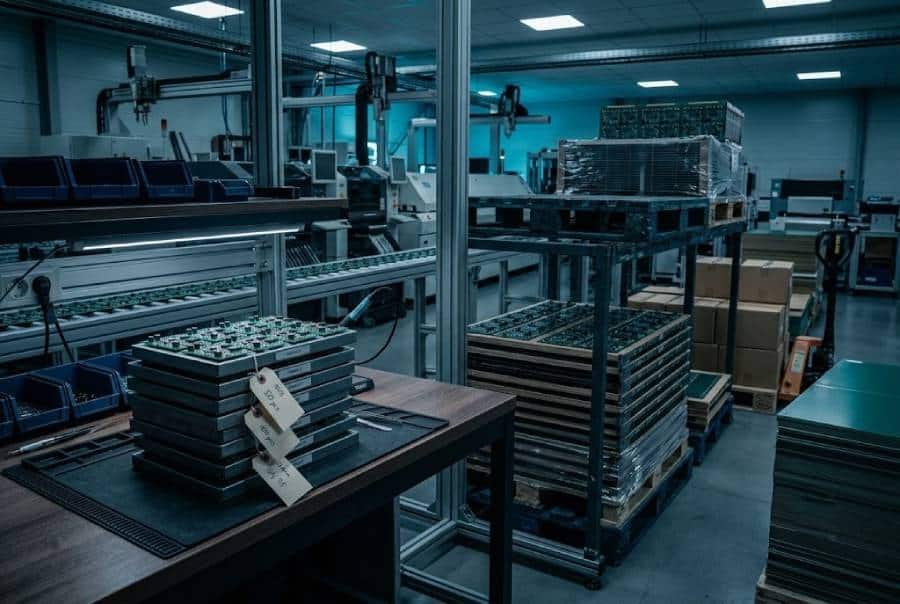
Low volume PCB assembly is particularly valuable in stages where learning, flexibility, and risk control matter more than absolute unit cost. Understanding these scenarios helps teams avoid premature mass production and the problems that can follow.
Early Development: Prototyping, Design Validation, and Pilot Runs
In early development, designs are changing, test strategies are still being refined, and demand is uncertain. Low volume PCBA supports this environment by enabling small batches of boards to be built and evaluated under realistic factory conditions.
Prototype runs can be followed by low volume engineering builds that test manufacturability, test coverage, and integration into mechanical assemblies. Pilot runs then extend validation to process stability, operator training, packaging, and logistics, all with limited quantities that contain the impact of any problems. In these phases, the higher unit price of low volume PCB assembly is justified by the information gained and the risk avoided.
Uncertain or Intentionally Limited Market Demand
When market demand is uncertain or intentionally limited, low volume PCB assembly is often the safer choice. New products, niche offerings, beta programs, and regional trials all carry demand risk: the number of units needed may differ significantly from initial estimates.
Using low volume PCBA for early launches allows teams to respond to real orders, collect feedback, and adjust their plans without overcommitting to inventory. If demand grows, production can be scaled up gradually; if it remains modest or shifts in unexpected ways, the company avoids large write-offs and can pivot with less friction.
Multiple Variants, Customization, and Specialized Applications
Products that require multiple variants or customization are another strong fit for low volume PCB assembly. Industrial control systems, medical devices, test equipment, and custom electronics often involve site-specific configurations, different feature sets, or one-off designs for particular customers.
In these cases, the cost and complexity of setting up mass production may not be justified. Small-batch PCBA can support ongoing low-demand orders, maintain flexibility for configuration changes, and accommodate design updates as requirements evolve. Customers receive tailored solutions, while manufacturers avoid the overhead associated with maintaining many variants at high volume.
Strategic Reasons: Speed, Agility, and Learning Value
Beyond immediate technical and market considerations, low volume PCB assembly offers strategic benefits related to speed and learning. Small batches can be built and shipped more quickly than large production lots, helping teams shorten the cycle between design decisions and field feedback.
For hardware startups in particular, low volume PCBA enables agile development: build a small batch, learn from customers, refine the product, and repeat. Even established companies launching new lines can benefit from this approach, using low volume builds as a way to experiment and gather data before committing to mass production.
In short, low volume PCB assembly is the better choice when the priority is learning and adapting rather than maximizing immediate cost efficiency.
When Mass Production PCB Assembly Makes Sense
Mass production PCB assembly becomes the preferred option once the product reaches a stage where design stability, proven demand, and cost targets require the efficiencies of scale.
Stable Design and Proven Demand
The most important prerequisite for mass production is a stable design with proven demand. Designs should have passed through prototype and low volume validation, with known performance and failure modes, and any major issues resolved. Demand should be supported by confirmed orders, reliable forecasts, or historical data indicating that large quantities will be sold.
When these conditions are met, the higher fixed costs of mass production—such as dedicated tooling and process optimization—can be justified by the volume of units over which they will be amortized.
Supply Chain Readiness and Redundancy
Supply chain readiness is another key factor. For mass production, critical components must be available in sufficient quantities, with stable lead times and quality performance. Ideally, multiple qualified suppliers exist for key parts, reducing dependency on single sources and improving resilience.
Low volume builds and pilot runs often serve as tests of supply chain robustness. Once these stages demonstrate that materials can support higher volumes without frequent shortages or quality problems, mass production becomes more feasible.
Cost Targets and Competitive Markets
In markets where price competition is intense—such as many consumer electronics segments—mass production PCB assembly is often necessary to meet cost targets. Customers may expect aggressive pricing, and margins may only be achievable when unit costs are minimized through scale.
In these cases, staying in low volume mode would keep unit prices too high, limiting competitiveness. Once the design and demand are ready, shifting to mass production becomes a strategic requirement rather than a discretionary choice.
Incremental vs New Products: When You Can Bypass Low Volume
There are some scenarios where products can move into mass production with minimal low volume stages. Incremental updates to a proven design—such as minor component substitutions, small feature additions, or cosmetic changes—may be manageable through limited pilot runs followed by high-volume builds.
Because the underlying architecture and market behavior are already known, the risk profile is lower than for entirely new products. Even in these cases, most teams still perform some level of validation before scaling up, but the required low volume builds may be smaller or more targeted than those for a brand-new design.
How to Transition from Low Volume to Mass Production
Moving from low volume PCB assembly to mass production is one of the most consequential steps in a hardware project. Done well, it converts validated designs and processes into cost-efficient, high-volume output. Done prematurely or without preparation, it can magnify unresolved issues across thousands of boards.
A successful transition uses low volume PCBA as a pilot stage to de-risk design, supply chain, and process decisions, and then applies deliberate actions to freeze the right elements before scaling up.
Using Pilot Runs to De-Risk the Jump to Mass Production
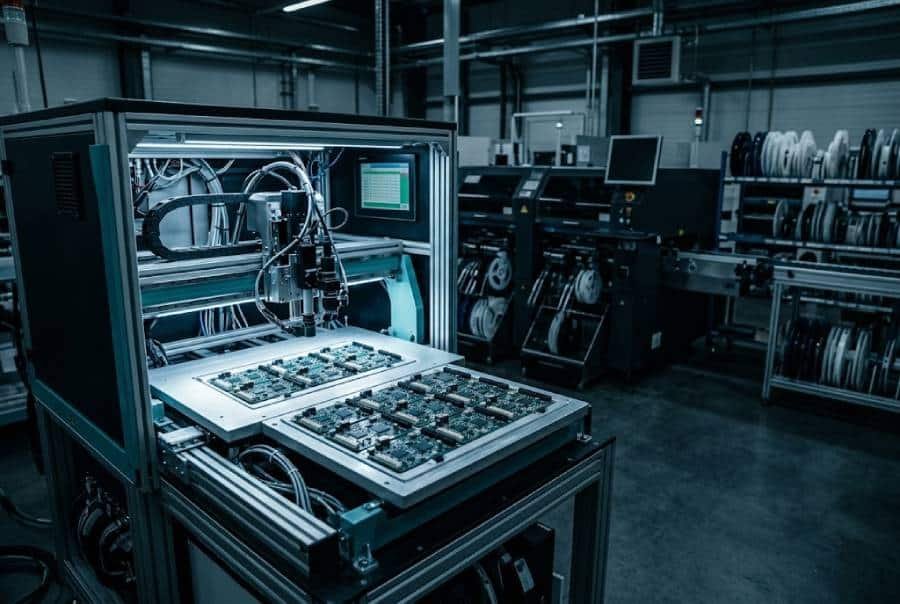
Pilot runs are structured low volume builds designed specifically to prepare for mass production. Instead of focusing solely on validating functionality, they test the entire manufacturing and logistics flow at a smaller scale.
In a typical pilot run, teams aim to:
- Confirm that the PCB design can be assembled consistently at acceptable yields.
- Verify that stencil designs, reflow profiles, and placement parameters work across multiple boards.
- Evaluate test fixtures, ICT and FCT programs, and programming steps under production-like conditions.
- Assess packaging, labeling, and shipment processes, including any requirements for ESD protection and traceability.
- Check that suppliers can deliver components and PCBs on time and within quality specifications.
By treating pilot runs as the rehearsal for mass production, teams can identify where additional refinement is needed and ensure that those changes are made while quantities are still limited.
Design and BOM Actions Before Scaling Up
Before committing to high-volume builds, design and BOM decisions should be brought to a stable state. That does not mean the product will never change again, but major changes should be resolved before large lots are ordered.
Key actions include:
- Freeze core design elements: Lock down the PCB architecture, critical component choices, and mechanical interfaces that define the product’s behavior.
- Finalize DFM and DFT recommendations: Incorporate lessons from low volume builds into the layout and test strategy—such as pad geometry adjustments, additional test points, or improved panelization.
- Clean up documentation: Ensure that BOM, Gerber/ODB++ files, assembly drawings, centroid data, and test instructions all match the latest approved revision.
- Define variant strategy: Decide which variants will be built at high volume, which will remain low volume or custom-only, and how differences will be managed in documentation and production.
Taking these steps prevents mismatches between design intent and manufacturing reality when mass production begins.
Process, Test, and Quality Adjustments for Higher Volumes
High-volume manufacturing demands more robust processes than early low volume builds. As quantities increase, assemblers and customers should agree on how process, test, and quality controls will evolve.
Typical adjustments include:
- Process tuning and standardization: Refine solder profiles, stencil apertures, placement programs, and work instructions based on pilot run data, then standardize them for ongoing use.
- Enhanced automation: Introduce or optimize automated processes such as in-line AOI, automated functional test, and data logging, which become more cost-effective at scale.
- Statistical process control: Implement monitoring of key parameters and yields over time to detect drifts and emerging issues early.
- Sampling plans and quality thresholds: Define inspection and test sampling strategies, reject criteria, and rework policies appropriate for large runs.
By agreeing on these measures before scaling up, both the OEM and the assembler can align expectations and reduce the chance of surprises when high-volume builds start.
Working with One Partner Across Both Stages: Role of PCBELEC
Transitioning from low volume to mass production is smoother when the same partner handles both stages. A manufacturer that has already run your prototypes, engineering builds, and pilot runs is familiar with your design, BOM, test requirements, and quality expectations.
PCBELEC supports this kind of end-to-end approach by offering low volume PCB assembly for prototypes, validation builds, and pilot runs, as well as scaling up to larger batches when products are ready. Our engineering review process and DFM support help identify issues early, while inspection and testing capabilities—such as AOI, X-ray, ICT, and FCT—provide confidence that builds are representative of production conditions.
When customers decide to move toward higher volumes, the data and experience gained from low volume PCBA at PCBELEC can inform stencil and process tuning, sampling strategies, and documentation updates, reducing risk in the transition. For teams that prefer to keep certain products in low volume while scaling others, we can support mixed strategies that match different products to the production mode that best fits their lifecycle.
Practical Transition Checklist
To make the transition actionable, teams can use a simple checklist before approving a move from low volume PCB assembly to mass production:
- Design maturity
- Prototype and low volume builds completed.
- No open major design issues affecting function or manufacturability.
- DFM/DFT implemented
- Recommended layout and test changes from pilot runs integrated into the design.
- Test coverage and fixture performance validated.
- Documentation alignment
- BOM, Gerber/ODB++, assembly drawings, centroid files, and test instructions fully synchronized to the same revision.
- Variant definitions and build codes clearly documented.
- Supply chain readiness
- Critical components available in required quantities with stable lead times.
- Alternative suppliers or parts identified for risk mitigation.
- Quality and yield data
- Pilot runs show acceptable yields and predictable failure modes.
- Corrective actions implemented for any significant issues.
- Demand and business case
- Confirmed orders or strong forecasts justify large lot sizes.
- Cost models show that mass production will meet unit price targets.
If all items are satisfied, moving from low volume to mass production is more likely to be successful and sustainable.
Summary: Building a Volume Strategy Around Your Product Lifecycle
Low volume and mass production PCB assembly are not competing ideas; they are complementary tools that serve different stages of a product’s lifecycle. Using them intentionally helps teams balance learning, flexibility, cost, and risk as hardware moves from concept to market and beyond.
Low volume PCB assembly provides a way to build small batches of boards with full manufacturing discipline, suitable for prototypes, engineering validation, pilot runs, early launches, and specialized low-demand products. It offers flexibility for design changes and variants, reduces exposure to design and inventory risk, and gives teams the opportunity to learn from real manufacturing and field data before committing to large volume.
Mass production PCB assembly takes over when designs are stable, demand is proven, and cost efficiency becomes critical. By amortizing setup and tooling costs across many units and leveraging bulk material pricing, high-volume processes can achieve low unit prices and consistent quality for mature products. However, this efficiency comes with higher sensitivity to mistakes and less tolerance for frequent changes.
The best volume strategy typically follows a progressive path:
- Start with prototypes and low volume PCBA to validate design and test ideas.
- Use structured low volume pilot runs to de-risk manufacturing, supply chain, and logistics.
- Transition to mass production once design, demand, and supply conditions justify the move.
- Maintain low volume builds for variants, custom orders, and specialized low-demand products alongside high-volume lines.
By aligning manufacturing mode with product stage, teams can avoid both premature mass production and excessive small-batch costs. They can learn quickly when uncertainty is high, and scale efficiently when the path forward is clear.
For companies seeking support across these stages, working with a partner that understands both low volume and mass production PCB assembly makes the journey smoother. With capabilities for small-batch PCBA, pilot runs, and larger builds, a provider like PCBELEC can help ensure that each step—from prototype to full-scale manufacturing—is supported by the right processes, quality controls, and technical expertise.