Table of Contents
Hardware Development Reality for Startups and R&D Teams
Bringing a new hardware product to life is fundamentally different from building software. Code can be deployed, rolled back, and patched quickly; physical devices require design cycles, components, manufacturing, testing, and logistics. For hardware startups and R&D teams, this reality shows up as long timelines, high cash burn, and a constant tension between moving fast and not wasting resources.
Early-stage teams often operate with limited funding, small engineering crews, and uncertain market signals. They need to validate concepts, iterate on designs, show working prototypes to investors and early customers, and still keep enough runway for future versions. Traditional assumptions from mass production—such as high minimum order quantities (MOQ), long lead times, and rigid contracts—do not fit these constraints well.
In this context, low volume PCB assembly becomes more than a production option; it is a development tool. By combining professional manufacturing and testing with small-batch quantities, low volume PCBA allows teams to get real boards built, learn from them, and change course without committing to large runs.
Why Hardware Is Hard: Time, Cash, and Uncertainty
Hardware projects for startups and R&D teams face three recurring challenges: time, cash, and uncertainty.
On the time side, each design change typically requires new prototypes, lab testing, and sometimes updated tooling. Even with quick-turn services, assembling boards still takes days or weeks, and debugging hardware issues can be slower than chasing software bugs. Teams must budget for multiple cycles of design, prototype, test, and revise, all while external pressures—from investors, customers, or internal sponsors—push for visible progress.
Cash is equally critical. Manufacturing hardware consumes capital through PCB fabrication, component purchases, assembly, test fixtures, and logistics. Large orders may offer lower unit pricing, but they also tie up funds in inventory and non-recurring engineering (NRE) costs. For early-stage teams, committing to a big production run before the design and market are proven can be financially risky.
Uncertainty is the third axis. Requirements may evolve as teams learn from prototypes and customer conversations. Target markets can shift. Regulatory or reliability constraints may introduce new design demands midstream. In such an environment, locking into a high-volume manufacturing plan too early can trap teams in decisions that no longer fit the product or the business.
Traditional Production Assumptions That Don’t Fit Early-Stage Projects
Many traditional PCB manufacturing models were designed around established products and predictable demand. They often assume that customers will place large orders, accept fixed MOQs, and commit to long-term production schedules. While this makes sense for mature, high-volume products, it is misaligned with how hardware startups and R&D efforts work.
High MOQs push teams to order more boards than they can realistically use in early stages, increasing the risk of obsolete inventory when designs change. Long lead times slow down iteration cycles and can delay critical milestones such as investor demos, pilot deployments, or regulatory testing. Rigid contracts can make it difficult to adjust BOMs, modify layouts, or introduce new variants as the product evolves.
In addition, mass production-oriented lines may not be optimized for high-mix, low-volume work. They are geared toward running large lots of the same design, not switching frequently between small batches for different projects. For a startup juggling multiple prototypes, evaluation boards, and early product revisions, this environment can feel slow and inflexible.
Where Low Volume PCB Assembly Fits Into This Picture
Low volume PCB assembly is designed to solve many of these early-stage constraints. It uses professional manufacturing processes—SMT lines, AOI, X-ray, functional testing—but applies them to small batches sized for prototyping, engineering validation, pilot runs, and limited early production.
Instead of forcing teams into large orders, low volume PCBA supports low or even no MOQ, allowing startups to build 5, 10, or 50 boards at a time as they refine their design and test strategy. Quick-turn capabilities mean that simple boards can be fabricated and assembled within days, shrinking the gap between design decisions and physical hardware. Because the same professional processes are used as in larger-scale manufacturing, low volume builds provide realistic feedback on manufacturability and quality, not just lab-only results.
For hardware startups and R&D teams, this combination—small quantities, fast turnaround, and production-grade processes—turns low volume PCB assembly into a foundation for agile hardware development. It supports the way early-stage teams actually work: iterate quickly, learn from each batch, and avoid overspending on units that might never be used.
What Low Volume PCB Assembly Looks Like for Startups
In a startup or R&D context, low volume PCB assembly rarely appears as a single, isolated build. Instead, it shows up as a series of small batches tied to specific goals: lab prototypes, engineering validation, pilot runs, demo units, and early customer shipments. Each batch is part of a learning loop, and the manufacturing model needs to support that loop rather than constrain it.
Typical Batch Sizes and Project Types in Startup Environments
For hardware startups and R&D teams, typical low volume PCB assembly batches often look like this:
- Lab prototypes: 5–20 boards for initial functionality tests, firmware bring-up, and basic mechanical fit checks.
- Engineering validation builds: 20–100 boards for more rigorous electrical, thermal, and reliability evaluation, often used in EVT/DVT-style work.
- Pilot runs and field trials: 50–500 boards deployed to early customers, internal users, or specific trial sites to gather field data.
- Early production for limited customers: Ongoing small-batch orders—perhaps 50–200 units at a time—for first paying customers or controlled rollouts.
These numbers are indicative, not prescriptive. The point is that early-stage hardware rarely needs thousands of units at once; it needs enough boards to learn and progress to the next milestone.
Project types also vary. A single startup might run low volume PCB assembly for a core product, evaluation kits, demo hardware for investors, and internal test tools, all within a high-mix environment where multiple designs are active simultaneously. A research group might use small batches for experimental boards, instrumentation, or prototypes supporting different streams of investigation.
High-Mix, Low-Volume Workflows vs Traditional Mass Production
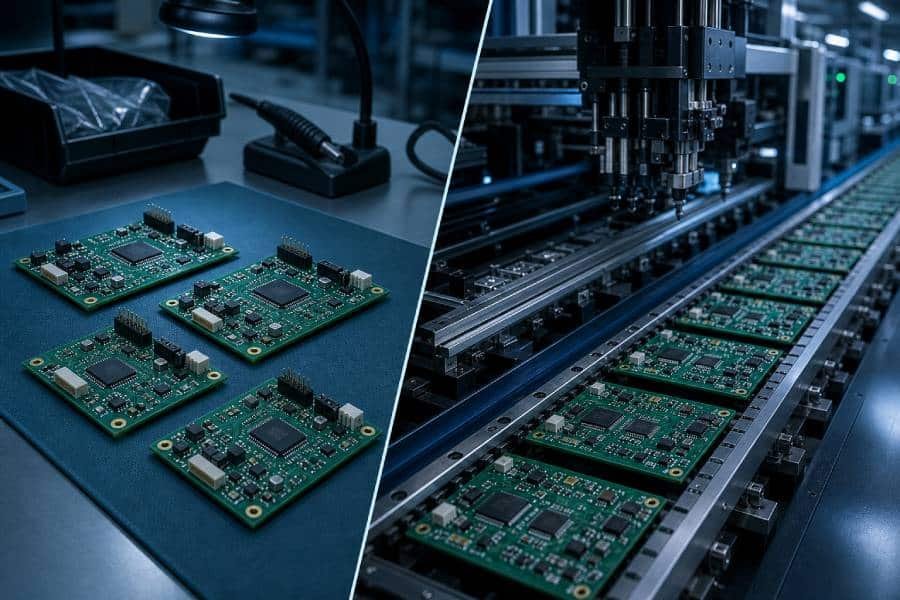
High-mix, low-volume manufacturing is a model that aligns well with startups and R&D teams. In this approach, assemblers expect to handle many different designs in small quantities, switching between projects more frequently and supporting diverse requirements.
Compared with traditional mass production workflows, high-mix, low-volume PCB assembly emphasizes:
- Frequent changeovers: Lines and teams are prepared to switch between designs with less downtime, enabling multiple small projects to run in parallel.
- Flexible scheduling: Builds are planned around prototype cycles and pilot timelines, rather than large, recurring production lots.
- Engineering collaboration: DFM feedback, quick file checks, and technical discussions are part of the service, helping teams refine designs as they go.
- Support for non-standard requirements: Custom test setups, unique panelization, or unusual BOM structures are handled more readily than in rigid mass production environments.
This model is particularly powerful for startups managing several incremental iterations of their hardware. Each revision can be built, tested, and used to inform the next, without waiting for long, fixed production windows.
Key Service Features That Matter to Startups: Quick-Turn, Low MOQ, Turnkey
From a startup’s perspective, not all low volume PCB assembly services are equal. Certain features make a significant difference in how well the service supports early-stage hardware development:
- Quick-turn capability: Fast prototyping cycles depend on short lead times. Services that can deliver simple boards within 24–72 hours when files and parts are ready dramatically improve iteration speed.
- Low or no MOQ: The ability to order only the number of boards needed—whether 1, 5, or 50—avoids unnecessary inventory and reduces financial risk when designs are still changing.
- Turnkey and partial-turnkey options: For many startups, sourcing all components independently is impractical. Turnkey PCBA, where the assembler handles PCB fabrication and component procurement, simplifies logistics and lets engineers focus on design and testing. Partial-turnkey models, where customers supply key parts and the assembler sources the rest, offer a middle ground that can help manage specialized components or existing inventory.
- DFM review and engineering support: Early-stage hardware benefits from experienced eyes on the design. Assemblers that provide DFM feedback, highlight potential manufacturability issues, and suggest improvements help teams avoid painful surprises in later builds.
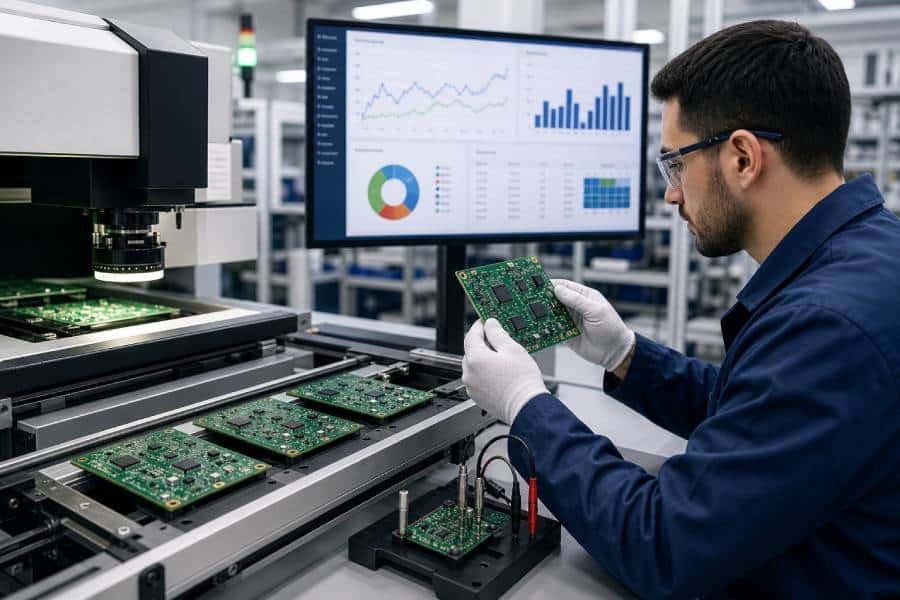
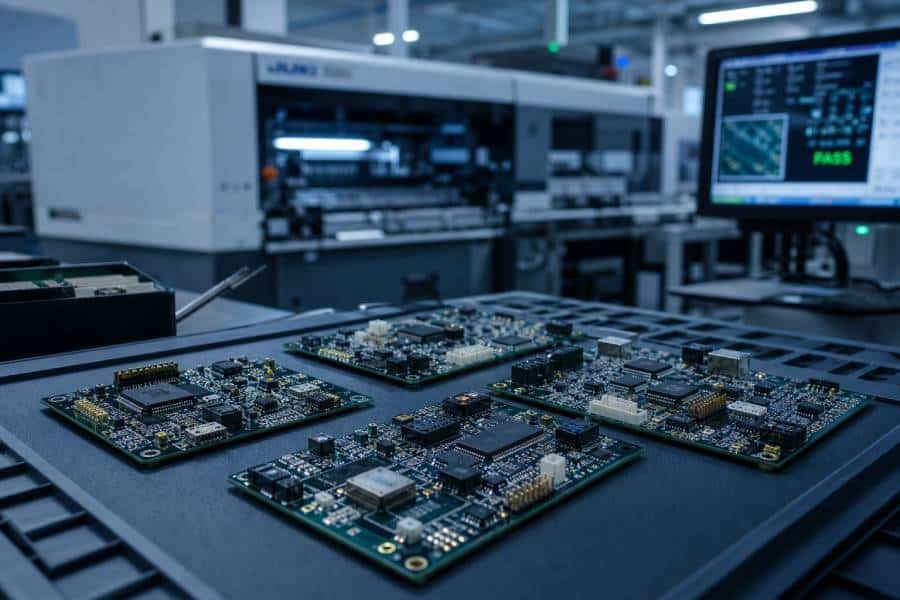
- Test and inspection capabilities: Even small batches need meaningful quality checks. Access to AOI, X-ray, ICT, and functional test methods ensures that boards are reliable enough for lab validation, pilot deployments, or investor demos.
When hardware startups and R&D teams find low volume PCB assembly services that combine these features, they gain a practical platform for turning ideas into tested hardware, learning from each iteration, and preparing for eventual scale-up when the product and market are ready.
Benefits of Low Volume PCB Assembly for Startups and R&D
Low volume PCB assembly is not just a smaller version of mass production. For hardware startups and R&D teams, it delivers a completely different set of benefits: faster design iteration, more controlled financial risk, greater process adaptability, and a more systematic way to learn from each build.
Fast Prototyping and Design Iteration
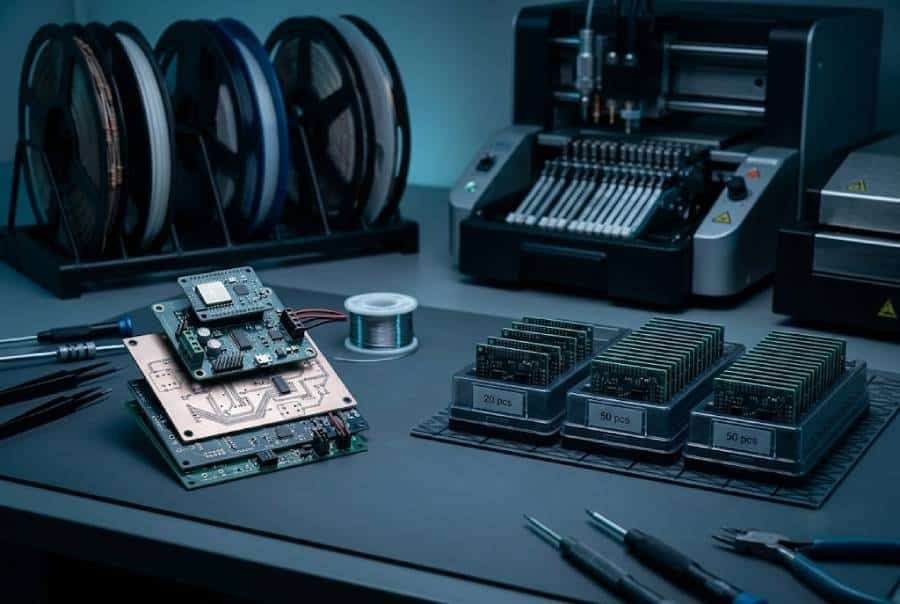
The most immediate benefit for early-stage teams is speed. Low volume PCB assembly services built for startups typically emphasize quick-turn capabilities, allowing engineers to go from updated design files to assembled boards in days rather than weeks.
Fast turnaround compresses the design–prototype–test loop. A team can adjust schematics and layout, send files for fabrication and assembly, and have working hardware back in time for the next sprint or investor meeting. This makes hardware development feel more like modern software development, where iterations are frequent and feedback cycles are short.
For R&D groups, quick low volume builds mean experiments can be run sooner and more often. Instead of waiting for a single large batch, researchers can produce small sets of boards for different concepts or parameter variations, accelerating the pace of discovery.
Lower Financial Risk Compared with Jumping to Mass Production
Low volume PCB assembly also lowers financial risk compared to committing directly to mass production. Large orders may reduce unit cost, but they require significant upfront investment in materials, NRE, and often non-reversible commitments. If the design, test strategy, or market assumptions turn out to be wrong, that investment can be difficult to recover.
Small-batch PCBA flips that equation. By building tens or hundreds of boards at a time, startups and R&D teams control how much capital is tied up in hardware during each iteration. If a design change is needed, fewer units are affected. If a pivot is required because customer feedback or experimental results point in a new direction, the team has not committed to large inventories that no longer match the product.
This approach aligns with the way early-stage businesses manage risk: make limited, reversible bets, learn from them, and increase investment only as confidence grows.
Process Adaptability and High-Mix Project Support
Startups and R&D teams rarely work on a single, stable design. They run multiple projects, versions, and experiments in parallel. High-mix, low-volume PCB manufacturing is designed for precisely this environment.
Assemblers offering high-mix, low-volume services build processes that can handle frequent changeovers, diverse BOMs, and different test requirements without significant downtime. This translates into:
- The ability to run several small projects in parallel without long waits for each design’s turn on a mass-production line.
- Flexibility to accommodate unique panelization, custom footprints, or experimental configurations that would be out of place in highly standardized mass production.
- Greater responsiveness to schedule changes and last-minute design updates, which are common in startup environments.
For R&D teams, high-mix, low-volume workflows also enable a broader portfolio of experiments, each supported by a tailored build rather than forced into a one-size-fits-all production model.
Better Learning: Using Each Small Batch as Data, Not Just Output
One of the less obvious but most important advantages of low volume PCB assembly is its role in learning. Each small batch of boards is not just output; it is data.
Startups can treat each run as an opportunity to learn about:
- Design behavior under real manufacturing conditions: solderability, placement accuracy, thermal performance, and test coverage.
- Supply chain realities: component availability, lead times, and the practicality of alternative parts.
- Customer and market responses: how early users react to the hardware, which features matter, and what needs to change before broader release.
R&D teams can similarly use low volume builds to validate hypotheses, uncover new failure modes, and refine experimental setups. Because quantities are small, the cost of learning from each batch remains manageable, and insights can be fed directly into subsequent design cycles.
In this sense, low volume PCB assembly turns manufacturing into an active part of the product’s learning system, rather than a passive step that happens after development is “finished.”
Typical Use Cases in Startup and R&D Environments
Low volume PCB assembly appears in many different scenarios across hardware startups and R&D teams. Understanding these use cases helps clarify when small-batch PCBA should be the default choice and how it supports the journey from concept to validated product.jlcpcb+2
EVT/DVT-Style Engineering Builds and Lab Validation
In structured hardware development, engineering validation often follows phased patterns such as EVT (Engineering Validation Test) and DVT (Design Validation Test). In these stages, teams need enough boards to run systematic tests, but not enough to justify mass production.
Low volume PCB assembly is ideal for these engineering builds. It provides production-grade assembly and inspection—such as AOI and X-ray—for tens or hundreds of boards used to:
- Verify electrical performance across multiple units and operating conditions.
- Evaluate thermal behavior and mechanical fit in real enclosures or systems.
- Test firmware, communication interfaces, and edge cases that may not appear in one-off lab prototypes.
- Check manufacturability and yield under realistic reflow and placement profiles.
Because each batch is still relatively small, teams can adjust layouts, component choices, test points, and panelization between cycles without being locked into a large inventory.
Pilot Runs and Limited Field Trials
Once engineering validation builds show that the design and process are sound, teams often move to pilot runs and limited field trials. In these scenarios, hardware is deployed outside the lab—to selected customers, internal users, or targeted trial sites—to gather real-world data.
Low volume PCB assembly supports pilot runs by producing batches large enough to reveal field behavior but small enough to keep risk under control. For example, a startup might build 100–300 units for an industrial pilot, or an R&D group might deploy 50 boards in different test environments.
Pilot builds through low volume PCBA help teams learn about:
- Environmental impacts such as vibration, temperature variation, and contamination.
- Installation and usage patterns that affect connectors, housings, and interfaces.
- Actual failure rates and modes in real deployments, which may differ from lab expectations.
Insights from these runs inform both design refinements and the decision whether to move toward broader production.
Early Market Launches and Investor/Demo Builds
Hardware startups frequently need working units for early customers, investors, trade shows, and other demonstrations before full commercial release. These builds must look and behave like real products, even if volumes are still low.
Low volume PCB assembly enables teams to produce polished hardware for:
- Beta programs or early adopter groups, where limited numbers of units are shipped with the understanding that the product may still evolve.
- Investor demos and fundraising campaigns, where credible physical prototypes can support product story and traction claims.
- Trade shows, conferences, and pilot deployments with strategic partners, where hardware must be robust and presentable, not just lab-grade.
In these scenarios, small-batch PCBA allows startups to allocate limited resources to high-impact units without overbuilding inventory. It also creates a feedback loop: early users can report issues and suggestions, which feed into the next low volume iteration.
Long-Tail R&D and Internal Tools That Never Reach Mass Production
Not every hardware project is destined for mass production. R&D organizations and some startups maintain long-tail hardware needs—internal test equipment, lab tools, custom fixtures, or niche solutions for specific customers—that are produced and updated in small quantities over time.
Low volume PCB assembly is well-suited to these long-tail projects. It allows teams to:
- Build internal tools and instrumentation as needed, without requiring high-volume commitments.
- Maintain specialized products for small markets that do not justify large-scale production but still require professional manufacturing and quality.
- Update and refresh designs periodically as requirements or technology change, leveraging high-mix, low-volume workflows to support multiple iterations.
In these contexts, low volume PCBA is not just a transitional stage—it is the enduring production model.
Design, BOM and Files: How Startups Can Make Low Volume PCBA Work Better
Low volume PCB assembly works best when designs, BOMs, and files are prepared with manufacturing in mind. For hardware startups and R&D teams, this is often where problems arise: the design team focuses only on functionality, and when the project reaches the factory quotations are delayed, parts cannot be sourced, assembly issues appear, and the iteration pace slows down.
Choosing Realistic Component Strategies for Early-Stage Hardware
Component strategy is one of the most important levers in early hardware projects. In the prototyping and low volume phase, choosing parts that look ideal on paper but are hard to source or assemble in practice can cause delays and unexpected costs.
For startups and R&D teams, it usually makes sense to prioritize:
- Common, widely available components and packages. Favor standard resistor and capacitor series, mainstream connectors, and commonly stocked IC packages over niche or exotic options.
- Stable lifecycle parts. When possible, choose components with clear lifecycle information and multiple approved vendors, reducing the risk of obsolescence or sudden shortages.
- Assembly-friendly packages. Extremely fine-pitch or unusual packages can be used when necessary, but they should be balanced against manufacturability and yield, especially in early low volume builds.
A pragmatic approach is to separate “must-have” components—those required for performance or unique functionality—from “nice-to-have” parts that can be swapped for more available or assembly-friendly alternatives if issues arise. This gives startups flexibility when sourcing and helps low volume PCB assembly partners respond quickly when constraints appear in the supply chain.
BOM Practices That Reduce Surprises and Quotation Delays
Clean, well-structured BOMs are essential for smooth low volume PCB assembly. Many assemblers note that incomplete or inconsistent BOMs are a common reason for quotation delays and build errors.
Best practices for startups and R&D teams include:
- Start the BOM early and maintain it as the design evolves. Building and updating the BOM alongside the schematic and layout helps catch errors sooner and keeps documentation aligned.
- Provide clear fields for each line item. At minimum, include reference designators, quantity per board, component description, footprint/package, and manufacturer part number for critical parts.
- Use standardized naming and structure. Consistent formatting across projects makes it easier for assemblers to parse BOMs, compare revisions, and identify changes.
- Define acceptable alternates and an AVL (Approved Vendor List) where possible. Identifying known-good substitutes for certain parts gives assemblers flexibility when sourcing, especially in low volume builds where availability can change quickly.
For low volume PCBA, even modest improvements in BOM clarity can significantly reduce back-and-forth during quotation and preparation, allowing teams to keep iteration cycles tight.
Preparing Complete Files: Gerber, Pick-and-Place, Assembly Drawings, Test Notes
Low volume PCB assembly still relies on the same core files as larger runs. Missing or incomplete files can slow down quick-turn services and introduce avoidable risks.
Startups and R&D teams should ensure they are consistently providing:
- Fabrication data: Gerber or ODB++ files covering copper layers, solder mask, silkscreen, drills, and board outline, generated from the latest approved layout.
- Pick-and-place (centroid) files: Accurate component placement data including reference designators, X/Y coordinates, rotation, and side (top/bottom) for all SMT parts.
- Assembly drawings and notes: Clear diagrams or annotated views showing component orientation, polarity, mechanical keep-outs, and any special assembly requirements.
- Test and programming instructions: Basic guidance on how boards should be tested—such as required voltages, interfaces, expected behavior—and any firmware programming steps or fixtures used in the lab.
Providing these files in a coherent package, with matching revision identifiers, makes it easier for low volume PCB assembly partners to start work quickly and reduces the risk of mismatched data between design and production.
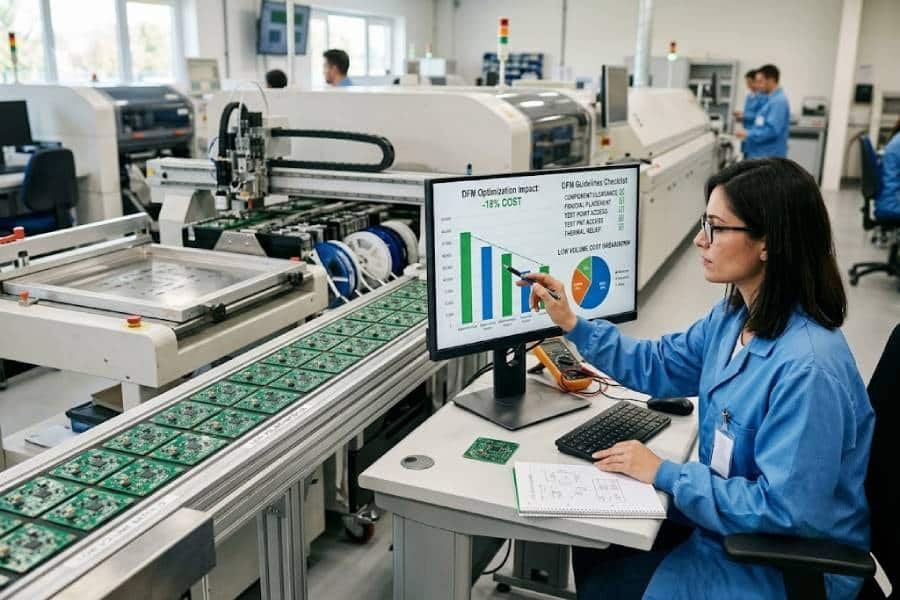
Using DFM Feedback Loops as Part of the Design Process
Design for Manufacturability (DFM) is often thought of as a late-stage or high-volume concern, but it is just as important for low volume PCB assembly—especially when each small batch is meant to inform future versions.
Startups and R&D teams can treat DFM feedback as an integral part of their design process by:
- Inviting review early. Sharing preliminary layouts with assembly partners before finalizing designs can reveal issues with clearances, pad sizes, component orientations, or panelization before they become costly.
- Capturing and tracking recommendations. Documenting DFM suggestions and deciding which to implement in each revision keeps improvements organized and prevents repeated issues.
- Closing the loop after each build. Comparing actual assembly data—such as yields, rework reasons, and test results—with DFM advice helps teams understand which changes have paid off and where further refinement is needed.
When treated as a feedback loop rather than a one-time checklist, DFM turns low volume PCB assembly runs into a powerful tool for improving both design quality and manufacturability over time.
Working with a Low Volume PCB Assembly Partner
Even with good design and documentation practices, the choice of assembly partner strongly influences how effective low volume PCB assembly will be for hardware startups and R&D teams. Not all manufacturers are optimized for small-batch, high-mix work, and selecting the right partner can determine whether projects move smoothly or face repeated friction.
What Startups Should Look for in a Low Volume PCBA Service
When evaluating low volume PCB assembly services, startups and R&D teams should consider several key factors beyond basic technical capability:
- True low volume and high-mix readiness. A partner that regularly handles many different designs in small quantities is more likely to support frequent iterations and experimental projects without schedule or cost penalties.
- Quick-turn options with clear constraints. Services that publish achievable turnaround times and file/part readiness requirements make it easier to plan prototype and validation cycles.
- Flexible MOQ and batch sizing. Low or no MOQ policies allow teams to order only what they need at each stage, avoiding unnecessary inventory and cost.
- Engineering and DFM support. Access to experienced engineers who can review layouts, BOMs, and test strategies helps prevent manufacturability issues and maintain quality as designs evolve.
- Inspection and test capabilities. Availability of AOI, X-ray, and functional test options is important for validating designs and ensuring that boards are suitable for lab, pilot, or demo use.
- Transparent communication and documentation practices. Clear quoting, order tracking, and feedback processes are essential for keeping multiple projects aligned and avoiding surprises.
Selecting partners with these characteristics supports the way startups and R&D teams work: with many moving parts, changing priorities, and a need for consistent, predictable collaboration.
Common Engagement Models: Prototypes, Ongoing Small Batches, and Scale-Up Support
Low volume PCB assembly partners often offer engagement models that map closely to the hardware development journey.
Typical patterns include:
- Prototype-focused engagements. Short-term work centered around initial boards, lab validation, and small demo builds. These engagements emphasize quick-turn, engineering support, and flexibility for frequent design updates.
- Ongoing small-batch production. For products that remain in low volume due to niche markets or internal use, assemblers provide recurring small-batch builds with stable processes and documentation.
- Scale-up and transition support. Some partners also help teams move from low volume to higher volumes when designs and demand mature, advising on DFM actions, process adjustments, and supply chain readiness.
Hardware startups can benefit by thinking in terms of these engagement modes. Rather than treating each order as separate, they can work with a partner to plan how prototype, pilot, and early production builds will fit together, and what will change if the product moves toward mass production.
How PCBELEC Supports Hardware Startups and R&D Teams
For teams looking for a practical low volume PCB assembly partner, PCBELEC offers services tailored to small-batch, high-mix hardware projects. Our capabilities include SMT, THT, and mixed-technology assembly, support for fine-pitch and BGA components, and inspection using AOI, X-ray, ICT, and functional test methods as projects require.
We provide full turnkey, partial-turnkey, and consigned PCBA options, allowing startups and R&D teams to decide whether to rely on us for PCB fabrication and component sourcing or to supply their own materials where appropriate. No minimum order quantity means that small batches—from initial prototypes to pilot runs and ongoing low-demand products—can be built without rigid volume constraints.
Engineering review and DFM support are integrated into our process, helping identify layout, BOM, and test issues before production begins. For time-sensitive projects, we offer quick-turn low volume PCB assembly, enabling rapid iteration cycles during development. As designs and demand mature, we can also assist in planning transitions to larger volumes, using data from low volume builds to inform process tuning and quality strategies.
Practical Roadmap: Using Low Volume PCBA from Idea to Launch
For hardware startups and R&D teams, low volume PCB assembly is most useful when it is treated as a structured path rather than a one-time procurement choice. Each batch should have a clear purpose, and each stage should produce decisions that inform the next one.
Stage 1 – Concept and Lab Prototypes
The earliest stage focuses on proving that the core idea works. Teams usually build a very small number of boards for circuit validation, firmware bring-up, bench testing, and initial mechanical checks. At this point, speed matters more than cost optimization, and low volume PCB assembly supports this by allowing small prototype quantities without large production commitments.
These early builds help answer basic technical questions: Does the power architecture behave as expected? Do critical interfaces work? Are there layout issues that only appear once real boards are assembled and powered? For startups, these prototypes are also often the first physical proof that can be shown to investors, advisors, or internal stakeholders.
Stage 2 – Engineering Builds and Pilot Runs
Once the first boards function, the next stage is to move into more structured engineering builds. Here, the objective shifts from “Can this work?” to “Can this be built and tested reliably?”
Low volume PCB assembly is especially valuable in this stage because it allows teams to produce enough boards to evaluate repeatability, test procedures, thermal behavior, assembly yield, and field-readiness without committing to full-scale production. Pilot runs may also reveal issues that do not show up in single-board lab testing, such as connector wear, soldering consistency, panelization problems, or edge-case firmware behavior across multiple units.
This is also the stage where teams begin to validate operations, not just electronics. Packaging, labeling, programming, and even basic deployment logistics start to matter, especially if boards are going to beta users, trial customers, or internal field testers.
Stage 3 – Early Production and Controlled Scale-Up
When engineering and pilot builds have reduced major technical risk, startups and R&D-driven product teams often move into early production. This does not necessarily mean full mass production. In many cases, it means repeated low volume batches that support controlled customer shipments while the team continues learning.
This stage is ideal for early customer orders, beta programs, limited market launches, and strategic deployments where product-market fit is still being confirmed. The goal is to balance progress with caution: ship enough units to gather meaningful feedback and generate revenue or traction, but not so many that the business becomes exposed to excess inventory or immature design decisions.
Controlled scale-up also gives teams a way to judge whether demand is stable enough to justify moving beyond low volume PCBA. If the product begins to show consistent order flow, stable field performance, and limited need for major design changes, the business may be ready to plan a transition toward higher volumes.
Deciding If and When to Move to Mass Production
Not every product should move to mass production immediately, and some may never need to. The transition makes sense only when three things begin to align: the design is stable, demand is more predictable, and unit-cost pressure becomes important enough that economies of scale matter.
A practical decision framework for startups and R&D teams is to ask:
- Has the board passed enough prototype, engineering, and pilot cycles that major redesigns are unlikely?
- Are critical components available in quantities that can support larger production without creating sourcing risk?
- Is market demand proven enough to justify larger lots, rather than speculative inventory?
- Will moving to higher volume create a meaningful cost advantage that supports pricing and margin goals?
If the answer to most of these questions is still “not yet,” continuing with low volume PCB assembly is often the smarter move. It allows the team to keep learning while maintaining financial and technical flexibility.
A Simple Startup Checklist for Using Low Volume PCBA Well
To make low volume PCB assembly more effective from idea to launch, startups and R&D teams can use a simple checklist at each stage:
- Define the goal of each batch before ordering: prototype validation, engineering test, pilot run, or customer delivery.
- Keep BOM, layout files, pick-and-place data, and assembly notes aligned to the same revision.
- Use each build to collect specific lessons: technical failures, sourcing issues, test gaps, or user feedback.
- Avoid over-ordering just to reduce unit cost if the design is still changing or demand is uncertain.
- Review DFM feedback after each run and feed improvements into the next version.
- Reassess readiness for scale only when design stability, supply chain readiness, and customer demand all improve together.
This kind of staged discipline helps early hardware teams turn low volume PCB assembly into a repeatable development system, rather than a reactive purchasing process.
Summary: Building Hardware Faster and Smarter with Low Volume PCBA
For hardware startups and R&D teams, low volume PCB assembly matters because it matches the way early-stage hardware is actually developed. These teams do not start with stable demand, frozen designs, or unlimited budgets. They start with uncertainty, learning goals, and the need to convert ideas into working hardware as efficiently as possible.
Low volume PCBA supports that reality by combining professional manufacturing processes with small-batch flexibility. It allows teams to prototype quickly, validate designs in engineering builds, run pilot lots, support limited early launches, and keep improving the product without taking on the risks of premature mass production.
Its importance lies not only in quantity, but in what those small quantities make possible. They reduce exposure to design mistakes, preserve cash, support high-mix experimentation, and turn every build into a learning opportunity about manufacturability, supply chain readiness, and market response. For startups, that means a more sustainable path from concept to market. For R&D teams, it means a more practical way to test ideas, refine systems, and support specialized hardware that may never fit a mass production model.
The most effective way to use low volume PCB assembly is to treat it as part of a roadmap. Start with prototypes, move into engineering builds and pilot runs, then use controlled early production to decide whether scale is justified. This staged approach helps teams move faster without forcing decisions too early, and it creates a clear bridge between technical progress and business readiness.
For companies working in this space, choosing the right manufacturing partner also matters. A partner that supports quick-turn builds, low MOQ, DFM review, inspection, and future scale-up can make low volume PCB assembly much more than a convenience—it becomes a strategic advantage in hardware development. PCBELEC’s low volume PCB assembly service is positioned to support exactly this type of workflow, from prototype and pilot runs to ongoing small-batch production and later expansion as projects mature.