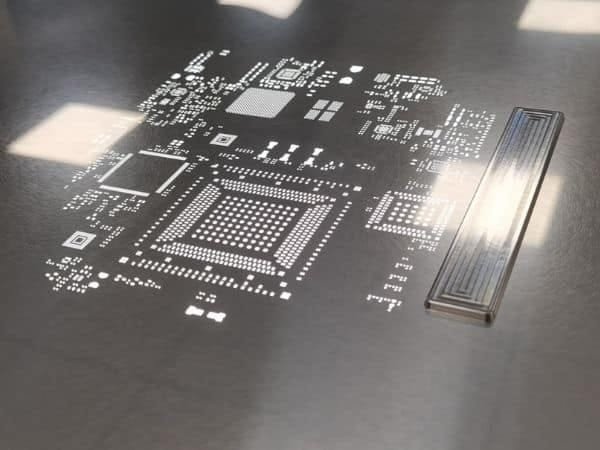
Custom Electroformed Nickel Stencils for SMT Printing
Evaluate electroformed stencil construction
for fine-feature solder paste printing.
Connect aperture geometry, foil thickness
and the finished configuration
with the requirements of
your printing process.
Submit an approved stencil
specification or the printing
requirements that need review.
Construction, dimensional requirements
and fabrication feasibility are
confirmed for the specific project.
Identify How the Foil and Apertures Are Formed
What Is an Electroformed Stencil?
An electroformed stencil is
produced by depositing metal,
typically nickel, on a
patterned mandrel.
In a fully electroformed
aperture construction, the openings
are defined during formation
rather than cut into
the finished foil afterward.
Fully Electroformed Apertures
The foil and aperture
construction are created
through the electroforming
route around the
defined pattern.
Laser-Cut Electroformed Nickel Foil
Electroforming produces the
starting foil, while
a later laser process
creates the openings.
This is a
different aperture route.
Plating or Coating
A subsequent surface treatment
does not by itself
identify how the
foil or apertures
were originally manufactured.
Stencil example.
The manufacturing specification
defines the material,
aperture route and
required dimensions.
With the manufacturing route
identified, review whether
electroforming addresses the
requirements of the
proposed printing task.
Evaluate the route when
the required aperture construction
or printing behavior warrants
a closer comparison.
Fine pitch alone does
not determine the
manufacturing choice.
Begin with the aperture
and printing requirements,
not an assumption that
electroforming always outperforms
another process.
Identify what the current
or proposed stencil
must achieve.
Use the matrix to frame
a project-specific comparison.
Scroll horizontally on smaller screens.
Conditions to review before selecting the stencil manufacturing route
Project Condition
What to Evaluate
Do Not Assume
Useful Inputs
Small or Critical Apertures
Aperture geometry and
foil thickness together,
with the required
opening condition and
printing targets.
That component pitch
alone establishes the
required process
or printable aperture.
Aperture files,
smallest openings,
foil thickness proposal
and critical locations.
Inconsistent Paste Transfer
The current stencil,
paste, printing setup,
deposit level and
variation before proposing
a manufacturing change.
That changing to nickel
guarantees a fixed
transfer percentage or
removes every
process issue.
Existing construction,
observed issue,
measurement method and
relevant process conditions.
Dense Aperture Fields
Openings, spacing,
pattern extent and
thickness as a
combined manufacturing
requirement.
That an unrestricted
aperture count implies
every density and
image size
is feasible.
Full pattern data,
critical gaps,
image dimensions and
required tolerances.
An Existing Laser-Cut Stencil Meets the Requirements
Retaining the qualified
construction unless a
documented requirement
justifies another route.
That electroforming is
automatically a necessary
upgrade for
every design.
Approved baseline,
acceptance criteria and
the reason for
considering a change.
See
laser-cut stencil options
.
Local Thickness or Clearance Requirements
The required three-dimensional
construction separately from
the selected material
and aperture-forming route.
That every electroformed
stencil includes steps,
relief or another
specialized geometry.
These are review directions,
not automatic recommendations
or capability limits.
Proposed changes remain
subject to the
project requirements and
applicable approval.
Next, connect aperture dimensions
and foil thickness with
the geometric and
paste-transfer measures used
in the review.
An aperture dimension is
only part of the
printing definition.
Evaluate it with foil
thickness, opening geometry
and the deposit requirements
of the process.
Area Ratio
A geometric comparison of
aperture opening area
to internal wall area.
It is not a
measured transfer percentage.
Theoretical Aperture Volume
The geometric capacity
of the defined opening.
It is not automatically
the volume deposited
on the board.
Measured Paste Transfer
A process result evaluated
against a stated reference.
Review the deposit level
and its variation,
not one percentage alone.
A Simple Rectangular-Aperture Model
For a rectangular opening
with straight, vertical walls
and constant dimensions:
AR = (L × W) / [2 × t × (L + W)]
Theoretical volume = L × W × t
L, W
Aperture length and width.
t
Local foil thickness.
AR
Dimensionless area ratio.
Use consistent length units.
Scope
A simplified geometry model,
not a full description
of tapered or
otherwise shaped apertures.
The Same Opening at Two Thicknesses
These hypothetical square apertures
illustrate geometry only.
They are not recommended
stackups, PCBELEC capability limits
or measured printing results.
Scroll horizontally on smaller screens
to compare the example values.
Illustrative calculations for straight-walled square openings
Example
Opening — L × W
Foil Thickness — t
Area Ratio
Theoretical Volume
A
0.20 × 0.20 mm
0.100 mm
0.500
0.0040 mm³
B
0.20 × 0.20 mm
0.080 mm
0.625
0.0032 mm³
No transfer efficiency has been
assigned to either example.
The calculations do not establish
process suitability or
dimensional manufacturing capability.
A Higher Area Ratio Does Not Mean a Larger Deposit
Example B has a higher
area ratio but a smaller
theoretical aperture volume.
The actual deposit still
depends on transfer behavior.
Geometry, target volume and
process consistency must be
considered together.
Define the Transfer Measurement
Where aperture volume is
the reference, transfer efficiency
expresses measured deposit volume
as a percentage of
that reference volume.
Confirm the reference used
by the inspection method.
Identify the actual aperture
geometry, local thickness
and reference volume.
Record the paste,
relevant print settings
and measurement conditions.
Review deposit level
and variation across
the relevant apertures
and repeated prints.
Compare results against
the agreed acceptance
criteria rather than
assuming a universal
transfer-efficiency target.
Formula background:
Analog Devices AN-772
.
Its package-specific recommendations
are not universal acceptance
rules for every stencil.
The examples above are
illustrative calculations for this guide.
Next, see how a patterned
mandrel and metal deposition
form the basis of
the electroforming route.
Electroforming builds a metal
structure on a patterned
mandrel. The simplified sequence
below explains the principle,
rather than specifying every
production operation for
an individual order.
In a fully electroformed
aperture construction, the pattern
controls where metal forms
and where openings remain.
Foil formation and the
required aperture construction
are therefore linked
in the forming route.
Step 01 / Pattern Definition
Image the Resist on the Mandrel
The aperture design is
translated into a
resist pattern.
The diagram illustrates
exposure using a phototool;
the selected imaging route
belongs in the
manufacturing definition.
Development establishes the
patterned resist features
and exposed mandrel areas.
This prepares the
geometry that guides
the subsequent
metal deposition.
Nickel is deposited
on the exposed
conductive areas.
Deposition and pattern
geometry are controlled
for the intended
foil thickness and
aperture construction.
Resist removal and release
produce the formed foil
according to the
selected route.
Applicable cleaning, finishing,
mounting and inspection
follow the approved
order requirements.
Specify the manufacturing route,
foil, apertures and
finished configuration together.
Dimensional requirements and
inspection scope should
refer to the
approved order definition.
Keep the Dimensions Distinct
A foil-size or minimum-opening
value does not describe
every aspect of
the finished stencil.
State what each
dimension measures and
which reference it uses.
Foil Dimensions
The overall metal
foil dimensions.
Image Area
The specified area
occupied by the
aperture pattern.
Frame / Interface
The mounting or
tensioning-system dimensions
and associated
tooling requirements.
Stencil example.
Any local levels,
relief or specialized
geometry must be
defined in the
project drawing.
Identify the required value,
tolerance and reference
where applicable.
Scroll horizontally on smaller screens.
Order requirements to define and confirm during review
Specification Area
What to Define
What to Confirm
Material & Forming Route
Required material designation
and whether the
specification calls for
electroformed apertures or
another approved route.
The actual process,
applicable material requirements
and any restriction
on alternative constructions.
Foil Thickness
Nominal thickness,
specified local levels
where relevant and
required thickness tolerance.
Feasible combinations,
measurement locations
and the required
thickness-verification basis.
The pattern together
with foil thickness
and the required
measurement method.
Pattern Position
Datum, alignment features,
position requirements
and orientation references.
Registration checks against
the specified coordinate
system and
approved file revision.
Foil, Image & Mounting Dimensions
Overall foil size,
image extent,
frame or tensioning
interface and
usable-area requirements.
Equipment compatibility and
the complete finished
configuration, not
one size alone.
Local Thickness or Relief
Region map,
specified face,
levels, clearances
and relevant
neighboring features.
Feasibility of the
requested geometry with
the selected route.
Specialized features
require explicit review.
Surface & Finishing
Requested surface condition,
post-treatment or coating
specification where applicable.
Availability, compatibility,
acceptance conditions and
any required
treatment documentation.
Inspection & Identification
Required checks,
acceptance criteria,
part identification,
revision and
delivery documents.
Agreed inspection scope,
measurement basis
and records required
for the order.
This checklist does not
establish a universal
thickness range, minimum
opening or tolerance.
The accepted combination
must be confirmed
for the proposed
material and construction.
Bring the approved files,
dimensional requirements
and inspection needs
together for review
and quotation.
Send the approved stencil
definition or the
printing requirements that
need evaluation.
Identify fixed specifications
separately from proposed
process or design changes.
Prepare the Available Requirements
Include the relevant information
below. If a value
or manufacturing route
remains open, state
the target or question
instead of assigning
an unsupported default.
01
Aperture Data & File Revision
Provide approved stencil
aperture data or
available paste-layer files,
drawings and
alignment references.
Identify the status
of each file.
02
Material & Manufacturing Route
State any required
material or process
designation and
substitution restrictions.
If the route
needs evaluation,
mark it as open.
03
Foil, Apertures & Critical Features
Include thickness,
critical opening dimensions,
gaps, required tolerances
and any local
levels or
relief geometry.
04
Dimensions, Orientation & Mounting
Specify foil and
image dimensions,
frame or tensioning
interface, stencil face
and relevant
orientation references.
05
Printing Target or Existing Issue
Describe the required
deposit outcome,
affected locations and
known printing conditions.
Include existing measurements
where available.
06
Finishing, Inspection & Documentation
List requested treatments,
acceptance criteria,
inspection records,
part identification
and change-approval
requirements.
07
Quantity & Delivery Requirements
State the number
of stencils,
destination and
requested delivery date.
Distinguish production timing
from shipping transit.
Send Your Stencil Requirements
Prepare an inquiry to
sales@pcbelec.com
with the available
files and specifications.
Manufacturing feasibility,
finished configuration,
inspection scope and
delivery timing are
confirmed for the
specific project.
Opens your email application.
Nothing is sent automatically.
No files are uploaded here.
Attach the available files
in your email or
use an appropriate
secure transfer method
for confidential documents.
If the email application
does not open,
copy sales@pcbelec.com
into your preferred
email service.
Manufacturing Route, Performance & Ordering
Electroformed Stencil Questions
These answers clarify common
questions about nickel stencils,
aperture construction and
project preparation.
Final specifications and
acceptance requirements are
confirmed for the order.
Is every nickel stencil an electroformed stencil?
No. Nickel identifies a
material, not every
manufacturing operation.
A stencil may have
electroformed apertures,
laser-cut openings in
electroformed nickel foil
or a subsequent
nickel-related surface treatment.
Identify how the foil
and apertures are formed
rather than relying
on the material name.
How does electroforming differ from laser cutting?
In a fully electroformed
aperture construction,
metal is deposited
around a defined
pattern on a mandrel.
Laser cutting produces
openings in an
existing foil.
Electroformed nickel foil
can also be
laser processed, so
the material and
aperture route should
be stated separately.
Does electroforming guarantee a specific paste transfer efficiency?
No single percentage applies
to every electroformed
stencil and printing task.
Transfer depends on
the aperture geometry,
thickness, surface condition,
paste and printing process.
Evaluate the deposit
level and variation
against a stated
measurement basis and
acceptance requirement.
How should aperture size and foil thickness be evaluated together?
Review opening geometry,
local thickness,
theoretical volume and
relevant area ratio
alongside the desired deposit.
A smaller thickness
changes both geometric
capacity and area ratio.
Neither the smallest
opening nor a
ratio alone establishes
printing suitability.
Can local thickness or relief requirements be reviewed?
Include the requested
levels or relief geometry
with the inquiry.
Provide the region map,
relevant faces,
neighboring features and
required clearances.
These requirements need
explicit feasibility review;
they are not
automatically included in
every electroformed construction.
What frame or tensioning-system information is needed?
Identify the printer
or mounting interface,
required frame or
tensioning-system dimensions,
usable area and
alignment features.
Keep overall foil size,
aperture image area
and mounting dimensions
distinct in the
specification.
What information should I provide for quotation?
Send available aperture files,
drawings, thickness requirements,
critical openings and
the finished configuration.
Include any material
or process restrictions,
requested finishing,
inspection documents,
quantity and delivery needs.
If the route is
undecided, describe the
printing target or
existing issue.
Use the
stencil inquiry checklist
to prepare the email.
Files are not uploaded
or sent automatically
by the email link.
How are inspection requirements and lead time confirmed?
Inspection scope follows
the agreed construction,
dimensional requirements
and acceptance criteria.
Timing is confirmed
against the files,
process, quantity,
finishing and required records.
Specify the destination
and requested delivery date,
distinguishing production timing
from shipping transit.
Have a requirement that
needs project-specific clarification?
Include the relevant
file, drawing or
printing condition
with the inquiry.
Review the technical background
and related manufacturing options.
Apply the relevant information
to the specific aperture,
foil and printing
requirements of the project.
Background on comparisons
involving different stencil
materials, aperture routes
and surface-treatment combinations,
including transfer level
and variation.
Background for aperture
area-ratio relationships.
Its package-specific
recommendations are not
universal stencil
acceptance rules.
Published research describes
particular samples,
methods and conditions.
It is not a
PCBELEC test report
or a guarantee
of the same
result in
another process.
Explore coating-related
stencil information.
Confirm the specified
treatment, compatibility
and availability for
the proposed order.
Material, aperture processing,
local thickness and
surface treatment describe
different aspects
of a stencil.
They are not
automatically mutually
exclusive choices.
Reference links do not
establish product certification,
an order-specific capability
or a guaranteed
printing result.
The agreed files,
construction and acceptance
requirements define
the supplied tool.
Scroll to Top
PCBELEC uses necessary cookies to operate and secure this website. With your consent, we also use analytics cookies to understand website usage and improve our services. You can accept or decline analytics cookies at any time. Learn more in our Cookie Policy and Privacy Policy.