Table of Contents
When a project is under time pressure, the question quickly becomes: where can I buy multilayer PCBs with a reliable quick turnaround—without blowing the budget? For many teams, that shortlist usually includes local U.S. PCB manufacturers that promise 24–72 hour turns, and China‑based suppliers that offer aggressive pricing on 4‑layer, 6‑layer, and higher‑layer‑count boards.
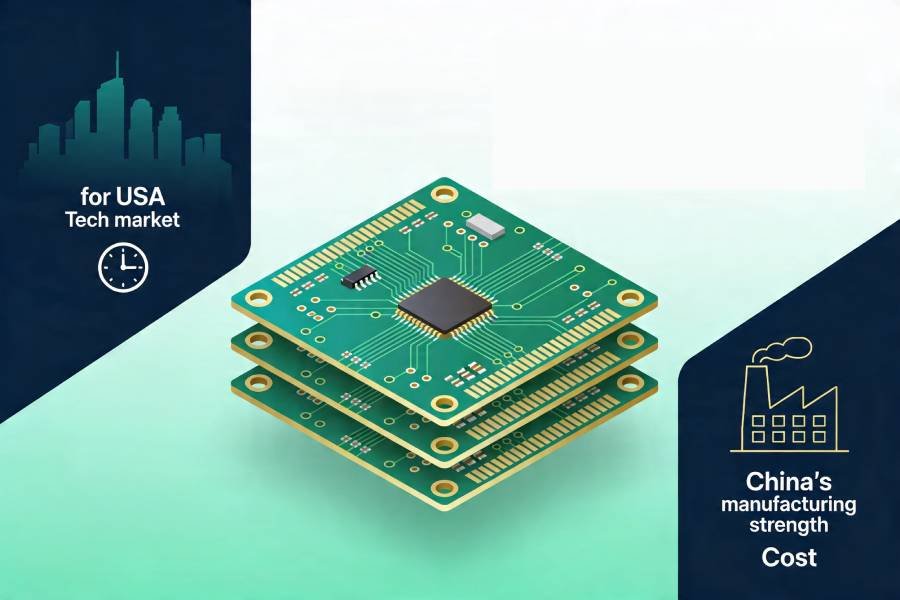
The trade‑off is rarely as simple as “USA is fast, China is cheap.” You also have to consider stackup complexity, quantity, logistics, and how often you expect to respin your multilayer design. In this article, we will clarify what “quick‑turn” really means for multilayer PCBs, explain where to buy quick‑turn multilayer PCBs in the USA and China, and show how to choose between domestic suppliers and export‑focused manufacturers like PCBELEC for prototypes, small batches, and production runs.
What “Quick-Turn” Really Means for Multilayer PCBs
Before you decide where to order, it is important to align expectations on what “quick‑turn” actually covers for multilayer PCBs. A realistic quick‑turn for a simple 4‑layer prototype is very different from a realistic quick‑turn for a dense 8‑layer HDI board with controlled impedance and via‑in‑pad.
Typical Quick-Turn Lead Time Tiers
Across both U.S. and China‑based suppliers, multilayer quick‑turn services usually fall into a few broad tiers:
- Express prototypes (often 24–72 hours fabrication):
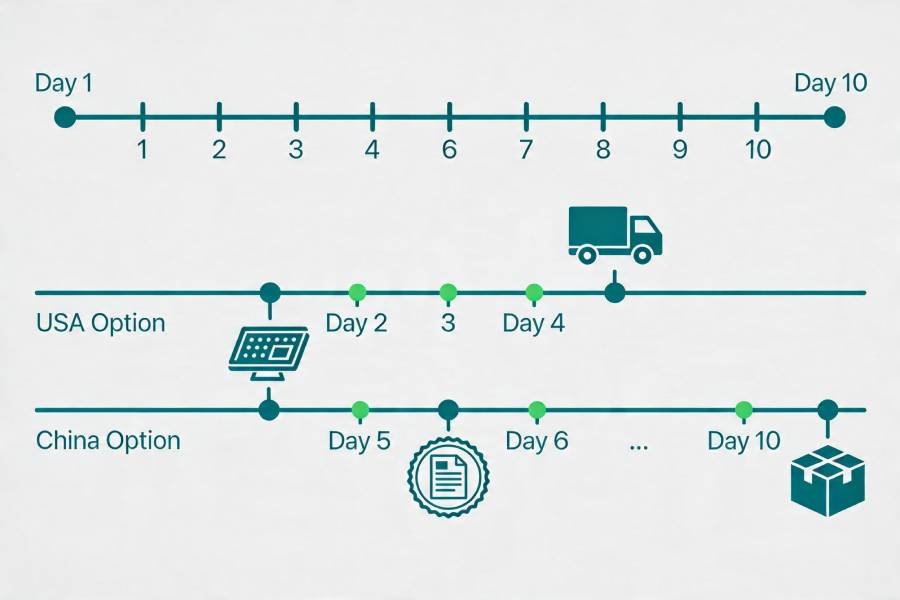
Common for standard 4‑layer boards with moderate complexity and no exotic materials. In the USA, this can translate into 2–4 days door‑to‑door including domestic shipping; from China, fabrication might be similarly fast, but total time stretches to roughly 5–10 days once express air freight and customs are included. - Fast engineering builds (about 3–7 working days fabrication):
Suitable for more complex 4‑layer and 6‑layer designs, and small batches of multilayer PCBs. In many comparisons, U.S. manufacturers quote 3–7 days plus local shipping, while China‑based factories quote similar fabrication windows plus several days of international transit. - Standard production (2–4 weeks or more):
For larger orders, higher layer counts, or advanced stackups, lead times naturally extend, especially when you add PCB assembly or special testing. At this stage, the difference between “quick‑turn” and “standard” is more about how high your order sits in the priority queue than about absolute process speed.
When vendors advertise “quick‑turn multilayer PCB services,” it is worth checking which tier they are referring to, and whether those timelines include shipping to your location or only bare fabrication time.
Key Factors That Affect Quick-Turn Lead Time
Several technical and logistical factors can stretch or shrink your effective quick‑turn window, regardless of whether you buy in the USA or China:
- Layer count and stackup complexity:
Higher layer counts, multiple lamination cycles, and hybrid stackups take longer to process than straightforward 4‑layer boards. - Via technology:
Blind/buried vias, microvias, and via‑in‑pad all add drilling and plating steps and may limit which lines can accept your job on a true “rush” basis. - Controlled impedance and tight tolerances:
Demanding impedance specs, very fine trace/space, or unusual thicknesses can reduce process margin and require additional engineering checks, which can extend lead times. - Panel utilization and quantity:
Small prototype quantities are easy to slot into existing production schedules; large or awkward panel sizes may need dedicated setups and longer runs. - Shipping and customs:
For U.S. orders, domestic carriers and no customs clearance keep logistics simple. For China‑to‑USA shipments, even the fastest couriers add several days for transit and border procedures.
Where to Buy Quick-Turn Multilayer PCBs in the USA
If you are based in the United States and speed is your top priority, buying quick‑turn multilayer PCBs from domestic suppliers is often the most straightforward option. You avoid customs, shorten shipping time, and can usually get a human on the phone in the same time zone when something changes at the last minute.
Local Quick-Turn PCB Fabricators
Some of the best‑known U.S. multilayer PCB manufacturers offer dedicated quick‑turn services for 4‑layer and 6‑layer PCBs, sometimes extending to 8‑layer and beyond. Typical offerings include:
- 24–72 hour fabrication for standard multilayer prototypes that fit well‑defined design rules.
- 3–5 working days for more complex multilayer stackups or small‑batch builds.
- Online quoting tools combined with direct access to CAM and process engineers during U.S. business hours.
For time‑critical engineering builds, this can translate into 2–4 days door‑to‑door when you factor in domestic shipping. Local fabricators are particularly attractive when you need:
- Very fast feedback on DFM issues.
- The ability to tweak designs between spins with minimal communication overhead.
- Confidence that boards will arrive in time for a scheduled lab slot, demo, or customer meeting.
Online U.S.-Based Ordering Platforms
In addition to traditional fabricators, there are also U.S.-based online platforms that combine web ordering with domestic manufacturing. These services typically allow you to:
- Upload Gerber or ODB++ files for instant pricing on 4‑layer and 6‑layer PCBs.
- Select from predefined quick‑turn lead times (for example, 1‑day, 3‑day, 5‑day fabrication).
- Track orders and receive status updates without long email threads.
While their pricing is usually higher than offshore options, they are ideal when you want e‑commerce convenience plus domestic speed and support for multilayer prototypes.
When a U.S. Quick-Turn Supplier Is the Best Choice
In practice, U.S.-based quick‑turn multilayer PCB suppliers are often the right choice when:
- You need the fastest possible turnaround for a multilayer prototype and cannot afford extra days of international transit.
- Your project requires close collaboration and same‑day engineering communication, such as during intense bring‑up or debug phases.
- There are regulatory, security, or IP concerns that make domestic fabrication preferable for early hardware, even at higher cost.
At later stages—or when cost pressure grows—you can then compare these domestic options with China‑based quick‑turn multilayer PCB manufacturers, such as PCBELEC, to see whether a slightly longer shipping time may be acceptable in exchange for much lower per‑unit cost. That is what we will look at next.
Where to Buy Quick-Turn Multilayer PCBs in China
When you need multilayer PCBs with reasonable turnaround and much lower cost, buying from China‑based manufacturers becomes very attractive. China’s PCB industry is optimized for volume and efficiency, and many factories now offer dedicated quick‑turn services for 4‑layer, 6‑layer, and higher‑layer‑count boards aimed at international customers.
Specialized Multilayer PCB Manufacturers (Like PCBELEC)
A first option is to work directly with a specialized multilayer PCB manufacturer that focuses on export business, such as PCBELEC. These suppliers typically provide:
- Strong capabilities for standard and complex multilayer stackups (4‑layer, 6‑layer, 8‑layer and above), including controlled impedance and various via structures.
- Quick‑turn windows for multilayer prototypes and small batches—often as fast as a few working days for fabrication, plus express shipping.
- Engineering support, DFM review, and English‑language communication tailored to U.S. and European customers.
For example, a China‑based multilayer PCB supplier may quote 3–5 days to build a 4‑ or 6‑layer prototype, with total door‑to‑door times of around 5–10 days when you add express air freight and customs. This is not as fast as a same‑country U.S. quick‑turn, but the price difference can be substantial, especially once quantities grow.
Large Online PCB Platforms Based in China
Another popular route is to order multilayer PCBs from large online PCB platforms headquartered in China. These services usually offer:
- Web‑based instant quoting for 4‑layer and 6‑layer PCBs, with selectable lead‑time tiers (for example, 24‑hour, 48‑hour, 3‑day fabrication).
- Standardized design rules and stackups that make it easy to place repeat orders once your design is stable.
- Very competitive per‑unit pricing, especially for small and medium runs.
Their main trade‑offs are:
- Less customized engineering interaction than you might get from a smaller, specialized shop.
- Reliance on online ticket systems and documentation rather than phone calls.
- The same international shipping and customs realities that any China‑to‑USA order faces.
For many projects, these platforms are an excellent way to prototype and ramp up multilayer PCBs at low cost, provided your designs fit their standard capabilities.
Typical Lead Times When Ordering from China
Across both specialized manufacturers and large platforms, the realistic quick‑turn pattern for multilayer PCBs shipped to the USA looks like this:
- Fabrication:
- Simple 4‑layer and 6‑layer boards: about 1–3 working days for quick‑turn slots.
- More complex multilayer stackups: around 3–7 working days, depending on requirements.
- Shipping and customs:
- Express air freight: typically 3–7 days door‑to‑door, depending on carrier, destination, and customs handling.
Putting this together, total quick‑turn door‑to‑door time from China for multilayer PCBs is usually in the 5–10 day range, which many teams find acceptable for most prototypes and small‑batch runs—especially given the cost savings compared with domestic fabrication.
When a China-Based Quick-Turn Supplier Is the Best Choice
China‑based quick‑turn multilayer PCB suppliers tend to be the best fit when:
- Your schedule can tolerate a few extra days for shipping in exchange for much lower board costs.
- You need to build multiple multilayer prototype spins or small batches within a fixed budget.
- You plan to scale from prototypes to volume with the same supplier, avoiding re‑qualification later.
- Your design is not constrained by ITAR or strict on‑shore production requirements.
In these situations, working with an export‑oriented multilayer PCB manufacturer like PCBELEC lets you combine quick‑turn multilayer capability with China’s cost and capacity advantages, while still getting the communication and quality systems you expect for international projects.
Cost and Lead Time Trade-Offs: USA vs China for Quick-Turn Multilayer PCBs
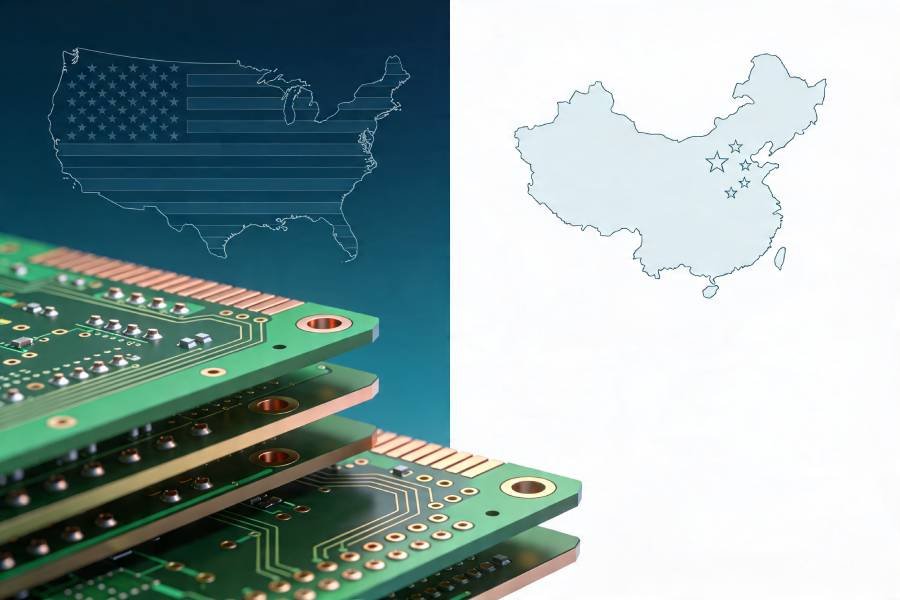
By now, the pattern should be clear: U.S. suppliers usually win on speed, China‑based suppliers usually win on cost. For quick‑turn multilayer PCBs, the right choice depends on how you trade off a few days of schedule vs potentially large differences in price.
Side-by-Side Snapshot
The table below summarizes typical cost and lead‑time differences for quick‑turn multilayer PCBs ordered by U.S. customers:
| Factor | U.S. Quick‑Turn Multilayer Manufacturer | China‑Based Quick‑Turn Multilayer Manufacturer |
|---|---|---|
| Fabrication time (4–6 layer proto) | Often 1–3 working days for express jobs. | Often 1–3 working days for quick‑turn slots. |
| Shipping to U.S. customer | 1–2 days via domestic carriers, no customs. | 3–7 days via express air freight plus customs. |
| Typical door‑to‑door time (proto) | ~2–4 days for many multilayer prototypes. | ~5–10 days door‑to‑door for most quick‑turn multilayer orders. |
| Unit price (4–6 layer) | Highest; multiple comparisons show significantly higher pricing than offshore, especially at volume. | Lowest; many analyses report 40–80% lower PCB prices for similar multilayer boards, even after freight and some tariffs. |
| Best fit | Time‑critical prototypes, regulated/on‑shore projects, intense debug cycles. | Cost‑sensitive prototypes and small batches, repeated multilayer spins, and production ramps. |
How to Decide for Each Project Stage
A useful way to think about USA vs China for quick‑turn multilayer PCBs is by project stage rather than one‑off orders:
- Early bring‑up / first prototypes:
- If you are facing a hard deadline (investor demo, trade show, customer pilot), U.S. quick‑turn suppliers give you the best chance of hitting dates.
- If you have a bit more schedule flexibility and need to stretch your budget across several spins, a China‑based multilayer manufacturer can provide more iterations for the same money.
- Design refinement / DVT (multiple multilayer spins):
- Once the design is mostly stable, cost efficiency becomes more important than shaving every day off each turn.
- Many teams prototype the first revision domestically, then move subsequent spins to a cost‑effective China‑based supplier like PCBELEC to run more experiments and validation builds at lower cost.
- Pilot runs and production:
- For commercial and industrial products without on‑shore requirements, China’s pricing and capacity are often decisive for 4‑layer, 6‑layer, and higher‑layer‑count boards.
- For regulated, defense, or highly sensitive products, many companies keep production with U.S. multilayer PCB manufacturers even if the unit cost is higher.
What to Look for in a Quick-Turn Multilayer PCB Supplier
Whether you buy in the USA or China, the best quick‑turn multilayer PCB supplier is the one that can actually build your stackup reliably, on time, and at a cost that fits your product. Instead of chasing the lowest headline lead time or unit price, it helps to evaluate suppliers against a few concrete criteria.
Technical Capability and Supported Stackups
First, make sure the supplier’s technical capabilities match your design. For quick‑turn multilayer PCBs, you should check:
- Maximum and typical layer counts they support in quick‑turn windows (for example, 4‑layer and 6‑layer as standard, 8‑layer and above on request).
- Available standard stackups with defined dielectric thicknesses and material types for controlled impedance.
- Supported via technologies (through‑holes only vs blind/buried vias, microvias, via‑in‑pad) and corresponding design rules.
- Minimum trace/space, drill sizes, and copper thickness that can be delivered reliably in a quick‑turn context.
If your design uses non‑standard materials or complex HDI structures, it is especially important to confirm that they are truly within the supplier’s quick‑turn comfort zone rather than treated as experimental.
Quality Control, Testing, and Certifications
Speed is not much use if boards arrive with hidden defects. For any quick‑turn multilayer PCB partner, look for clear information about:
- In‑process inspection: Inner‑layer AOI, solder mask inspection, and registration checks.
- Electrical testing: Flying‑probe or fixture‑based 100% net testing for multilayer boards.
- Final inspection and packaging: How they protect boards during shipping to avoid mechanical damage or contamination.
- Certifications: ISO 9001, UL recognition for materials, and industry‑specific standards where relevant.
Many China‑based multilayer manufacturers that serve international customers, including PCBELEC, explicitly highlight their quality systems and test coverage for export work, which is a good sign that quick‑turn does not mean “cutting corners.”
Transparent Lead Times and Realistic Promises
Genuine quick‑turn suppliers are transparent about what they can and cannot do quickly. When evaluating options, pay attention to:
- Whether published lead times are clearly tied to specific board types (for example, “up to 6 layers, standard FR‑4, no special materials”).
- How they handle holidays, capacity peaks, and complex stackups—do they caveat timelines or promise the same turnaround for every order?
- Whether quoted times include shipping to your location or only fabrication.
Suppliers that give conservative, realistic estimates usually cause fewer unpleasant surprises than those with aggressive marketing numbers and fine print.
Communication and DFM Support
Finally, quick‑turn works best when communication is smooth. A good multilayer PCB supplier should:
- Provide DFM checks and flag manufacturability issues before production, especially for unusual stackups or tight design rules.
- Offer clear channels for engineering questions—email, ticket system, or direct contact with CAM/engineering staff.
- Be willing to suggest cost and lead‑time optimizations, such as using standard stackups or slightly relaxing tolerances, without compromising performance.
This is an area where specialized export‑oriented manufacturers like PCBELEC often differentiate themselves from purely web‑only platforms: they combine competitive pricing with accessible engineering support for international customers.
How PCBELEC Fits into Your Quick-Turn Strategy
In the landscape of quick‑turn multilayer PCB suppliers, PCBELEC positions itself as a China‑based, export‑oriented manufacturer that combines strong multilayer capabilities with realistic lead times and competitive pricing for U.S. and European customers. Instead of focusing on ultra‑cheap, low‑touch commodity work, the company targets 4‑layer, 6‑layer, and higher‑layer‑count boards where engineering support and stable quality matter.
Multilayer Quick-Turn Capabilities
PCBELEC’s core business is multilayer PCB fabrication, not just simple 2‑layer boards. For international customers, this typically includes:
- Standard 4‑layer and 6‑layer quick‑turn PCBs, with stackups suitable for controlled impedance and high‑speed digital designs.
- Higher‑layer‑count options for more demanding applications, depending on design rules and order size.
- Quick‑turn fabrication windows that can be as short as a few working days for typical multilayer prototypes, followed by express shipping to the USA or Europe.
For many teams, this combination of multilayer focus and practical quick‑turn options makes PCBELEC a natural candidate for second and subsequent prototype spins, as well as small‑batch builds that bridge the gap between lab validation and production.
Cost-Effective for Repeated Multilayer Spins and Small Batches
Because PCBELEC operates in China’s mature PCB ecosystem, it can offer significantly lower pricing than most U.S. manufacturers for multilayer PCBs, especially once you move beyond the very first prototype. This is particularly useful when:
- You expect to run several rounds of multilayer prototypes to tune stackups, routing, or power integrity.
- You need small‑ to medium‑volume batches of 4‑layer or 6‑layer boards for pilots, internal tools, or low‑to‑mid‑volume products.
- Your schedule can accommodate 5–10 days door‑to‑door for quick‑turn orders from China.
In these scenarios, PCBELEC allows you to stretch the same prototyping budget across more multilayer iterations, or to move early production into a more sustainable cost structure than domestic quick‑turn pricing typically allows.
Engineering Support and Export-Focused Service
Unlike fully anonymous web‑only platforms, PCBELEC emphasizes engineering‑driven service for overseas customers. In practice, this means:
- Pre‑production DFM checks on multilayer stackups, clearances, and drill structures before fabrication.
- English‑language communication via email or messaging for clarifying technical details and resolving questions quickly.
- Familiarity with common design file formats (Gerber, ODB++, IPC‑2581) used by U.S. and European teams.
- Experience shipping multilayer PCBs internationally, with packaging and logistics tuned to protect boards in transit.
For many hardware teams, this combination—China‑level cost and capacity, plus export‑oriented communication and quality systems—is exactly what they want from a quick‑turn multilayer partner.
Practical Ordering Scenarios (Prototype to Production)
Seeing how other teams structure their quick‑turn multilayer PCB orders can make the USA vs China choice much easier to apply in your own projects. Below are three practical scenarios that show how U.S. suppliers and a China‑based manufacturer like PCBELEC can fit together from first prototype to production.
Scenario A: Hard Deadline, First Prototype in the USA, Then Shift to PCBELEC
In this scenario, you have an upcoming demo, investor meeting, or trade show, and the date is fixed.
- Step 1 – First multilayer prototype in the USA:
- Order a 4‑layer or 6‑layer quick‑turn PCB from a local U.S. manufacturer, aiming for 24–72 hour fabrication and 2–4 days total delivery.
- Use the boards to validate core functionality, mechanical fit, and basic performance in time for the event.
- Step 2 – Refinement spins and small batches at PCBELEC:
- Once the design is proven but still evolving, move subsequent multilayer spins and small batches to PCBELEC.
- Accept a 5–10 day door‑to‑door window in exchange for significantly lower pricing per spin and per board.
This approach lets you hit the first deadline using U.S. speed, then leverage China‑based cost advantages for the more iterative stages that follow.
Scenario B: Budget-Constrained Development with Flexible Dates
Here, your schedule has some flexibility, but your budget is tight and you know you will need multiple multilayer prototype spins.
- Step 1 – Start directly with PCBELEC for multilayer prototypes:
- Share your intended 4‑layer or 6‑layer stackup with PCBELEC, get DFM feedback and a quick‑turn quote.
- Plan around a 5–10 day door‑to‑door quick‑turn cycle for each spin.
- Step 2 – Use savings to fund more iterations:
- Because each multilayer spin costs substantially less than a domestic quick‑turn build, you can afford more iterations within the same budget.
- This is especially useful for fine‑tuning signal integrity, power distribution, or thermal behavior on complex boards.
In this scenario, you trade a few extra days of shipping time for better coverage of the design space, which often leads to a more robust final product.
Scenario C: Mixed Portfolio – Regulated Projects in the USA, Commercial Projects with PCBELEC
Many companies have a mixed portfolio: some projects are regulated or strategically sensitive, while others are purely commercial.
- Regulated / high‑sensitivity projects:
- Keep multilayer PCB fabrication with U.S. manufacturers that hold relevant certifications and support ITAR or other compliance requirements.
- Use domestic quick‑turn services for both prototypes and production to simplify audits and risk management.
- Commercial and industrial projects:
- Use PCBELEC as the main supplier for multilayer PCBs, from early prototypes through small‑ and medium‑volume production.
- Maintain a smaller U.S. quick‑turn relationship as a backup for truly time‑critical emergency builds.
This hybrid approach lets you apply the right sourcing strategy to each project, instead of forcing all designs into a single model.
Conclusion – Build a Quick-Turn Sourcing Plan, Not Just a One-Off Order
Where you buy quick‑turn multilayer PCBs should be guided by a simple question: what does this specific project need most right now—speed, cost efficiency, or regulatory comfort? U.S. manufacturers are hard to beat for the very fastest, most collaborative multilayer prototypes and for regulated, on‑shore work. China‑based suppliers, especially export‑oriented multilayer specialists like PCBELEC, excel when you need to control cost, support multiple iterations, or scale into production without sacrificing technical capability.
Instead of treating each order as a standalone decision, consider building a repeatable quick‑turn sourcing plan: use domestic suppliers when deadlines or regulations demand it, and use PCBELEC for cost‑effective multilayer prototypes, small batches, and production runs where a 5–10 day door‑to‑door cycle is acceptable. If you share your current multilayer PCB requirements—stackup, quantities, and target dates—with PCBELEC, you can get a no‑obligation quote and lead‑time proposal that make it much easier to compare against local options and choose the mix that works best for your team.