
Table of Contents
BGA assemblies are challenging to inspect because many of the most important solder-joint defects are hidden underneath the package. That means no single inspection method can give you the full picture, especially when you need to balance speed, cost, and defect coverage.
AOI, X-Ray, and Boundary Scan each solve a different part of the problem. AOI is best for surface-level defects, X-Ray is designed to reveal hidden solder-joint issues, and Boundary Scan helps verify electrical interconnects that are difficult to access physically.
In this article, we will compare these three BGA inspection methods side by side and explain what each one can detect, where each one falls short, and when it makes the most sense to use them together. If you are choosing an inspection strategy for a new design or evaluating your current quality-control flow, this comparison will help you make a more informed decision.
AOI in BGA Inspection
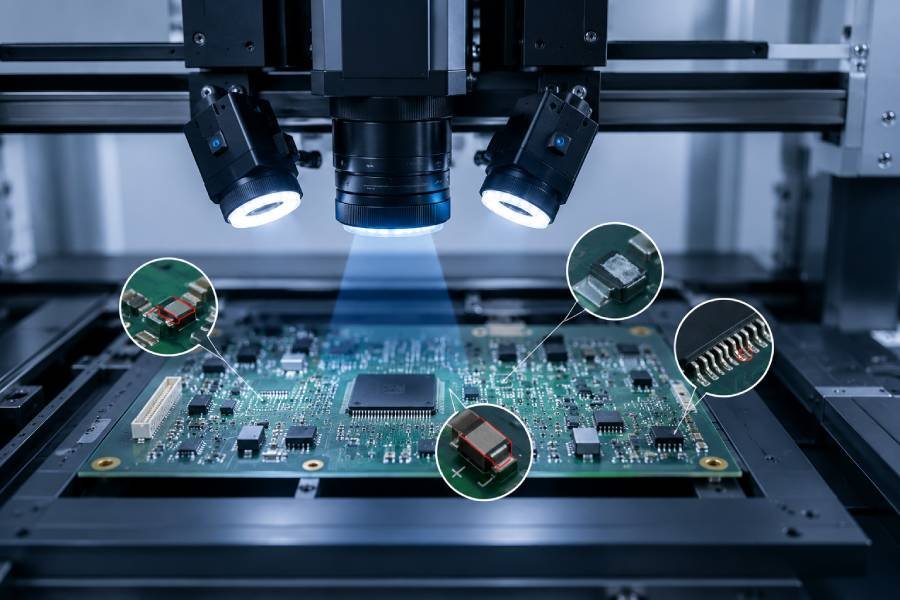
Automated Optical Inspection, or AOI, is usually the first line of defense in PCB assembly inspection. It uses high-resolution cameras, controlled lighting, and image-processing software to scan the board surface and compare it against a reference standard, looking for visible assembly defects.
For BGA-related assemblies, AOI is especially useful for catching surface-level problems such as missing components, incorrect placement, polarity errors, solder bridges, and other obvious placement defects. It is fast, scalable, and well suited for production lines where quick feedback matters.
The main limitation of AOI is simple: it can only inspect what it can see. Because the solder joints of a BGA are hidden underneath the package, AOI cannot directly evaluate hidden joints, voids, or internal solder defects, which means it must be paired with other methods when BGA reliability is critical.
In practice, AOI works best as a surface-quality filter rather than a complete BGA inspection solution. It helps catch visible defects early, reduce downstream rework, and improve line efficiency, but it should not be treated as a substitute for X-Ray or Boundary Scan when the design requires deeper verification.
X-Ray in BGA Inspection
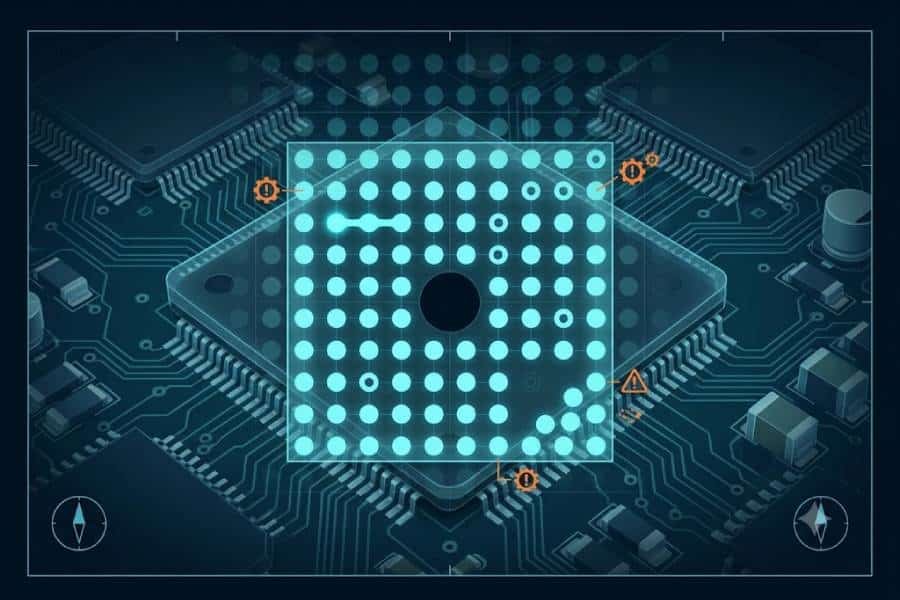
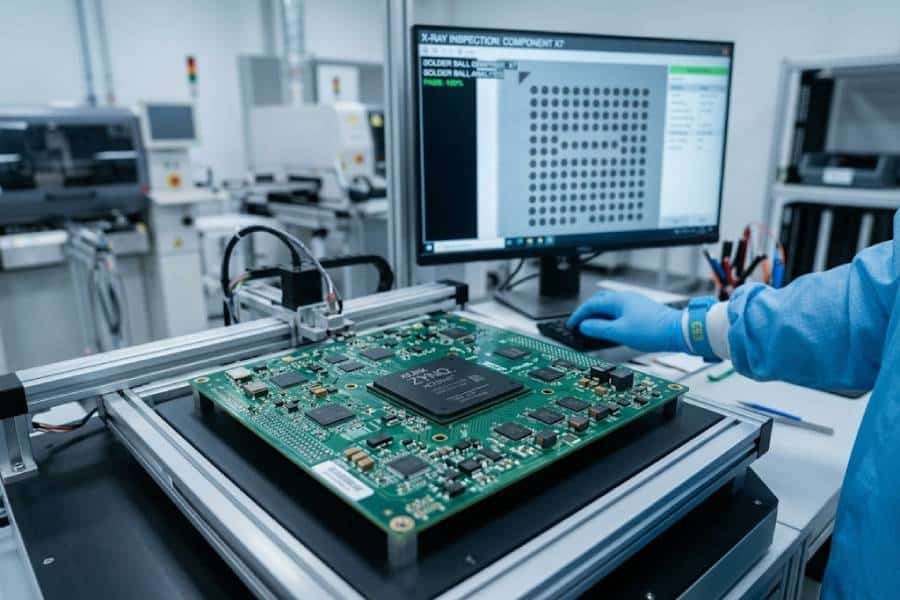
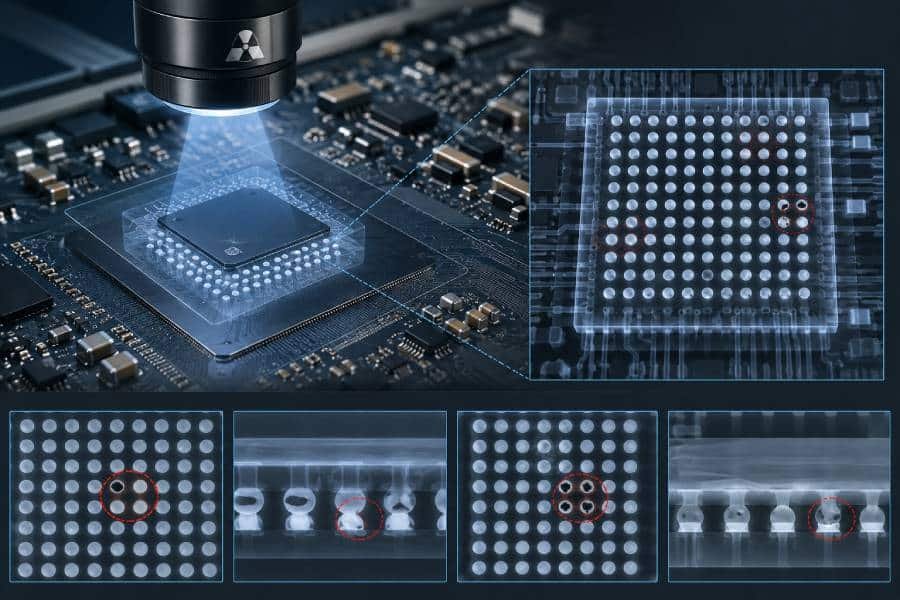
X-Ray inspection is the preferred method when you need to verify what AOI cannot see: the hidden solder joints underneath a BGA package. By passing X-rays through the assembly, the system creates a non-destructive image of the internal joint structure, allowing inspectors to evaluate solder ball shape, alignment, voiding, and other concealed defects.
For BGA assemblies, this matters because many of the most serious failure modes are invisible from the outside. X-Ray can help reveal voids, head-in-pillow defects, incomplete wetting, solder cracks, and other internal abnormalities that would normally escape visual inspection.
X-Ray is not, however, a universal solution. It is typically more expensive than AOI, may require more setup time, and still depends on skilled interpretation, especially when the image contrast is weak or the defect is subtle.
In practice, X-Ray works best as a deeper verification step for high-density or high-reliability designs. AOI is usually the fast surface filter, while X-Ray provides the internal confirmation needed to judge the quality of hidden BGA joints.
Boundary Scan in BGA Inspection
Boundary Scan is an electrical test method used to verify interconnections on PCBs without needing direct physical access to every solder joint. It relies on JTAG/IEEE 1149.1-compliant devices, which include built-in boundary-scan cells that can drive and capture signals at the pin level.
For BGA assemblies, this makes Boundary Scan especially useful when the solder joints are hidden and cannot be probed easily. It can help detect opens, shorts, and other interconnect faults on scan-enabled digital nets, making it a powerful complement to AOI and X-Ray.
The limitation is that Boundary Scan tests electrical connectivity, not the physical appearance of the solder joint. It also depends on device support and good test design, so it cannot replace visual or radiographic inspection when you need to evaluate solder quality directly.
In practice, Boundary Scan is most valuable in complex boards with BGAs, fine-pitch devices, and limited probe access. When used together with AOI and X-Ray, it helps close the test coverage gap by checking what the other two methods cannot reliably confirm.

Comparison of the Three Methods
AOI, X-Ray, and Boundary Scan do not compete for the same job; they solve different inspection problems at different stages of the assembly process. AOI is strongest for visible surface defects, X-Ray is strongest for hidden BGA solder-joint analysis, and Boundary Scan is strongest for electrical interconnect testing when physical access is limited.
| Method | Best at | Main limitation | Typical role in BGA inspection |
|---|---|---|---|
| AOI | Detecting missing parts, misalignment, polarity errors, and solder bridges on the board surface | Cannot see hidden BGA joints | Fast inline surface screeningseamarkzm+1 |
| X-Ray | Revealing voids, cracks, head-in-pillow, incomplete wetting, and other hidden solder defects | Higher cost and slower setup than AOI | Deep inspection of BGA solder qualityallpcb+2 |
| Boundary Scan | Checking opens, shorts, and net connectivity on scan-enabled digital interconnects | Depends on device support and does not show physical joint quality | Electrical test for hard-to-probe BGAscorelis+3 |
In most production flows, AOI is the first pass, X-Ray is the deeper physical verification step, and Boundary Scan fills the electrical coverage gap. That combination gives the broadest coverage because no single method can fully evaluate both visible assembly quality and hidden BGA reliability.
Selection Guidance
The right choice depends on what you are trying to verify, how much access you have, and how much test coverage you need. AOI is the best starting point for visible surface defects, X-Ray is the right choice for hidden BGA solder-joint quality, and Boundary Scan is most useful for electrical interconnect testing on scan-enabled digital devices.
Use AOI when
- You need fast inline screening of every board.
- The main risk is missing parts, misalignment, polarity errors, or solder bridges.
- You want a cost-effective first-pass inspection method for surface-level defects.
Use X-Ray when
- The design includes BGAs or other packages with hidden solder joints.
- You need to evaluate voids, incomplete wetting, head-in-pillow, or other internal solder issues.
- Reliability is critical enough to justify slower inspection and higher equipment cost.
Use Boundary Scan when
- Physical probing is difficult because the board is dense or BGAs block access.
- The product includes JTAG-compliant digital devices and you want to test opens, shorts, and net connectivity.
- You want to improve DFT and expand structural test coverage beyond visual inspection.
Best combined approach
For most BGA assemblies, the best strategy is not to choose one inspection method, but to combine them in a way that matches the defect risk at each stage. AOI handles fast surface screening, X-Ray verifies hidden solder-joint quality, and Boundary Scan adds electrical coverage for scan-enabled digital nets.
A practical production flow is to use AOI on every board first, because it is the fastest and most cost-effective way to catch visible placement and solder issues. Then use X-Ray selectively on BGAs and other hidden-joint components, especially when voiding, incomplete wetting, or head-in-pillow risk matters.
Boundary Scan works best as a design-for-test layer rather than a late-stage inspection patch. If the board includes JTAG-compliant devices, plan Boundary Scan early so it can complement AOI and X-Ray instead of trying to replace them after layout is already frozen.
In high-volume consumer products, the most efficient mix is often AOI plus selective X-Ray on critical parts. In high-reliability or dense BGA designs, the stronger choice is AOI plus X-Ray plus Boundary Scan, because that combination covers visible defects, hidden joint defects, and electrical interconnect faults together.
A good rule is simple: use AOI for breadth, X-Ray for depth, and Boundary Scan for connectivity. Together, they create a more complete inspection strategy than any one method can provide alone.
Conclusion
No single inspection method can fully cover every BGA risk, which is why the most effective quality strategy is usually a combination of AOI, X-Ray, and Boundary Scan. AOI gives you fast surface screening, X-Ray reveals hidden solder-joint defects, and Boundary Scan strengthens electrical test coverage where physical access is limited.
If your goal is efficient production, start with AOI and add X-Ray for BGA-critical joints. If your design supports JTAG, Boundary Scan should be planned early so it can complement the other methods instead of being added too late.
The best choice depends on board complexity, defect risk, and reliability target. For most BGA assemblies, the strongest answer is not “AOI or X-Ray or Boundary Scan,” but “AOI plus X-Ray plus Boundary Scan” in the right balance for the product.