
Table of Contents
As electronic products continue to shrink while performance demands keep rising, PCB assembly has to support denser component layouts and more complex interconnects. That is one reason BGA assembly has become such an important process in modern electronics manufacturing, especially for devices that need high connection density, short electrical paths, and stable thermal performance.
BGA assembly is not just about attaching a component to a board. It is a precision process that affects electrical reliability, manufacturing yield, and long-term product performance, which is why understanding the package itself is the right place to start.
What Is a BGA?
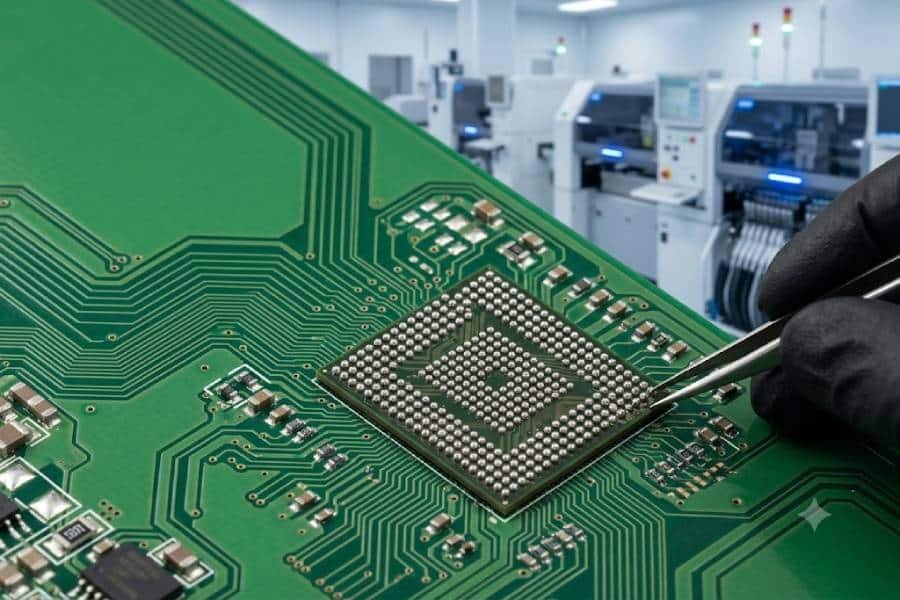
A Ball Grid Array, or BGA, is a type of surface-mount package that uses a grid of solder balls on the underside of the component to connect it to the PCB. Instead of placing leads only around the outer edge of the package, a BGA uses the entire bottom surface for interconnection, which allows for more I/O connections in a smaller footprint.
This package structure offers several practical advantages. It supports higher pin counts, shorter electrical pathways, better high-speed performance, and improved thermal characteristics, which is why BGAs are widely used in microprocessors, memory devices, chipsets, and other high-performance ICs.
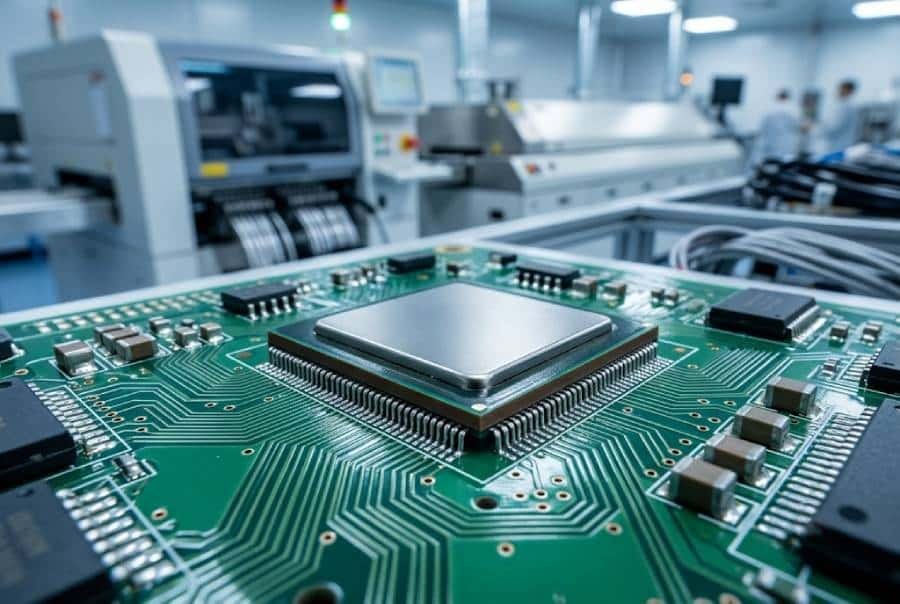
In assembly, BGA components are typically mounted using a controlled reflow soldering process, where the solder balls melt and form joints with the PCB pads. Because the solder joints are hidden beneath the package, accurate process control and proper inspection are especially important for reliable results.
What Is BGA Assembly?
BGA assembly is the process of mounting a Ball Grid Array component onto a printed circuit board using a controlled solder reflow process. In this process, solder paste is first applied to the PCB pads, the BGA component is placed with precise alignment, and the assembly is then heated so the solder balls melt and form electrical and mechanical connections.
Because the solder joints are located under the package, BGA assembly requires tighter process control than many other SMT assembly operations. Factors such as solder paste volume, placement accuracy, thermal profile, and inspection method all play a direct role in the quality of the finished board.
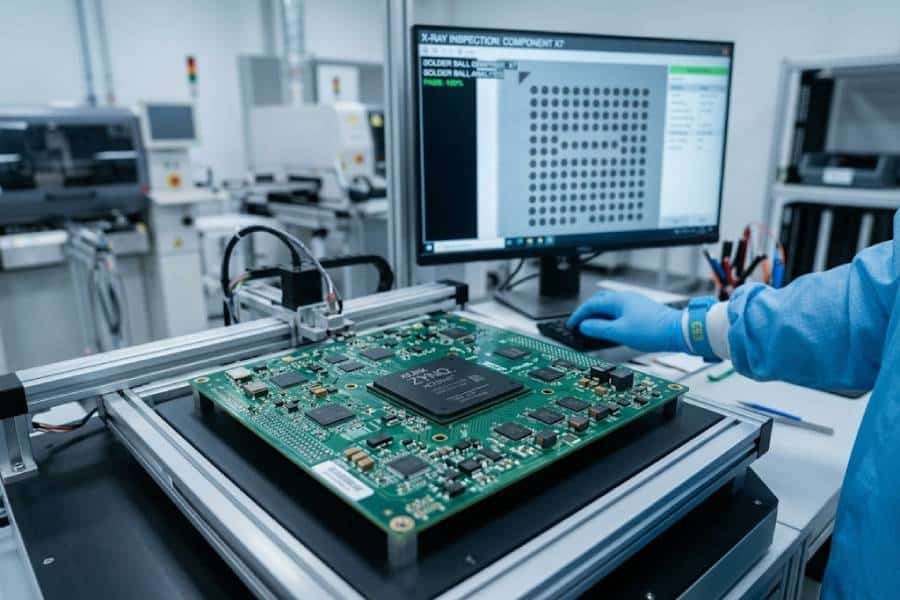
Unlike packages with visible leads around the edge, BGA devices rely on an array of hidden solder connections beneath the component body. That design improves connection density and electrical performance, but it also makes inspection and rework more challenging, which is why x-ray inspection is often used to verify solder joint quality after assembly.
In practical terms, BGA assembly is a precision manufacturing step used when a design needs compact packaging, high pin count, and reliable performance in demanding applications. It is especially common in products where signal integrity, thermal management, and long-term stability matter.
How BGA Assembly Works
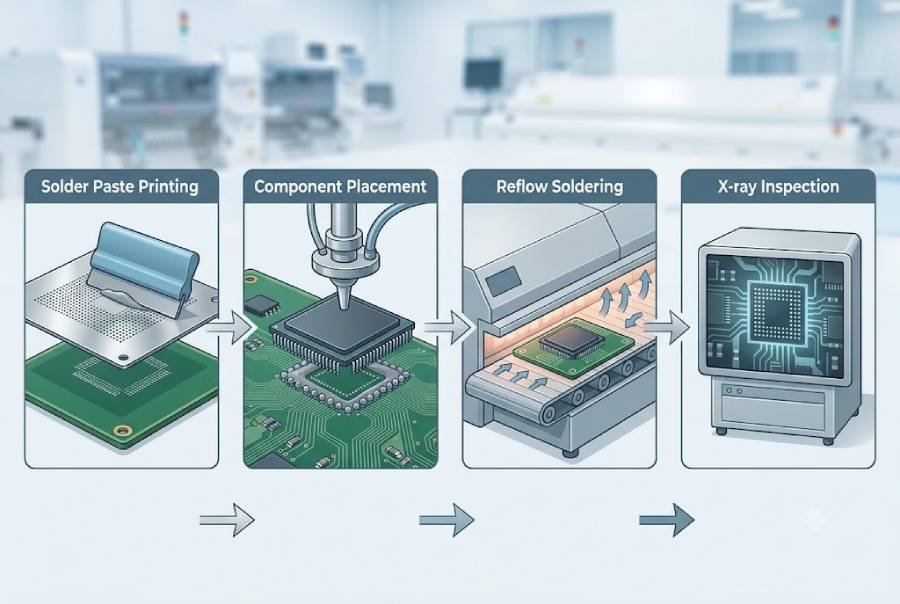
BGA assembly typically begins with solder paste printing. A stencil is used to deposit a controlled amount of solder paste onto the PCB pads, because paste volume and placement accuracy are critical for forming consistent solder joints under the package.
Next, the BGA component is placed onto the solder paste using automated pick-and-place equipment. Since the solder joints will end up hidden beneath the package, precise alignment is essential to ensure that each solder ball lands correctly on its matching pad.
After placement, the board passes through a reflow oven. During this stage, the solder paste and solder balls are heated according to a controlled thermal profile so they melt, wet the pads, and then solidify into permanent electrical and mechanical connections.
Inspection follows the reflow process. Because the solder joints are not visible from the outside, X-ray inspection is commonly used to evaluate joint formation and identify defects such as voids, bridging, or misalignment.
In many production lines, cleaning and functional testing are also included after soldering. These steps help remove flux residue when needed and confirm that the assembled board performs as intended before it moves into the next manufacturing stage.
Why BGA Assembly Matters
BGA assembly matters because it supports the kind of compact, high-performance electronics that modern products require. By using solder balls on the underside of the package, BGA components can accommodate a high number of I/O connections in a small footprint, which is difficult to achieve with many traditional package styles.
It also matters for electrical performance. The short interconnect paths in a BGA package help reduce inductance and improve signal integrity, which is especially valuable in high-speed designs where clean signal transmission is critical.
Thermal performance is another major reason BGA assembly is widely used. Because the package design helps dissipate heat efficiently, BGAs are well suited for processors, memory devices, and other components that generate significant thermal load during operation.
From a manufacturing perspective, BGA assembly enables reliable packaging of complex chips without sacrificing board space. That makes it a practical choice for products where miniaturization, performance, and durability all need to be balanced at the same time.
At the same time, BGA assembly matters because it raises the bar for process quality. The hidden solder joints require tighter control and more advanced inspection, so the assembly process has a direct impact on yield, rework risk, and long-term product reliability.
Common Applications
BGA packages are widely used in consumer electronics such as smartphones, tablets, and laptops because they pack many I/O connections into a small footprint while supporting high-speed interfaces.
Memory devices and microprocessors frequently use BGA packaging to meet high pin counts and thermal requirements common in computing hardware.
Networking and telecommunications equipment adopt BGAs for chipsets and ASICs where signal integrity and density are critical for performance.
Industrial control and instrumentation use BGA-equipped modules when robustness and long-term reliability are required in compact form factors.
Automotive electronics increasingly rely on BGAs for ADAS, infotainment, and powertrain controllers due to their thermal performance and ability to support complex ICs.
High-performance computing systems such as servers and GPUs use BGAs to support very high I/O counts and efficient heat dissipation in demanding workloads.
Common Challenges
One of the biggest challenges in BGA assembly is that the solder joints are hidden beneath the package. This makes visual inspection impossible and means manufacturers must rely on X-ray or other advanced methods to detect defects after reflow.
Another common issue is solder voiding. Voids can form when gas or flux gets trapped during reflow, and excessive voiding can weaken electrical and thermal performance, especially in high-power applications.
Misalignment is also a major concern. If the BGA is not placed accurately on the PCB pads, the result can be open joints, shorts, or poor wetting, all of which can affect board functionality.

Solder bridging can occur when too much solder or improper paste control causes adjacent balls to connect. This creates unintended electrical paths and can lead to immediate short circuits.
Open connections and non-wet joints are another risk. These defects happen when the solder does not properly bond to the pad, which may cause intermittent failures or complete loss of connectivity.
Thermal stress is a long-term challenge as well. Because BGAs are often used in demanding applications, temperature cycling can gradually weaken joints or create cracks, especially if the reflow profile or board design is not well controlled.
Finally, rework and repair are more complicated with BGAs than with many other packages. Since the joints are hidden and the pitch can be very fine, removing or replacing a BGA usually requires specialized equipment, careful thermal control, and post-repair inspection.
How to Improve Assembly Results
Improving BGA assembly results starts with good design for manufacturability. Pad size, pad type, routing strategy, and via treatment all affect how well the solder joints form, so these details should be reviewed early rather than corrected after production begins.
Solder paste printing is another critical step. Using the right stencil thickness, aperture design, and print parameters helps control paste volume, which is important for avoiding voids, bridging, and uneven solder joint formation.
Component placement also needs to be accurate and consistent. Because BGA joints are hidden under the package, precise alignment helps ensure each ball lands on the correct pad and makes use of the package’s natural self-alignment during reflow.
Thermal profile control is one of the most important factors in BGA assembly. The reflow process should follow the component manufacturer’s recommendations so the solder melts properly without overheating the board or creating weak joints.
Inspection should be built into the process, not treated as an afterthought. X-ray inspection is commonly used to confirm solder joint quality, while SPI and other process checks help catch issues earlier and reduce the risk of downstream defects.
Moisture control and storage discipline can also improve results. Proper handling of PCBs and moisture-sensitive components helps prevent popcorning, warpage, and solderability issues during reflow.
Finally, if a design is complex or high-reliability, it is worth involving the assembly partner early. Early collaboration helps align pad design, routing, inspection criteria, and reflow planning before the first build, which usually leads to better yield and fewer surprises.
When to Choose a Professional BGA Assembly Service
A professional BGA assembly service is a smart choice when a design includes fine-pitch BGAs, high pin counts, or other complex components that require tight process control. These projects are more sensitive to placement accuracy, thermal profiling, and inspection quality, so experienced assembly support can reduce defects and improve yield.
Professional support is especially important when the product has strict reliability requirements. Industries such as automotive, industrial control, telecommunications, and high-performance computing often depend on BGA packages, and hidden solder joints make advanced inspection and process discipline essential.
A professional service is also the better choice when DFM guidance is needed early in the project. Experienced assembly partners can review pad design, stencil strategy, routing constraints, and reflow planning before production starts, which helps prevent expensive rework later.
If a board requires X-ray inspection, process documentation, or compliance with customer quality criteria, a dedicated BGA assembly provider is usually the safer option. X-ray-based inspection is widely used to confirm hidden solder joints and to detect issues such as voids, bridging, and misalignment.
Professional assembly is also worth considering when the cost of failure is high. Replacing a board after field failure is usually far more expensive than using a capable assembly partner upfront, especially when BGA rework or repair would otherwise be complex and time-consuming.
Conclusion
BGA assembly plays an essential role in modern electronics because it supports high connection density, strong electrical performance, and efficient thermal behavior in a compact package.
At the same time, the hidden nature of BGA solder joints means that success depends on precise printing, placement, reflow control, and inspection. When those steps are handled well, BGA assemblies can deliver the reliability and performance demanded by advanced products.
For complex boards, high-reliability applications, or projects with tight quality requirements, working with a professional BGA assembly service is often the most practical choice. It helps reduce defects, improve yield, and ensure that the final product meets both technical and commercial expectations.
For projects that require dependable BGA assembly support, a capable manufacturing partner can help turn complex designs into manufacturable, reliable boards.