Table of Contents
Choosing a high frequency PCB manufacturer is very different from picking a standard PCB shop for low‑speed digital designs. At RF, microwave, and mmWave frequencies, small mistakes in material handling, stackup, line width, or impedance control can quickly turn into lost link budget, failed compliance tests, and expensive respins, so “cheapest quote” is almost never the right way to choose a high frequency PCB supplier. This becomes even more important when you are evaluating a high frequency PCB manufacturer in China, where there are many factories on paper that can “do Rogers/PTFE”, but only a subset have the process control and experience to do it reliably for demanding applications.
This article is a practical guide on how to choose a high frequency PCB manufacturer and build a short list of high frequency PCB suppliers that actually match your technical and business needs. We will walk through eight key evaluation criteria—RF and process capabilities, material expertise, stackup and DFM support, quality systems and traceability, RF testing, application experience, communication and lead times, and specific considerations when selecting a high frequency PCB factory or high frequency PCB China supplier. The goal is to give you a clear, engineer‑friendly checklist you can use to compare high frequency PCB manufacturers side by side, so you can move from one‑off prototypes to stable, long‑term partnerships with confidence.
Criterion 1 – RF and High Frequency Process Capabilities
The first step in how to choose a high frequency PCB manufacturer is to verify that they are truly set up for RF, microwave, and mmWave work, not just generic multilayer digital boards. A capable high frequency PCB supplier should be able to show real experience with controlled‑impedance stackups, tight line/space (often 75–100 μm or better), and consistent dielectric thicknesses that support your target frequency range—whether that is sub‑6 GHz, 24–40 GHz, or even 77 GHz and beyond.
When you evaluate a high frequency PCB factory, ask specifically which material families and stackup types they process in production: low‑loss FR‑4 only, Rogers‑FR‑4 hybrids, or full PTFE and ceramic‑filled PTFE builds. In China, for example, some high frequency PCB manufacturers can only handle basic low‑loss FR‑4, while others have proven processes for RO4350B hybrids or full RO3003/RT‑duroid stackups with plasma desmear, sodium etch, and HVLP copper. You should also confirm the level of impedance control they can hold (for instance ±10% vs ±5% or ±3%), whether they routinely build and measure impedance coupons with TDR, and how they monitor impedance and loss consistency across lots.
A practical way to compare high frequency PCB suppliers is to ask for a concise “capability snapshot” covering maximum layer count for RF boards, minimum line/space, supported via types (blind, buried, via‑in‑pad, backdrilled), and the highest frequency bands they have successfully produced for real customers. High‑end high frequency PCB manufacturers will often be able to mention concrete application areas—such as 5G base stations, automotive radar, or satellite communication hardware—along with the materials and frequency ranges they support, giving you confidence that their processes have been tested under conditions similar to your own design.
Criterion 2 – Material Expertise and Inventory (Rogers, PTFE, Low‑Loss FR‑4)
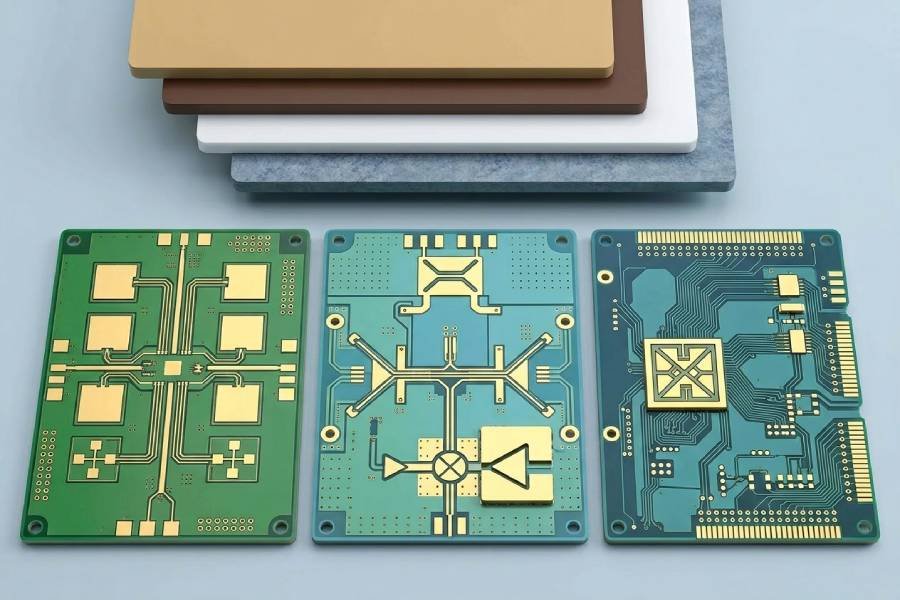
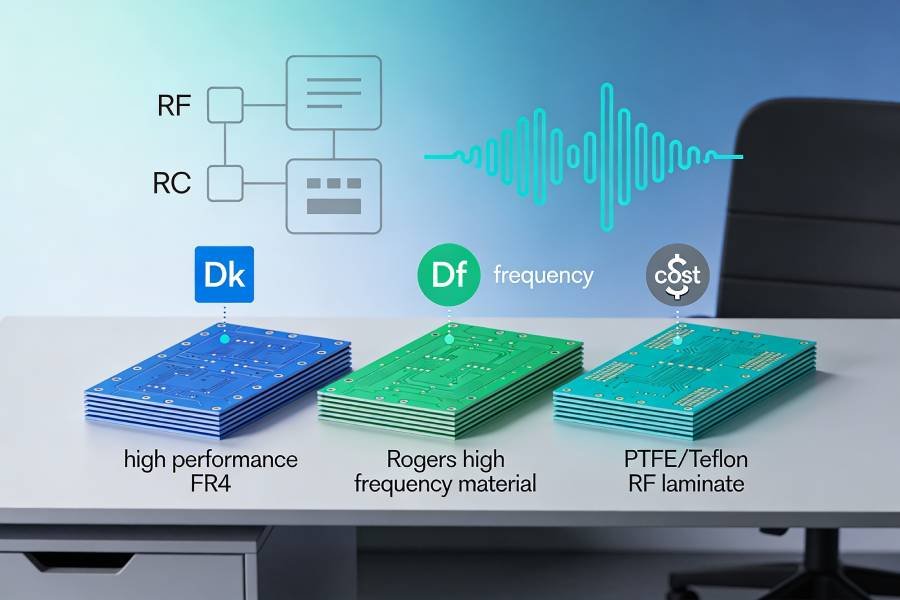
A strong high frequency PCB manufacturer is not just “willing” to buy Rogers or PTFE; they understand which material families make sense for your frequency, environment, and budget. When you evaluate high frequency PCB supplier selection, ask how familiar their engineers are with specific families such as RO4000, RO3000, RT/duroid, Taconic, Arlon, and low‑loss FR‑4, and whether they can explain the trade‑offs in Dk, Df, processing, and cost for your application. A good high frequency PCB supplier should be able to recommend sensible starting materials (for example RO4350B for sub‑6 GHz, RO3003 for 24–40 GHz, RT/duroid‑class laminates for demanding mmWave) rather than simply asking you to specify everything.
Inventory and supply‑chain management is another key differentiator, especially when you are shortlisting a high frequency PCB manufacturer China. Many Chinese high frequency PCB factories now maintain buffer stock of common Rogers materials (such as RO4003C and RO4350B in standard thicknesses and copper weights) and can procure PTFE or specialty laminates through authorized channels, with certificates and lot traceability. This can significantly reduce lead times and minimum order quantities compared to shops that order every RF laminate as a one‑off. When comparing suppliers, ask for a list of their regularly stocked high‑frequency materials, how they store them (temperature/humidity control and shelf‑life management), and how they handle custom procurements for non‑standard thicknesses or copper foils. A high frequency PCB supplier in China who can show strong material partnerships, documented inventory, and flexible procurement is far more likely to support your program smoothly from prototype through volume.
Criterion 3 – Stackup and DFM Support for High Frequency Designs
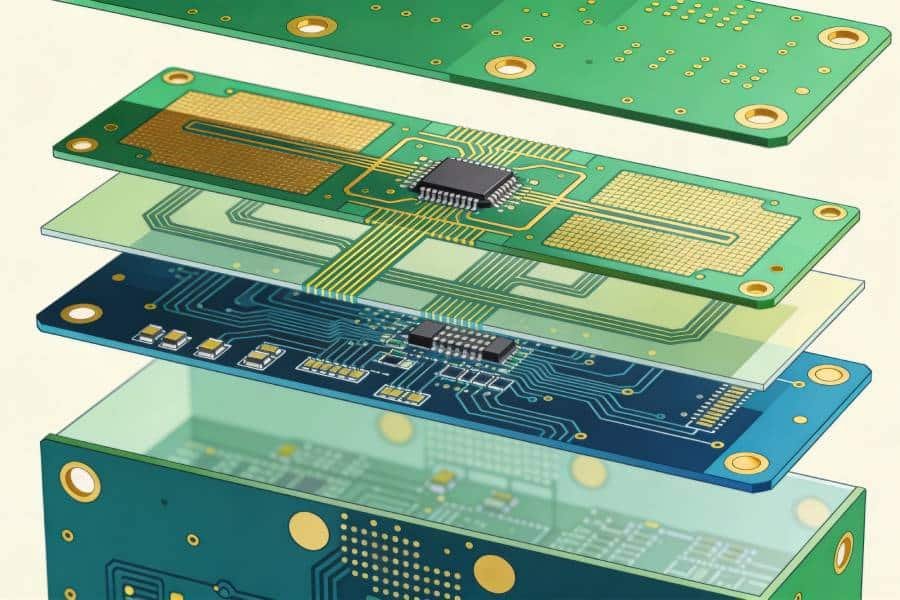
A good high frequency PCB manufacturer does more than “build to print”; they help you get the stackup and layout right before you commit to tooling. When comparing suppliers, ask whether they can propose RF‑friendly stackups (for example, RF microstrip over solid ground, inner stripline layers for high‑speed digital, symmetric plane pairing) and check that their proposals align with high‑frequency best practices, not just generic 4‑layer templates.
Design‑for‑manufacturability (DFM) support is especially important in high frequency PCB supplier selection because many RF layouts that look fine in simulation are difficult or expensive to build reliably. A strong high frequency PCB supplier should offer DFM reviews focused on issues like minimum line/space for your chosen laminate, realistic via sizes and aspect ratios, sensible use of via‑in‑pad and backdrilling, and stackup symmetry to avoid warpage. For customers, a practical test is to send a representative design and see whether the factory simply quotes it, or whether their engineers come back with specific, technically grounded suggestions to improve impedance control, yield, and cost.
Criterion 4 – Quality Systems, Certifications, and Traceability
For mission‑critical RF, microwave, and mmWave designs, you are not just buying copper and laminate—you are buying a quality system. A serious high frequency PCB manufacturer should at minimum be certified to ISO 9001, with additional certifications such as IATF 16949 (automotive), AS9100 (aerospace), and UL where relevant to your end market. If your application is safety‑critical or high‑reliability, check whether they can build to IPC Class 3 or 3A and whether they actually follow IPC‑6012 Class III process controls rather than treating it as a marketing label.
Traceability is another key factor in high frequency PCB supplier selection because small process drifts in lamination, drilling, plating, or backdrilling can directly impact impedance, loss, and long‑term reliability. Ask how the factory tracks materials, work orders, and test results—leading high frequency PCB factories and China suppliers increasingly use MES‑based traceability with unique board IDs, logged press profiles, drill parameters, and impedance or test data tied to each lot. This kind of closed‑loop control makes it far easier to debug any field issues or performance shifts and to ensure that future builds use the same “golden” process window as your qualified prototypes.
Criterion 5 – RF Test, Inspection, and Data Transparency
For high frequency PCB manufacturing, robust RF test and inspection capabilities are just as important as materials and stackup, because they verify that real boards match your simulated performance targets. When you evaluate a high frequency PCB manufacturer, ask specifically what RF and high‑speed tests they can perform in‑house—for example TDR‑based controlled impedance testing on coupons, insertion‑loss and return‑loss measurements using VNA setups, and whether they can support standards such as IPC TM‑650 Delta‑L methods for loss characterization at multi‑GHz frequencies. A mature RF PCB supplier should be able to show typical impedance tolerances they can hold (for instance ±10% as standard and ±5% for tighter high‑speed or RF builds) and provide example TDR or S‑parameter plots that demonstrate process capability on Rogers, PTFE, and hybrid stackups.
Beyond pure RF metrics, you should also look at how the factory handles structural and visual inspection for high frequency layers and features. Leading manufacturers use a combination of AOI for 100% surface coverage of fine lines and pads, X‑ray for sampling critical buried features such as via barrels and BGA pads, and, where applicable, micro‑section analysis to monitor plating thickness, via integrity, and dielectric thickness in controlled‑impedance layers. The best high frequency PCB suppliers do not treat inspection as a black box: they share clear, batch‑level reports covering impedance coupon results, insertion‑loss measurements where specified, AOI/X‑ray defect statistics, and any rework or scrap that occurred. This kind of data transparency makes it far easier for RF engineers to close the loop between design and manufacturing, debug marginal signal‑integrity issues, and build confidence that future lots will continue to meet the same RF performance envelope as the original qualification builds.
Criterion 6 – Experience, Application Focus, and Reference Projects
When selecting a high frequency PCB manufacturer, the depth and focus of their experience often matter more than sheer factory size or number of SMT lines. You want a supplier that has already shipped boards in applications that look like yours—whether that is 5G infrastructure, satellite and RF front‑ends, automotive radar, medical imaging, or industrial sensing—because each domain comes with its own regulatory, environmental, and reliability constraints. A credible high frequency PCB factory should be able to explain which frequency ranges they routinely handle (for example sub‑6 GHz, 24–40 GHz, 77–81 GHz radar), which material systems they use there, and what typical stackups and impedance tolerances they achieve in those projects.
Application focus is also reflected in how the supplier talks about challenges and trade‑offs. For example, a partner with strong telecom and networking experience will be conversant in backplane‑style loss budgets and crosstalk control; an automotive radar‑focused supplier will emphasize thermal cycling, vibration robustness, and compliance with automotive quality standards; a medical or industrial RF supplier may focus on long‑term stability, biocompatibility of finishes, and strict documentation. During vendor interviews, ask the factory to walk you through one or two representative RF designs they have built, including materials, stackup, key RF structures (antennas, couplers, filters), and how they solved specific manufacturability or performance issues.
Finally, reference projects and reputation are powerful filters when you are choosing among high frequency PCB manufacturers. Case studies, anonymized project summaries, and customer testimonials can reveal how the supplier performs on real‑world metrics such as yield, on‑time delivery, RF performance consistency, and responsiveness when problems occur. Ideally, your short‑listed RF PCB suppliers should be able to provide at least a few references in similar industries or frequency bands, and—when NDAs allow—some concrete evidence such as photos of RF modules, radar boards, or communication front‑ends they have produced. Taken together, this combination of proven experience, clear application focus, and solid reference projects gives you much higher confidence that the manufacturer can support your specific high frequency roadmap over the long term, not just win a one‑off prototype order.
Criterion 7 – Communication, Lead Time, and Engineering Collaboration
For high frequency PCB supplier selection, technical capability is only half the story; communication quality and collaboration style often determine your real time‑to‑market. Strong high frequency PCB manufacturers typically provide fast responses (for example within 24–48 hours for RFQs and engineering queries), a stable English‑speaking engineering contact, and are willing to schedule calls or online meetings to review critical stackup and RF layout questions instead of relaying messages solely through sales. Especially when working with China‑based high frequency PCB factories, it is worth checking whether they can flex working hours or provide overlapping time slots with your time zone for design reviews and issue resolution.
Lead time performance and the ability to transition smoothly from prototype to volume builds are also key criteria when choosing a high frequency PCB manufacturer. Many capable RF PCB suppliers will publish typical timelines for each stage, such as 3–7 working days for prototypes, around 1–2 weeks for small pilot batches, and 2–3 weeks or more for mass production depending on complexity and materials. Because Rogers, PTFE, and other specialty laminates can dominate the schedule, it is worth asking how they handle material procurement, whether they offer quick‑turn options, and how they prioritize urgent RF builds. A practical way to evaluate a potential long‑term high frequency PCB partner is to start with a small, representative RF prototype order and observe whether they proactively flag risks, keep you updated at each step, and propose realistic corrective actions when something unexpected happens.
Criterion 8 – Pricing, Cost Drivers, and Transparency
When choosing a high frequency PCB manufacturer, you should understand what really drives cost so you can compare quotes on more than just the final number. For RF and microwave boards, the biggest cost drivers typically include the laminate choice (for example FR‑4 vs Rogers vs PTFE), layer count and board thickness, panel utilization, drill count and via technology (blind/buried, microvias, backdrill), controlled‑impedance tolerances, and special finishes or testing requirements. As a rough guide, common high‑frequency materials like Rogers RO4350B often cost around 2–5× standard FR‑4, while PTFE and very low‑loss RF materials can reach 4–8× or more once processing complexity is included.
Because of these cost drivers, transparent quoting from your high frequency PCB supplier is essential. A reliable RF PCB manufacturer should clearly list the exact laminate and grade, stackup, copper weights, surface finish, impedance control requirements, test coverage, and any express lead‑time surcharges so you know what you are paying for. It is also best practice to standardize your RFQ (same dimensions, materials, surface finish, test requirements, and delivery terms) and then request quotes from multiple high frequency PCB factories in China and elsewhere so you can make a true apples‑to‑apples comparison. Finally, instead of focusing only on unit price, look at total cost of ownership: scrap and rework risk, engineering support, shipping, and the likelihood that the supplier can hold pricing and lead times stable as you ramp from prototype to volume.
Criterion 9 – IP Protection, NDA, and Confidentiality Practices
For many high frequency PCB projects, especially in RF, radar, and communications, protecting your design IP is just as important as getting the stackup and impedance right. A serious high frequency PCB manufacturer should treat confidentiality as a core part of their service, not an afterthought, and be ready to sign a well‑drafted NDA (or, for China, preferably an NNN‑style agreement that covers non‑disclosure, non‑use, and non‑circumvention) before you share Gerbers, schematics, and BOMs. Look for suppliers who can describe concrete internal controls—for example staff confidentiality training, restricted access to customer folders, and information partitioning so PCB fabs only see the Gerber layers they need and component distributors only see the BOM, reducing the chance that any one party can fully replicate your product.
Beyond contracts, robust operational security is where the best high frequency PCB suppliers differentiate themselves. Leading manufacturers increasingly certify their information‑security processes (for example ISO/IEC 27001), use encrypted file‑transfer platforms instead of email attachments, apply role‑based access to design data, and log who accesses which customer files and when. When you evaluate a potential RF PCB partner in China or elsewhere, ask specific questions: how design files are stored and backed up, who can access them, how long they are retained, and what happens to data after a project ends; also check if their key sub‑suppliers (such as assembly houses and test facilities) are covered under the same NDAs or NNN agreements. In high‑value RF applications like defense and telecom, you can go further by using techniques such as encrypting firmware, watermarking design files, or splitting manufacturing steps across multiple vendors so that no single supplier can see the complete IP picture.
Criterion 10 – Pilot Builds and Building a Long‑Term Partnership
Once a high frequency PCB manufacturer passes your initial screening, the most reliable way to qualify them is through one or more pilot builds before committing full production. A well‑structured pilot run (for example 20–200 boards that mirror your intended RF stackup, materials, and test coverage) lets you verify real yields, impedance stability, and field performance rather than relying only on datasheets and sample coupons. During these builds, track concrete metrics such as first‑pass yield, rework rate, on‑time delivery, responsiveness to issues, and the quality of their DFM feedback on RF and high‑speed sections.
If the pilot phase is successful, you can start treating the chosen high frequency PCB supplier as a strategic partner rather than a transactional vendor. Long‑term partnerships work best when you share forecast visibility, involve the factory early in new RF designs for stackup and material selection, and review performance KPIs such as defect rates and lead‑time adherence on a regular cadence. Many OEMs intentionally consolidate more of their high frequency work (for example prototypes, RF PCBs, and RF‑heavy assemblies) with one or two trusted suppliers so those partners are willing to invest in dedicated fixtures, process tuning, and reserved capacity for their Rogers/PTFE builds. Over time, this kind of collaboration can significantly reduce total cost and schedule risk for complex RF and microwave programs, especially when moving from early 5G/IoT concepts to mature, high‑volume deployments.
Criterion 11 – Evaluating High Frequency PCB Manufacturers in China Specifically
China has become one of the most important hubs for high frequency PCB fabrication, offering a wide spectrum of capabilities from low‑loss FR‑4 up to mmWave PTFE stackups, but the range of quality and specialization between factories is very large. When you evaluate Chinese high frequency PCB manufacturers, it helps to think in tiers: many shops can handle low‑loss FR‑4 up to a few GHz, fewer are truly comfortable with hybrid Rogers/FR‑4 stackups into the mid‑teens of GHz, and only a small group have fully validated PTFE and mmWave processes (for example plasma desmear, sodium etch activation, ultra‑smooth copper, and tight impedance control) suitable for 24–40 GHz or 77–81 GHz radar applications. Shortlisting the right tier for your frequency range and complexity is usually more important than simply choosing the largest or cheapest factory.
Several China‑specific factors deserve extra attention beyond the general criteria you apply to any high frequency PCB supplier. First, you should verify material sourcing and authenticity: ask for documentation that Rogers, Taconic, or other RF laminates come from authorized distributors, and be cautious when a quote substitutes lesser‑known local materials without clear, tested performance data. Second, communication practices matter more at RF: look for bilingual engineering teams, clear DFM feedback, and structured project management, because language and time‑zone gaps can otherwise turn into subtle but costly specification errors. Third, pay attention to how transparent the factory is about its real position in the ecosystem—whether it is primarily a prototype house, a volume producer, or an integrator offering combined RF PCB plus PCBA services—since many Chinese suppliers now bundle fabrication, component sourcing, and assembly, which can be a major advantage if you want faster RF prototyping and a single point of accountability. Finally, whenever possible, combine remote audits with at least one trial order and, for strategic projects, an on‑site or third‑party audit so you can verify that the promised high frequency capabilities, quality systems, and IP‑protection measures are genuinely in place, not just listed on a website.
Where to Find High Frequency PCB Manufacturers
Once you know what to look for, the next question is where to actually find reliable high frequency PCB manufacturers that match these criteria. Instead of relying only on generic PCB directories, it helps to focus on sources and regions that explicitly emphasize RF, microwave, or Rogers / PTFE capabilities.
High frequency PCB manufacturers in China
China hosts a large number of high frequency PCB manufacturers that focus on RF, microwave, 5G, and high‑speed communication hardware.
- Specialist fabs in regions such as Shenzhen and Guangdong that highlight “high frequency PCB”, “RF PCB”, or “Rogers PCB” in their service pages, and list supported RF materials like RO4000/RO3000 series, Taconic, and PTFE.
- Medium‑to‑large manufacturers with a track record in telecom base stations, radar, and automotive ADAS PCBs, often showcasing case studies or application notes for high‑frequency designs.
- Online ordering platforms that offer standard high‑frequency PCB stackups, impedance coupons, and options for Rogers and PTFE materials directly in their quoting tools.
Overseas and global high frequency PCB manufacturers
Outside China, there are many established high frequency PCB manufacturers serving telecom, aerospace, defense, and industrial RF markets.
- European and North American fabs that specialize in RF and microwave PCBs and hold certifications such as ISO 9001, AS9100, or ITAR for sensitive applications.
- Global manufacturers that publish RF‑focused design guides, material libraries for Rogers and PTFE, and S‑parameter or VNA test capabilities as part of their standard services.
- Full‑service providers capable of both high‑frequency PCB fabrication and assembly, including metal‑backed RF boards, antenna arrays, and hybrid digital + RF stackups.
By combining these regional sources with the criteria above, you can build a targeted shortlist of high frequency PCB manufacturers instead of sifting through generic PCB vendors that may not be able to meet your RF requirements.
Practical Checklist for Selecting a High Frequency PCB Manufacturer
To close the guide, you can offer readers a concise, actionable checklist that ties all previous sections together. Engineers can literally walk through these points when shortlisting or auditing high frequency PCB suppliers for RF, microwave, and mmWave projects.
High Frequency PCB Supplier Quick Checklist
- RF/microwave track record: Documented experience with RF, microwave, or mmWave designs in your frequency range and industry (for example telecom, radar, automotive ADAS).
- Manufacturing capabilities: Ability to handle your minimum trace/space, layer count, blind/buried vias, backdrilling, controlled impedance, and advanced finishes on high frequency materials.
- Material expertise: Familiarity with Rogers, PTFE, low‑loss FR‑4, and hybrid stackups, plus guidance on Dk/Df trade‑offs, thermal behavior, and cost.
- Material inventory and sourcing: Regular stock of common RF laminates, reliable channels for special materials, proper storage, and clear traceability.
- Stackup and DFM support: Ability to propose RF‑appropriate stackups and provide targeted DFM feedback on impedance, via structures, and routing constraints.
- Quality systems and certifications: ISO 9001 as a baseline; IPC Class 3 capability, AS9100, IATF 16949, UL, or other sector‑specific certifications where relevant.
- Process control and traceability: MES or equivalent systems that track materials, press cycles, drilling and plating parameters, and test results to each batch.
- RF testing capabilities: Access to TDR for impedance checks and, where needed, VNAs or RF test setups to characterize insertion loss, return loss, and related parameters.
- Communication and collaboration: Fast quotation and engineering response times, clear English communication, and willingness to hold technical calls across time zones.
- Lead times and flexibility: Realistic prototype, pilot, and mass‑production cycles, with options for expedited builds on RF materials when time‑critical.
- Pricing transparency: Itemized quotes that separate material, process, testing, and express surcharges, enabling apples‑to‑apples comparison among high frequency PCB factories.
- IP protection and confidentiality: Robust NDAs or NNN agreements (especially in China), controlled access to design files, and defined data‑retention and deletion policies.
- Pilot build performance: Measured yields, on‑time delivery, issue resolution, and consistency across at least one or two pilot runs that mimic your real RF production conditions.
- Long‑term partnership potential: Willingness to invest in fixtures, process tuning, and capacity reservations for your RF portfolio once you ramp volumes.
A short example of how readers might use this checklist is to score each candidate high frequency PCB manufacturer from 1–5 on these points and then compare total scores alongside quoted prices so that the final decision balances RF performance, risk, and cost rather than focusing only on unit price.
Conclusion – Turning Criteria into Better RF Outcomes
Choosing the right high frequency PCB manufacturer is not just a purchasing decision; it is a strategic choice that directly affects RF performance, reliability, schedule risk, and total cost over the life of your product. By systematically evaluating suppliers on material expertise, RF‑capable processes, quality systems, communication, IP protection, and pilot‑build performance, you greatly improve the odds that your boards will behave in hardware the way they do in simulation—and that they will keep doing so as you move from prototypes to volume production. In practice, the most successful teams treat their high frequency PCB manufacturer as an engineering partner: they involve them early in stackup and material selection, share realistic forecasts, and use structured checklists and pilot runs to qualify capabilities before committing critical RF programs.