Table of Contents
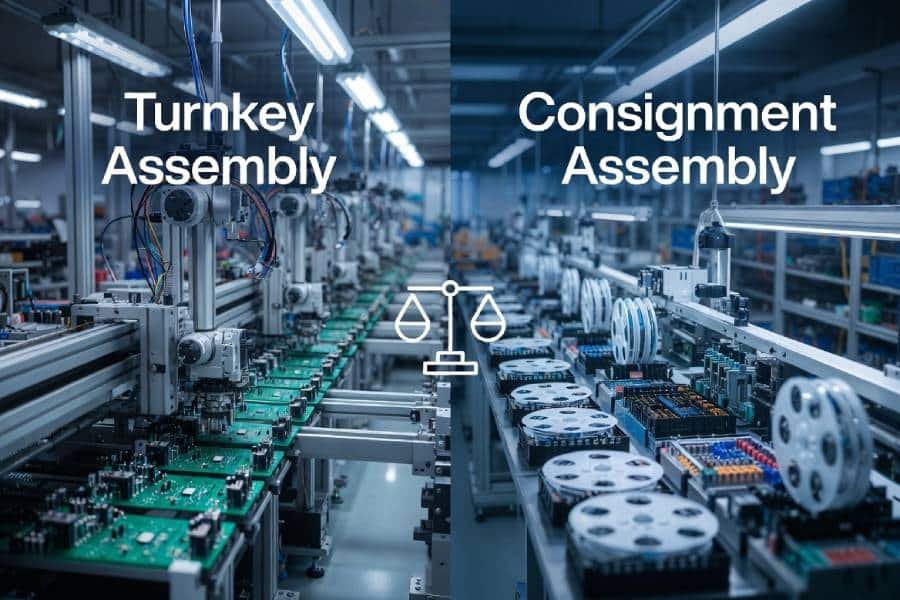
When launching a new PCB project, one of the most critical strategic decisions you face is how to manage your supply chain: should you opt for a Turnkey assembly model or stick with Consignment? This choice dictates not only your project’s budget and timeline but also your administrative burden and the overall risk profile of your manufacturing process. For many project managers and engineers, the “best” model depends entirely on your company’s supply chain maturity, the project’s urgency, and your team’s internal procurement resources.
At PCBELEC, we understand that every client has unique operational needs. That is why we offer flexible manufacturing models designed to align with your specific goals—whether that means leveraging our global supply chain network for an end-to-end Turnkey solution or providing the high-precision assembly capacity for your own sourced components via Consignment. In this guide, we will break down the fundamental differences between these two approaches, examine their respective pros and cons, and help you determine which model will drive the most value for your next PCB assembly project. If you are ready to streamline your production strategy, visit our SMT PCB Assembly Service to explore how our manufacturing experts can support your project requirements, regardless of your chosen supply chain model.
What is Turnkey SMT PCB Assembly?
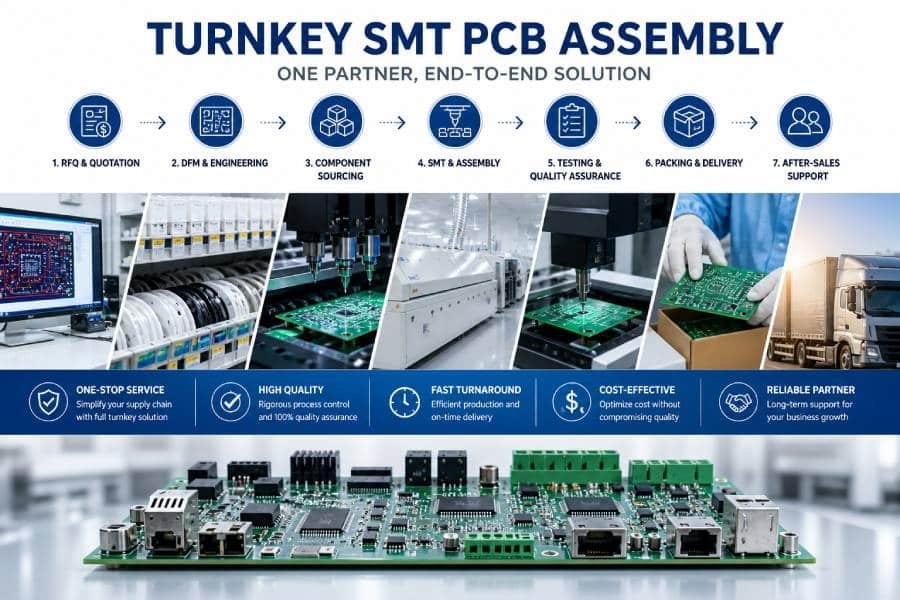
Turnkey SMT assembly, often referred to as “full turnkey,” is an all-inclusive manufacturing solution where the assembly partner manages every aspect of your project—from component procurement and supply chain coordination to the final assembly, inspection, and testing of your boards. In this model, you simply provide your design files (Gerber files), Bill of Materials (BOM), and assembly instructions, and your partner takes care of the rest.
The Strategic Advantages of a Turnkey Approach
For many companies, especially those focused on rapid product development or those without dedicated internal procurement teams, Turnkey assembly is the preferred choice for several key reasons:
- Simplified Supply Chain Management: By centralizing procurement, you eliminate the need to coordinate with multiple component distributors, handle shipping logistics, or manage individual component lead times. Your assembly partner acts as your single point of contact for the entire process.
- Reduced Administrative Burden: Turnkey services offload the heavy lifting of purchasing, vendor vetting, and inventory tracking. This allows your internal engineering and project management teams to focus on core product design and innovation rather than navigating the complexities of component sourcing.
- Optimized Quality and Traceability: Because your assembly partner manages the sourcing, they can ensure that all components are acquired from authorized, reputable distributors. This reduces the risk of counterfeit parts, ensures better quality consistency, and provides a clear audit trail for the entire supply chain.
- Accelerated Time-to-Market: With an experienced partner handling the logistics, potential supply chain hiccups—such as unexpected shortages or shipping delays—are often identified and resolved before they impact your production schedule. This leads to a smoother, more predictable manufacturing cycle and faster delivery of your finished products.
What is Consignment SMT Assembly?
Consignment SMT assembly, also known as “kitted” assembly, is a manufacturing model where you, the customer, are responsible for sourcing and purchasing all the electronic components required for your project. Once you have procured the parts, you ship them to our facility, where our team focuses exclusively on the assembly, soldering, and inspection of your boards. In this model, we function as an extension of your own production line, leveraging our technical expertise and advanced SMT machinery to bring your designs to life.
Why Choose the Consignment Approach?
While the Turnkey model offers convenience, many companies—particularly those with mature supply chain teams or specific strategic requirements—find that the Consignment model provides greater control and cost-efficiency. Key benefits include:
- Direct Control Over Sourcing: You maintain full visibility and control over your component suppliers. This is especially valuable if you have long-standing relationships with specific vendors, qualify for exclusive volume discounts, or require components that are uniquely difficult to source through standard distribution channels.
- Optimal Cost Management: By managing the procurement process yourself, you can directly negotiate prices, manage inventory levels, and avoid any additional management fees associated with third-party sourcing. This model is often preferred by companies that already have surplus components in stock or that operate with specialized procurement workflows.
- Strategic Flexibility: Consignment assembly offers a “plug-and-play” flexibility. If you are developing a new project or iterating on a design, you can supply precisely the parts you need without requiring the manufacturer to navigate your specific BOM (Bill of Materials) requirements, which can be advantageous for highly complex or proprietary projects.
- Reduced Dependency: For companies with highly specific engineering requirements, the Consignment model allows you to ensure that every single component—down to the specific resistor brand or capacitor batch—matches your engineering specifications exactly, without the need for cross-referencing or potential substitutions.
Turnkey vs. Consignment: A Side-by-Side Comparison
To help you decide which procurement model is best for your specific project requirements, we’ve summarized the key differences in the comparison table below:
| Feature | Turnkey Assembly | Consignment Assembly |
|---|---|---|
| Cost Structure | All-in-one (Materials + Assembly) | Assembly services only |
| Procurement Risk | Managed by Manufacturer | Managed by Client |
| Logistical Complexity | Low (Just provide design files) | High (Requires multiple vendors) |
| Administrative Efficiency | High (Single point of contact) | Low (Requires heavy coordination) |
| Best For | Speed, efficiency, & total peace of mind | Specific component sourcing/pricing power |
Understanding the Comparison
As illustrated in the table, the core difference lies in responsibility and control.
- Turnkey Assembly is designed for speed and administrative simplicity. By letting us manage the entire supply chain, you minimize the risk of component shortages and shipping delays—common bottlenecks that often stall projects. This model is ideal if you want to focus entirely on product design and innovation, leaving the complexities of global procurement to our experts.
- Consignment Assembly, conversely, puts the control firmly in your hands. This is the preferred choice for clients who have existing relationships with component distributors, hold their own inventory, or have specific requirements for proprietary or hard-to-source parts. While it requires more management effort on your part, it provides maximum transparency over your material costs and ensures that every specific component brand or batch matches your engineering specs exactly.
Which should you choose?
If your primary goal is to accelerate your time-to-market and minimize internal overhead, Turnkey is generally the superior choice. If your project is highly specialized or you have already secured strategic pricing on critical components, Consignment allows you to maintain that advantage while leveraging our high-precision assembly capabilities.
Key Factors to Consider Before Deciding
Choosing between Turnkey and Consignment assembly isn’t just about how parts arrive at our facility; it’s a strategic decision that affects your project’s total cost, production schedule, and quality outcomes. To make the right choice, consider the following key factors.
1. Lead Time and Supply Chain Velocity
In the fast-paced electronics industry, time-to-market is often the most critical metric. Turnkey assembly inherently offers a faster velocity because our sourcing experts utilize established relationships with global distributors to secure components efficiently, often navigating shortages that may delay individual procurement efforts. If your project faces tight deadlines, a Turnkey model helps mitigate the risk of assembly stalls caused by missing parts or delayed vendor shipments.
2. Total Cost of Ownership (TCO)
When evaluating costs, look beyond the quoted assembly price. While Consignment might appear cheaper on an assembly line invoice, consider the “Total Cost of Ownership” (TCO) that includes internal labor for procurement, vendor management, shipping costs from multiple suppliers, and the risk of inventory loss. Turnkey assembly consolidates these costs into a single, predictable structure, often proving more cost-effective when you account for the administrative time saved and the reduction in supply chain management overhead.
3. Quality Control and Traceability
Quality consistency is a hallmark of a professional manufacturing partner. Under a Turnkey model, we take full responsibility for the quality of materials entering the production line. We perform rigorous incoming inspections and source only from verified, high-quality distributors to minimize the risk of counterfeit or substandard components. In contrast, Consignment assembly places the responsibility of material quality on your team. While we will perform standard verification, we cannot guarantee the quality of parts sourced through your own channels, which can introduce variability into the final assembly.
4. Administrative and Operational Bandwidth
Assess the current capacity of your team. Does your company have a dedicated procurement specialist, a warehouse manager for component handling, and the software tools to track complex component lifecycles? If your team is lean and focused on engineering, the Turnkey model provides the necessary operational bandwidth to scale production without increasing your internal administrative burden. Conversely, if you have a well-oiled procurement machine, you may prefer the hands-on control that Consignment affords.
Frequently Asked Questions (FAQ)
To help you clarify the common doubts surrounding our manufacturing models, we’ve compiled answers to the most frequently asked questions from our clients:
Absolutely. Many of our clients use a hybrid approach, where we manage the procurement of standard, common components (like resistors and capacitors), while the client supplies specialized or proprietary parts (such as unique microcontrollers or sensors). We are flexible and happy to tailor the model to your project's specific needs.
In most cases, yes. Because we manage the end-to-end supply chain, we can proactively navigate potential shortages and consolidate shipments, which significantly reduces the risk of assembly delays compared to managing multiple separate component deliveries yourself.
Under our Turnkey service, we take full responsibility for sourcing and quality verification. If a component arrives defective or does not match your BOM specifications, we handle the return and replacement process, ensuring your project timeline remains as stable as possible.
For small batches, Turnkey is often more cost-effective when you consider the administrative overhead. While the unit price might be slightly higher than raw components, the time and effort saved on logistics, vendor communication, and consolidated shipping usually result in a lower "Total Cost of Ownership" for your prototype development.
Consignment assembly can make full traceability more challenging because the materials come from multiple external sources. In a Turnkey model, we provide a complete audit trail for all materials, which is often required for high-reliability industries like medical, aerospace, or industrial automation.
Why Partner with [Company Name] for Your Next Project?
At PCBELEC, we believe that successful manufacturing is built on more than just high-speed machinery—it is built on trust, transparency, and a relentless focus on your project’s success. Whether you choose the efficiency of a Turnkey solution or the strategic control of a Consignment model, our team is equipped to support your objectives with industry-leading precision and world-class service.
We distinguish ourselves through our robust global supply chain network, which allows us to navigate complex procurement landscapes with ease, and our rigorous quality management systems that ensure every board meets the highest global standards. Our manufacturing experts act as an extension of your own team, providing proactive DFM feedback, transparent cost structures, and real-time communication throughout every stage of the assembly process.
Don’t let supply chain complexities or manufacturing uncertainty slow down your innovation. Partnering with PCBELEC means you gain a dedicated manufacturing expert committed to your product’s quality, reliability, and market readiness.
Ready to choose the best manufacturing partner?
Visit our SMT PCB Assembly Service to explore our full production capabilities, view our equipment certifications, or discuss your specific project needs directly with our supply chain and manufacturing experts. Let’s build your next high-performance product together with the manufacturing agility and reliability you deserve.